
 Best Platforms
 Live Odds








South Carolina Senate Candidate: Key Milestones to Election Day
Follow a South Carolina Senate candidate from filing to Election Day: FEC forms, majority-runoff primaries, nominee replacement, and voting/ad deadlines.
You’re watching a South Carolina Senate race and trying to tell the difference between real turning points and daily noise. The hard part is that campaigns don’t move forward on one simple timeline: the ballot process, the nomination process, and the money-and-disclosure process can all change the story on different days.
Get this wrong and you’ll trade on headlines that don’t actually alter who can appear on the ballot, who can become the nominee, or when spending and turnout efforts can meaningfully ramp. This explainer breaks the campaign into the parallel systems, shows how runoffs and replacement paths reset the field, and maps the calendar windows and ad/ground rules that create tradeable updates.
Two Parallel Systems
A South Carolina Senate candidate is running one campaign, but operating under two different rulebooks. One is about ballots and voting logistics inside South Carolina. The other is about federal money rules and disclosures.
Ballot access track
For anything that determines who can vote and when votes are cast, you’re in South Carolina Election Commission territory. That’s where the state’s election calendar and polling administration live.
Two dates drive real campaign operations because they’re hard cutoffs, not vibes. Under S.C. Code § 7-5-150, South Carolina closes voter registration books 30 days before an election, which means your persuasion plan has to stop treating “new voters” as a moving target once that window shuts. And for the 2026 general election, the state calendar sets early voting from October 19, 2026 through October 31, 2026, with counties running the locations and hours.
Money and reporting
For anything involving contributions, spending, and public disclosure, you switch to federal law and the Federal Election Commission (FEC).
A federal run becomes a reporting campaign once the person running raises or spends more than $5,000. From there, the timing gets mechanical: the candidate must file their candidacy statement within 15 days, and their campaign committee’s organization filing follows within 10 days after it’s designated. Contribution rules are federal too—an individual can give $3,500 per election to a candidate committee, and the national party committee plus the national senatorial committee can give a combined $62,000 per candidate per six-year cycle (2025–2026 cycle).
There’s also a Senate-specific wrinkle: Senate candidates and their committees file required reports on paper with the Secretary of the Senate, not through the FEC’s electronic filing system.
Keep these tracks separate as you follow the calendar—state deadlines move voters; federal deadlines move filings and money.
Nomination Is Dynamic
Treat “candidate” and “nominee” as different species of headline. A South Carolina Senate candidate can be running and raising money, but the party nominee is only the person the party’s process has actually produced.
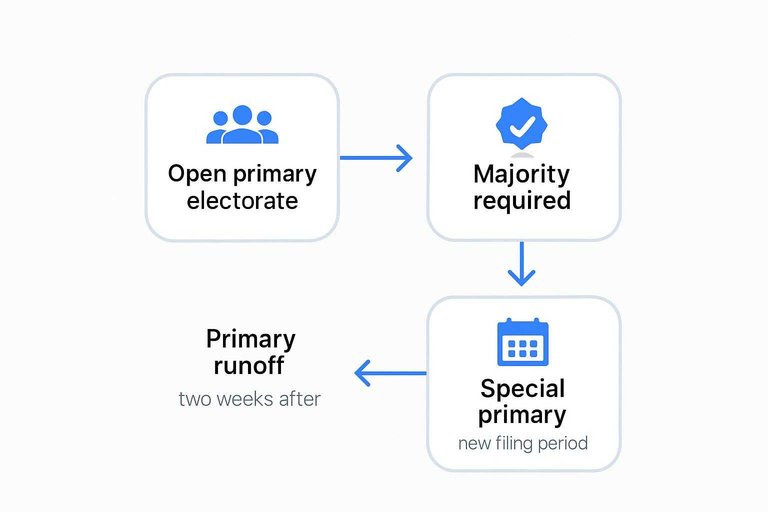
First, the primary electorate is bigger (and less predictable) than in closed-primary states. South Carolina doesn’t register voters by party, and the South Carolina Election Commission explains that any registered voter can choose which party’s primary ballot to vote at check-in. That means the set of people who can influence a party’s nomination is not limited to pre-declared partisans.
Second, South Carolina’s first primary doesn’t always settle anything. State law requires a majority to win the nomination in the first party primary. If no one gets that majority, you get a primary runoff (often called a “second primary”: a follow-up election after the first party primary when no candidate wins a majority; in South Carolina it is treated as a continuation of that party’s primary). The SEC’s primary FAQ says that runoff happens two weeks after the primary, and the runoff winner is simply whoever gets the most votes.
That “continuation” idea matters for eligibility. The same FAQ says if you voted in one party’s primary, you can only vote in that same party’s runoff. If you skipped both primaries, you can pick either party’s runoff.
Third, the field can reset after a nominee vacancy. S.C. Code § 7-11-55’s special primary (South Carolina’s mechanism for replacing a party nominee chosen in a primary by opening a new filing period and holding a special primary) kicks in if a nominee dies, becomes disqualified after nomination, or resigns for a “legitimate nonpolitical reason.” The statute sets a fresh filing window: it opens the second Tuesday after the triggering event and lasts one week.
This isn’t theoretical. In 2026, the SEC announced a special Republican filing period and special primary for U.S. Senate under this law after the Republican nominee died, and it also drew hard eligibility lines based on who voted in the earlier June primaries.
FEC Plumbing Early
A lot of “I’m running” activity is just talk until federal compliance makes it legible. For a U.S. Senate campaign, the moment it becomes “real” in disclosure terms is when you hit the FEC candidate threshold—the point where you’ve raised or spent more than $5,000, which triggers federal registration and reporting requirements.
From that point on, you can stop guessing and start verifying. The filings tell you whether the person is officially a federal candidate, which committee is allowed to take money for them, and why a campaign can look “quiet” to the public right up until the paperwork clock starts.
What gets filed when
- Cross the $5,000 line. Until the candidate threshold is met, there’s no federal reporting stream for you to follow.
- Candidate files FEC Form 2. FEC Form 2 (Statement of Candidacy) is the filing where the person formally registers as a candidate and designates their main committee; it’s due within 15 days of becoming a candidate.
- A principal campaign committee gets designated. The principal campaign committee is the single main committee the candidate designates to receive contributions and make expenditures on the candidate’s behalf. That designation matters because it’s the committee the public will treat as “the campaign” in the reporting system.
- Committee files FEC Form 1. FEC Form 1 (Statement of Organization) is the committee’s setup document, and it must be filed within 10 days after the committee is designated.
- Remember the Senate filing reality. Senate candidates and their committees file required reports on paper with the Secretary of the Senate, not through the FEC’s electronic filing system—so “no fresh-looking FEC dashboard” is not the same thing as “no compliance activity.”
Late in the cycle, there’s one more plumbing check traders notice fast: FEC Form 6 (48-Hour Notice), a time-sensitive disclosure when a candidate committee receives certain late contributions close to an election. That’s the regime designed to prevent late money from staying hidden until the next scheduled report.
Voting Windows Drive Ops
These election-calendar windows act like hard phase changes. Once registration books close 30 days out (S.C. Code § 7-5-150) and early voting opens (for the 2026 general election, October 19–31), a South Carolina Senate candidate’s “ground game” stops being persuasion theater and starts being ballot-chasing logistics.
| Calendar trigger | What the campaign does | What the headline usually signals | Trader timestamp to watch |
|---|---|---|---|
| Registration cutoff hits (30 days out) | Drop registration drives; lock universe | Targeting list freezes | Cutover in field scripts |
| Early voting opens (e.g., Oct 19, 2026) | Shift to “vote now” asks; extend hours | Real GOTV ramp | First-day early-vote push |
| Mid–early-vote stretch | Chase low-propensity supporters | Turnout operation stress test | Daily/weekly vote pace |
| Final early-vote days | Triage: who hasn’t voted yet | Serious door + phone surge | Last weekend field staffing |
| Absentee ballot return mechanics | Teach return rules; reduce “ballot help” | Competence, not enthusiasm | Voter guidance updates |
One operational gotcha that creates real confusion: state absentee guidance distinguishes between a voter returning their own absentee ballot (mail or personal delivery) and an “authorized returnee” returning a ballot for someone else (must be returned in person; mailing isn’t allowed).

Ads and Ground Rules
Spending spikes aren’t always a response to news. A lot of what you see from a South Carolina Senate candidate is a calendar play driven by ad-pricing and on-the-ground legal boundaries.
- Broadcast buys surge inside “lowest unit charge” windows. Lowest unit charge—47 U.S.C. § 315(b)’s rule that forces broadcast stations to give candidates their lowest ad rate in defined pre‑election periods—creates a strong incentive to hold TV/radio money for that stretch.
- Those windows are fixed. The lowest-unit-charge window is 45 days before a primary or primary runoff and 60 days before a general or special election.
- Disclaimers add friction you can’t ignore. Late creative changes aren’t just a messaging decision; required sponsorship disclaimers and station compliance checks make “last-minute” ad flights harder to improvise.
- GOTV surges get pushed away from the door. South Carolina’s electioneering buffer—the 500‑foot restricted zone around polling-place entrances (S.C. Code § 7-25-180)—makes handing out literature or placing posters unlawful inside the line.
If you want to track whether a late “surge” is structural or reactive, MarketsPrediction helps you watch how different platforms reprice these known windows in real time.
Trade the rule triggers, not chatter
The clean way to separate signal from noise in a South Carolina Senate race is to ask which rulebook a headline actually moves: state ballot/voting logistics, party nomination mechanics, or federal money-and-disclosure compliance. Real turning points are the mechanical ones—crossing the FEC “candidate” threshold and starting the Form 2/Form 1 clock (even if you won’t see it on an FEC dashboard), a majority shortfall that forces a runoff with locked-in eligibility, or a nominee vacancy that can reopen the field via a special primary filing window. Then anchor your expectations to the hard phase changes campaigns plan around: registration closing 30 days out, early voting opening, and the fixed 45‑day/60‑day lowest-unit-charge windows that make “sudden” ad surges predictable. If an update doesn’t change who can be the nominee, who can appear on the ballot, or when spending and turnout operations can legally and practically ramp, treat it as commentary—not a catalyst.
Frequently Asked Questions
- When does voter registration close for a South Carolina Senate candidate election?
- South Carolina closes voter registration books 30 days before an election. Treat that cutoff as the point where your target universe stops expanding and shifts to turnout execution.
- Does a South Carolina Senate candidate need a majority to win the party primary, or is it winner-take-all?
- A candidate must win a majority in the first party primary to secure the nomination. If nobody reaches a majority, the race goes to a runoff where the winner is the top vote-getter.
- What happens if a South Carolina Senate candidate becomes the nominee and then drops out or dies?
- South Carolina can run a special primary to replace a party nominee if the nominee dies, becomes disqualified after nomination, or resigns for a legitimate nonpolitical reason. The replacement process opens a new filing period starting the second Tuesday after the triggering event and runs for one week.
- How close to a polling place can a South Carolina Senate candidate’s campaign hand out flyers or put up signs?
- South Carolina bans distributing or displaying campaign material within 500 feet of a polling-place entrance. Plan Election Day visibility and volunteer placement outside that boundary to avoid violations.
- Where do I verify official rules and dates for a South Carolina Senate candidate election (not just headlines)?
- Use the South Carolina Election Commission site (scVOTES.gov) for official election rules, calendars, and voter-facing guidance. It’s the fastest way to confirm what’s actually binding versus what’s being repeated in campaign coverage.