
 Best Platforms
 Live Odds








Senate Primary Results: Election-Night Returns vs Certified Results for Trading
For senate primary results markets, see how election-night returns differ from certified totals and which contract clauses control settlement timing.
You’re watching a Senate primary on election night, the vote totals are updating fast, and the market price is moving even faster. If you treat the latest numbers—or a projected winner—as “the result,” you can get trapped in post‑night drift, surprise settlement rules, or capital locked longer than you expected.
This piece separates the two results streams you’ll see in practice, walks through what happens between election night and certification, and shows how “called,” “certified,” and “settled” can diverge. You’ll also get a contract-first checklist and a simple rubric for whether to trade the night feed or wait for certification.
Two Results Streams
On election night, you’re usually looking at one of two “truth sources” for senate primary results: a fast, updateable returns feed, or the later, legally final certification. Trading mistakes happen when those get treated as the same thing.
Election-night returns
Election-night returns—vote totals published and updated after polls close, before canvass and certification—are unofficial by definition. The U.S. Election Assistance Commission is blunt about it: even if a site shows “100% Precincts Reporting,” the results are still unofficial, and election-night numbers are “unofficial and never final.”
That “100%” usually means the reporting units the feed is tracking (often precincts) have posted some report. It does not mean every valid ballot that can be counted in the primary has been processed into the totals. The Congressional Research Service also frames election-night results as “unofficial and preliminary,” not necessarily canvassed, and says it’s “normal and expected” for final totals to differ from what you saw on election night.
In practice, the feed you see may be mediated. A local news “live results” page may embed Associated Press election interactives and state the results are from AP and a state elections division. Decision Desk HQ, by contrast, says its results are sourced from official state sources (typically the Secretary of State or elections department) and that it does not model or impute results. Different pipes; still not final.
Certified, by status
Certified results—official, finalized results after canvass (and sometimes audits or recounts), issued by the election authority with legal effect—arrive later, and they are the version that closes the book.
To label what you’re seeing more precisely, NIST’s Election Results Reporting Common Data Format defines status values that matter for traders: unofficial-partial, unofficial-complete (for example, “complete election night results”), and certified. Here’s the key distinction: unofficial-complete can mean the election-night report is done updating for that feed, but it’s still not certified.
You can often spot “unofficial” in the wild. Maryland’s official results page, for example, labels its primary results “Unofficial” and includes a “Last refreshed” timestamp—signals you’re looking at a changeable reporting stream, not a certification artifact. California’s Secretary of State uses similar framing: election-night results are “semi-official,” and media “calls” and concessions are based on those semi-official numbers, not final results.
If money is on the line, tag the screenshot first: unofficial-partial, unofficial-complete, or certified. Then decide what you’re actually trading.
Operational mapping: what your feed “status” actually is
If you’re trading off senate primary results intranight, you need a repeatable way to tag whatever page/API is on your screen into one of NIST’s three statuses—so you don’t accidentally treat an updating feed like a settlement-grade artifact (NIST SP 1500-100).
Use this quick mapping:
-
unofficial-partial(tradeable volatility, revision risk is live) -
The page is still updating (“Last refreshed” timestamps, frequent deltas, or obvious missing reporting units).
-
It’s any election-night returns stream before that publisher is “done for the night.” (EAC’s point still applies even if a UI says “100% Precincts Reporting”: it’s unofficial and not final.)
-
unofficial-complete(stop treating updates as the edge; start treating settlement as the edge) -
The publisher is signaling the election-night reporting run is complete for that feed (“complete election night results” in NIST’s sense), but there is no certification artifact yet.
-
Practical cue: the numbers go static for hours and the page still labels results as unofficial (for example, an official site can remain labeled “Unofficial” even when it isn’t changing).
-
certified(settlement-watch, not “who’s up right now”) -
The election authority has completed canvass and issued official results with legal effect.
-
If your contract’s resolution clause keys to “official certified results” (as Kalshi’s ELECTIONMOV does), this is the status that matters for payout timing—not an election-night call.
Two clean triggers to keep you honest:
- “Trade” trigger: you’re explicitly choosing to trade an
unofficial-partialstream (AP embed, DDHQ feed, or a state results dashboard labeled unofficial) as a price signal, knowing it’s not final. - “Settlement-watch” trigger: as soon as your best available source is
unofficial-complete, shift from chasing marginal return updates to monitoring the contract’s stated resolution source and timeline—because the next meaningful state change for payout iscertified, not “one more refresh.”
Between Night and Cert
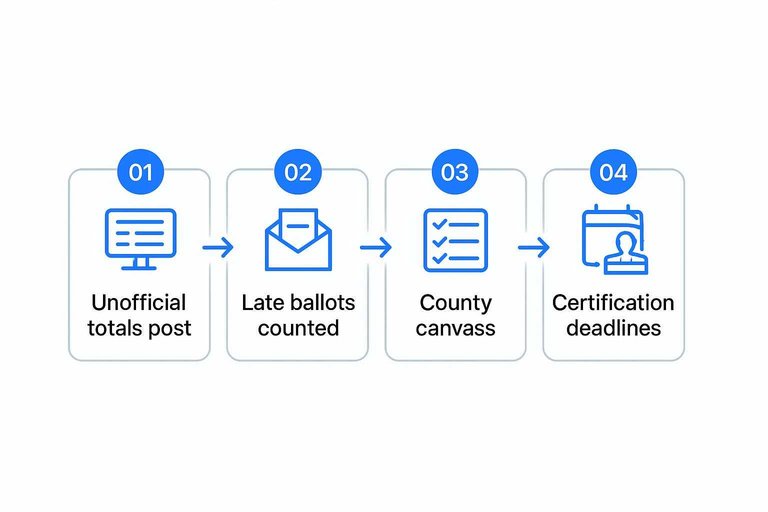
Election-night returns can stop moving on your screen while the legal result is still being built. The gap is the post-election workflow that turns a running tally into something an election authority can certify.
-
Polls close → initial unofficial totals post
Counties (and the state) publish early aggregates. Even if a feed reads “complete,” you’re still before the legal closeout. -
Late-arriving valid ballots get folded in (state rules control the clock)
California is a clean example of time risk: vote-by-mail ballots that are postmarked by Election Day can still be received and counted for 7 days after Election Day. That’s a full week where totals can legitimately change without anything “going wrong.” -
County canvass: reconcile, correct, and finalize the county record
The canvass—the post-election process where officials reconcile vote totals, resolve discrepancies, and incorporate valid ballots counted after election night—is where numbers get checked against chain-of-custody and reporting records.
In California, the county canvass period runs 30 days.
-
Audits and (if triggered) recounts run on top of the canvass record
These steps don’t exist to “update a live feed.” They exist to confirm the count (audit) or rerun it under defined rules (recount). Either can hold up finality even if the winner looks obvious. -
Certification happens on statutory-style deadlines—then the book closes
California’s Secretary of State certification timing is described as 38 days after the election.
Florida shows a different kind of deadline: under Florida Statutes § 102.112, counties must file returns no later than noon on the 8th day following a primary election—and if returns aren’t received by then, they “shall be ignored” and the department certifies what’s on file.
If your trading contract resolves on certified results, this is the window where prices can look “done” but settlement (and capital unlock) is still waiting on process and deadlines.
Called ≠ Certified
“Senate primary results” can describe three different things on the same night: a media call, an election office’s later certification, and whatever your market uses for settlement. They often line up. They are not the same clock.
AP and state feeds
A lot of “live results” pages are really distribution layers. For example, FOX 35 Orlando’s results page embeds Associated Press (AP) election interactives and explicitly labels the source as “the Associated Press and the Florida Division of Elections.” That’s a clue you’re seeing a combined display: a media UX sitting on top of official reporting.
The state dashboard is still the election authority’s stream, and it typically treats election-night totals as changeable (you’ll often see an “unofficial” status and a refresh timestamp). AP-style embeds are excellent for fast, standardized election-night tracking—but they are not a certification artifact. If you’re trading, the practical point is simple: the prettiest live widget on the page is not the legal document that closes the book.
Decision desk logic
A decision desk is a specialized team (often at a media outlet) that makes a race call—a projection of the winner—using unofficial returns and whatever supporting methodology that desk relies on. Decision Desk HQ (DDHQ) positions its results as coming from official state sources rather than modeled estimates, but a call is still a projection, not a legal act.
In CFTC materials describing election-market operations, there’s an explicit tension between contracts built to resolve only after certification (or even later) and trader pressure for decision-desk-based accelerated resolution for capital efficiency—paired with the need to manage retraction risk (e.g., buffer periods) if a call gets walked back.
That retraction risk shows up directly in market design. A CFTC-posted Kalshi rule filing describes an accelerated-resolution approach keyed to multi-outlet decision-desk declarations—and it explicitly includes an anti-retraction buffer.
A call can be tradable because it moves price and can be a resolution trigger in some contracts. It’s just not payout-final unless your contract says it is.
Contract Controls Settlement
Settlement risk in senate primary results markets isn’t about what your results widget shows—it’s about one clause in the contract.
On first read, find the resolution source (sometimes titled “Source Agencies”): the specific authority or publication the rules name for determining the outcome, often in a hierarchy. Also watch for accelerated resolution language: a clause that allows early settlement based on stated triggers (like multiple designated outlets declaring a winner) instead of waiting for certification. And if you’re on an oracle-based venue, know what that oracle is: the UMA Optimistic Oracle is a dispute-driven design where someone proposes an outcome with a bond and it stands unless challenged within a window.
| Resolution pattern | Contract language cue | Concrete example | What to watch as trader |
|---|---|---|---|
| Certified-only settlement | “Only certified results” | Kalshi ELECTIONMOV: unofficial results excluded | Capital can stay locked until cert |
| Source hierarchy (tie-breaker) | “Source Agencies” list, ordered | Starts with certifying authority; then AP, Reuters, major networks; plus official website | Which source wins conflicts; recency rule |
| Accelerated resolution trigger | Multi-source “call” threshold | ELECTIONMOV: 4 of 8 designated media sources | Retraction risk; buffers can delay payout |
| Fallback when cert misses deadline | “Fully Conducted” + expiration fallback | If not certified by Expiration Date, may use unofficial results with ≥95% votes counted | Threshold details; still not “election-night final” |
| Oracle-driven settlement process | Proposed outcome + dispute window | Polymarket: UMA Optimistic Oracle; $750 proposal bond; 2-hour challenge period | “Obvious winner” still needs proposal/dispute flow |
The practical read is fast: locate (1) the named resolution source(s), (2) the earliest acceleration trigger, and (3) the latest possible fallback path (often keyed to an expiration date). That trio tells you whether you’re trading election-night movement—or trading the wait.

Trading Rubric + Pick
Use this rubric to decide what you’re trading in senate primary results: fast movement vs payout-final settlement (“settlement certainty” = your confidence the contract will resolve on the timeline you expect).
| Criterion | Trade election-night returns now | Wait for certification / settlement | Winner |
|---|---|---|---|
| Speed | Moves with unofficial returns updates and race calls | Moves on the contract’s settlement timeline (often after certification) | Trade now |
| Finality | Unofficial—even at “100% precincts reporting” | Certified | Wait |
| Settlement certainty | If the rules exclude unofficial results, price can look “done” before payout | Highest when the rules say only certified results are used | Wait |
Default pick: Wait—unless the contract explicitly accelerates resolution and you’re trading that trigger (not the narrative). Kalshi’s ELECTIONMOV terms are explicit that (except for its Fully-Conducted Elections provision) only certified results shall be used and preliminary or unofficial results shall not determine the outcome—so “trade now” there is a volatility play, not a settlement play. On UMA-oracle markets, resolution still requires someone to propose an outcome with a bond, and the proposed outcome can be disputed during the challenge window.
Pre-trade checklist (must pass all):
- Identify the resolution source (and any hierarchy).
- If there’s accelerated resolution, write down the exact trigger and any anti-retraction buffer.
- Note expiration date and any fallback path if certification isn’t in by then.
- If it’s UMA-based, confirm who proposes, the bond requirement, and the dispute window.
- Define your exit/update rule: call retracted, source conflict, or trigger conditions no longer met.
Trade the contract, not the feed
Election-night totals—even when your screen says “100% reporting” or a desk has “called” it—are a fast, unofficial stream, not the payout-relevant answer. The only result that matters for your money is whatever your market’s rules name as the resolution source, plus any accelerated-resolution trigger and buffer. So before you hit buy, open the contract and write down those clauses; if it’s certified-only, treat election-night action as volatility, not settlement. Default to waiting unless you’re explicitly trading the call/trigger—and you already know what would invalidate it.
Frequently Asked Questions
- Are senate primary results the same thing as the election outcome your prediction market contract will settle on?
- Not necessarily. Your contract may settle on certified results, an “accelerated resolution” media call trigger, or an oracle outcome—so you must read the resolution source section, not the live returns page.
- Why hasn’t my Polymarket position settled even though the senate primary results look obvious on the news?
- Polymarket resolves via the UMA Optimistic Oracle: someone must propose the outcome with a bond, and that proposal can be disputed during the challenge window. Until that process completes, “obvious” senate primary results don’t automatically become a settled market.
- How long after election night can senate primary results still affect settlement, even if the race looks decided?
- In Florida primaries, counties must file returns by noon on the 8th day after the primary election; anything received after that deadline is ignored for certification. If your contract keys off certified results, that statutory clock matters more than the last election-night refresh.
- What should I check first in a senate primary results market to avoid getting stuck waiting for payout?
- Open the contract terms and write down (1) the named resolution source (and any hierarchy), (2) the earliest accelerated-resolution trigger, and (3) the latest fallback path tied to an expiration date. Those three lines tell you whether you’re trading election-night volatility or settlement timing.
- How do I build alerts or backtests on senate primary results without confusing ‘complete’ with ‘final’?
- Tag your data by status (unofficial partial, unofficial complete, certified) and only treat “certified” as payout-final for certified-only contracts. In practice, that means separating election-night feed timestamps from the later certification record in your dataset and alerts.