
 Best Platforms
 Live Odds








FEC Filings vs Ballot Lists: Which Confirms SC Senate Candidates?
Verify a South Carolina U.S. Senate candidate: trust scVOTES Candidate Tracking for ballot status, then use FEC Form 2/Browse Filings as finance signals.
You’re trying to figure out whether a person is genuinely in the South Carolina Senate race before you trust a market, poll, or headline. The obvious move—grab the first “candidate” list you find—breaks fast once you notice different sources disagree, some names appear early and vanish later, and “Senate” can mean U.S. Senate or a state district.
Get this wrong and you can end up trading a contract tied to the wrong candidate set, misreading momentum, or wasting time reconciling conflicting lists. This piece shows what each source actually confirms, when each becomes reliable, and how to do a quick cross-check before you compare prices across platforms on MarketsPrediction.
Confirming what, exactly?
“Confirm” can mean three different things for a south carolina senate candidate: a campaign-finance signal (money is moving), ballot access (the state accepted the paperwork), or nomination (the person actually becomes the party’s nominee). Before you pick a source, pin down which one you mean—and for which stage: primary, general, or special election.
US vs State Senate
“South Carolina Senate” is ambiguous: it can mean U.S. Senate (federal office) or the South Carolina State Senate (state office). Only the U.S. Senate race ties cleanly to Federal Election Commission (FEC) records, because those filings exist to satisfy federal campaign-finance rules.
If you’re actually verifying a State Senate district candidate, FEC searches won’t “confirm” anything meaningful about ballot status in South Carolina.
What you need confirmed
- Financial activity / federal trigger: Under federal rules, someone becomes a federal “candidate” once contributions or expenditures go over $5,000 in an election cycle.
- Formal federal candidacy paperwork: After crossing that line, FEC Form 2 is due within 15 days.
- Primary ballot access (SC-specific, election-date specific): Use the South Carolina Election Commission’s Candidate Tracking system for the specific primary or special primary you care about.
- General-election ballot placement: Use the same state tracking tool for the specific general (or special general) election date; it’s the state’s current “who’s on the ballot” view.
What FEC status means
An FEC “hit” is a campaign-finance compliance signal, not a ballot guarantee. Under federal rules, a person becomes a statutory candidate (FEC context)—someone who has crossed the federal $5,000 activity threshold (or related triggers), which starts FEC registration/reporting duties—this is not the same thing as being certified for a state ballot.
Once that line is crossed, the clock matters. FEC Form 2 (Statement of Candidacy)—the registration form a federal candidate files (within the required window) to declare candidacy and designate key details like office sought—must be filed within 15 days. That filing also ties to the candidate’s principal campaign committee (PCC)—the main authorized committee for a federal candidate; it files the campaign’s periodic financial reports—typically organized on FEC Form 1.
Two reasons this still doesn’t “confirm” a south carolina senate candidate will appear on South Carolina’s ballot.
First, “testing the waters” exists. The FEC explains that someone can raise or spend money to explore a run without registering/reporting yet; once they decide to run or start campaigning, that earlier activity can retroactively count toward the $5,000 threshold.
Second, FEC datasets are broader than “people who filed Form 2 for this election.” The FEC’s candidate master file can include candidates with active campaign committees without regard to election year, and even candidates who are merely referenced by draft or nonconnected committees supporting or opposing them. The same file also notes that a candidate’s election-year field may come from either a Statement of Candidacy or a state ballot list—so the dataset can blend federal paperwork with state list inputs.
Treat FEC presence/absence as “federal reporting duties are (or aren’t) visible here,” not as “the state accepted them for the ballot.”
FEC data gotchas
Treat “appears in FEC data” as a clue about federal reporting—not a clean yes/no on whether a south carolina senate candidate is real for your election.
First, timing can run backward. “Testing the waters” (raising/spending money to explore a run before deciding to become a candidate) can stay off the public candidate/committee picture for a while; once the person actually decides to run or starts campaigning, earlier activity can become reportable. So an early absence in FEC search results can be a false negative: the exploration phase isn’t always visible as a registered candidacy yet.
Second, some datasets are intentionally broader than “people who filed the main candidacy form for this cycle.” If you’re pulling names via OpenFEC (api.open.fec.gov) or master-file-style candidate lists, you can see extra names that are present because a committee exists, because a committee mentioned them, or because an edge-case trigger is involved. For example, the FEC’s candidate rules (11 CFR § 100.3) include scenarios tied to unauthorized activity and a 30-day window to disavow after notice—signals that can surface in compliance data without mapping neatly to “on the ballot.”
Third, processing lag is real. The FEC says its coding/categorization can take days for electronic filings and weeks for paper filings, and the “raw” electronic feed doesn’t include paper filings at all. If you’re trading on breaking news, that gap is where the misses happen.

What SC lists prove
If you’re trying to confirm a south carolina senate candidate for a specific South Carolina election date, scVOTES is the closest thing to “ground truth” because it reflects the state’s election administration records—not fundraising signals, not party promotion, and not whoever a reporter heard is “considering a run.”
Start with how names get onto a South Carolina ballot. For party primaries, many offices require a SICPP (Statement of Intention of Candidacy/Party Pledge)—South Carolina’s party-nomination filing form used to enter a party primary ballot—filed with the appropriate election office during the filing period. scVOTES lists that general-election-year filing window as opening at noon March 16 and closing at noon March 30.
If someone isn’t pursuing a party nomination, South Carolina also allows nomination by petition. scVOTES describes that route as requiring valid signatures equal to at least 5% of active registered voters in the relevant geography, capped at 10,000 signatures for any office, with the petition due by noon July 15 in a general-election year (a threshold also reflected in S.C. Code § 7-11-70).
Where traders get burned is mixing artifacts. A party’s “filed candidates” list is about who entered that party’s process. Wikipedia/news lists are editorial snapshots. The scVOTES Candidate Tracking system (VREMS)—the state’s official, election-specific lookup for filed candidates and ballots—is where you verify the current candidate list for the exact primary/general/special election date. The Commission has even announced ballot changes by court order and told voters to use their sample ballot or Candidate Tracking for the current list.
Deadlines and finality
South Carolina’s “who’s a candidate?” answer hardens over time. Early in the cycle, scVOTES tools are a moving snapshot of who has filed; after the key deadlines and certifications, they become the state’s yes/no record of who is actually headed to a specific ballot.
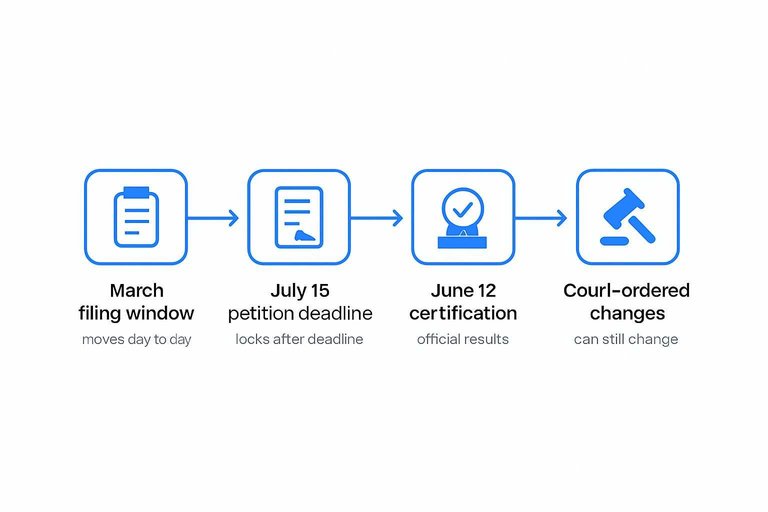
Start with the March filing window for party primaries: during that period, Candidate Tracking can change day to day as paperwork is accepted and processed. That’s useful for monitoring, but it isn’t final.
If someone is running outside the party-primary path, watch the petition track. Nomination by petition—a South Carolina ballot-access route that requires collecting and filing a threshold number of valid voter signatures by a deadline—doesn’t lock until the petition deadline passes. For general elections, scVOTES lists July 15 (12:00 noon) as the last day to file a nominating petition.
Then the primary resolves the party side. In 2026, South Carolina’s statewide primary is June 9, 2026, and the state’s primary certification date is June 12, 2026. State certification (South Carolina)—the state’s official certification of election results—is when the nominees/results become official for downstream ballot steps.
Finally, even “final” can still move: court-ordered ballot changes happen. If you’re close to voting—or trading on “will X be on the ballot?”—treat Candidate Tracking (and the voter-facing sample ballot for the right election date) as the current ground truth, not older lists or earlier filings.
Five-minute cross-check
You’re answering one question: “Is X a real south carolina senate candidate for a specific election date?” Start with the state’s election-specific list, then use the FEC to explain (not override) what you saw.
-
Lock the race you mean (U.S. Senate, not State Senate). If it’s not a federal office, stop—FEC records won’t confirm the ballot question. (Federal offices are the ones covered by federal-election rules.)
-
Check scVOTES Candidate Tracking first (for the exact election). Select the right contest and date (for example, the South Carolina general election on November 3, 2026). If X is listed there, you’re done: that’s your “real candidate right now” proof.
-
If X is missing, sanity-check freshness. Candidate lists can change late (including by court order), so re-run the lookup for the correct election and treat older screenshots/articles as stale.
-
Then interpret the FEC as a finance/compliance signal. Use the FEC’s Browse Filings to look for candidate paperwork and an authorized committee (typically the candidate’s committee on Form 1). If you see filings, log them as “federal reporting exists,” not “South Carolina ballot confirmed.”
-
Document your trail. Save the scVOTES result (or “not found”) and the FEC filing page URLs plus the timestamp you checked. The FEC’s state filing waiver guidance lists South Carolina as a waiver state—federal candidates/committees don’t have to file duplicate copies of FEC disclosure reports with the state office—so “not on a state disclosure portal” isn’t a disproof by itself.
Trading-ready recommendation
Use this rubric to decide which source “confirms” a south carolina senate candidate for the contract you’re trading (a market that settles on whether a named person is a candidate/nominee/winner).
| If you’re trading on… | Trust first | Then verify in… | Trading hygiene action |
|---|---|---|---|
| “Is X on this SC ballot date?” | scVOTES Candidate Tracking | FEC “Browse Filings” | Don’t buy markets for unlisted names |
| “Is X a real federal campaign?” | FEC “Browse Filings” | Form 1 / committee ID | Treat as finance signal, not ballot |
| “Is this even federal office?” | 11 CFR § 100.4 scope | scVOTES contest label | Avoid FEC-only confirmation for state races |
| “Platform uses a weird name” | scVOTES spelling | FEC name/committee | Trade only after name-match is exact |
| “Special filing chatter” | scVOTES special-election page | Candidate Tracking entry | Remember fees exist (e.g., $10,440 GOP special filing) |
After you’ve validated the exact candidate names, use MarketsPrediction to compare which platforms actually list matching SC Senate markets—and where the displayed liquidity/volume is—before you put capital into a contract.
Verify the ballot, then the filings
If your question is “is this person actually in the South Carolina U.S. Senate race for this election date?”, treat the scVOTES Candidate Tracking entry as the confirmation and treat FEC presence as a separate finance/compliance signal—not a substitute for the ballot list. Start every check by locking the exact contest and date in Candidate Tracking, then use FEC “Browse Filings” only to explain what’s happening financially or procedurally. Once the names match the state list exactly, you’re in a position to compare the corresponding markets across platforms for price and liquidity; if the name isn’t on the state list (or doesn’t match), don’t take the contract.
Frequently Asked Questions
- How do I confirm whether a south carolina senate candidate has actually filed anything with the FEC?
- Use the FEC’s Browse Filings page to search the candidate or committee and open the filing detail pages directly. That confirms federal paperwork exists in the FEC system, even if it doesn’t confirm South Carolina ballot access.
- If a south carolina senate candidate shows up in FEC data, does that mean they’re officially running in the 2026 South Carolina U.S. Senate race?
- No—FEC presence confirms a campaign-finance/compliance footprint, not that the state accepted the candidate onto a specific South Carolina ballot. Treat it as evidence of federal election activity, then verify ballot status using South Carolina’s official election-specific candidate/ballot tools.
- Where do I check South Carolina campaign finance reports for a south carolina senate candidate if I’m trying to verify fundraising claims?
- Use the South Carolina State Ethics Commission’s campaign disclosure system to review state-level filings tied to South Carolina disclosure rules. This is separate from FEC filings and won’t substitute for confirming ballot access for a specific election date.
- What does an FEC Form 1 tell me about a south carolina senate candidate?
- FEC Form 1 is the Statement of Organization for a committee, so it tells you a political committee exists and how it’s organized. It does not prove the candidate is certified for South Carolina’s ballot for a specific election date.
- I’m trading a “Will X be the nominee?” market—what’s the cleanest way to avoid mixing up ‘candidate,’ ‘on the ballot,’ and ‘nominee’ for a south carolina senate candidate?
- Define the market’s settlement condition first (candidate vs nominee vs winner), then collect evidence that matches that exact stage before you trade. For market shopping across platforms, MarketsPrediction helps you compare where the same South Carolina U.S. Senate contracts are listed and active before you commit capital.