
 Best Platforms
 Live Odds








What Is the South Carolina Senate Primary?
What “South Carolina Senate primary” means in 2026: U.S. vs state Senate, June 9/23 primaries, Aug 11/25 GOP replacement, and who can vote.

You’re trying to track one election, but the phrase “South Carolina Senate primary” can point to different contests—and different rules—depending on who’s talking. If you assume it’s a single primary on a single day, you can misread timelines, misunderstand who was allowed to vote, and get blindsided by a runoff or a second round of party selection.
This guide breaks down which “Senate” race is being referenced, how the 2026 calendar fits together, why Republicans had an extra nomination event, what ballot choices lock you in (including the August tripwire), how winners are determined, and when results are actually final.
Define “South Carolina Senate primary”
A “South Carolina Senate primary” is a primary election—an election used by a political party to choose its nominee for the general election—for a Senate race in South Carolina. In most forecasting and odds contexts, people mean the U.S. Senate primary (the federal seat that represents South Carolina in Washington), not a state-level legislative contest. The South Carolina State Election Commission describes primaries as the step parties use to pick their general-election candidates.
U.S. vs. state
“Senate” can point to two different offices:
- U.S. Senate: one statewide federal race that decides who will run in November for South Carolina’s seat.
- South Carolina State Senate: many district-level races for seats in the state legislature.
Headlines and results pages can mix these because they’ll list “Senate” contests side by side—so always check whether the race is labeled U.S. Senate or State Senate before you treat a result as statewide.
Regular vs. special (2026)
In 2026, “south carolina senate primary” can also mean two different nomination events for the U.S. Senate:
- The regular statewide party primaries on June 9, 2026.
- A GOP-only replacement primary on August 11, 2026, held under South Carolina’s special-primary law after the death of the Republican nominee for U.S. Senate.
South Carolina doesn’t register voters by party; poll managers ask which party’s primary you want to vote in—an open primary (in practice), meaning you choose a party ballot at the polls (with legal limits on participating in multiple parties’ contests). In that August GOP replacement contest, the SEC said voters who participated in the June Democratic primary were not eligible to vote, while June Republican-primary voters and nonparticipants were eligible.
2026 key dates
In 2026, “south carolina senate primary” headlines can point to two different GOP nomination moments: the regular June primary track, and a later GOP-only replacement track triggered by a vacancy in nomination under state law.
-
Late June: the regular primary runoff (if needed)
If no candidate wins outright in the June primary, South Carolina holds a “second primary” (runoff) two weeks later under the same basic rules. For 2026, the statewide runoff date is June 23, 2026. -
Late July: the special GOP filing window opens and closes
A vacancy in a party’s nomination triggers a statute-defined replacement process, including a one-week candidate filing period. For the U.S. Senate Special Republican contest, filing opens July 21, 2026 at noon and closes July 28, 2026 at noon. -
August: the GOP replacement primary happens (date is set by the statute’s timing rule)
South Carolina’s vacancy-in-nomination law sets the election date by formula: the special primary is held the second Tuesday after filing closes. That’s why there’s a second GOP nomination event in the same cycle—it’s not a “redo,” it’s the legally required replacement process. -
August: the special GOP runoff (if needed)
If the special GOP primary requires a runoff, it is held two weeks later. For 2026, that special-runoff date is August 25, 2026. -
November: the general election
All of this feeds into the November 2026 general election. On Election Day in South Carolina, polls are open 7:00 a.m. to 7:00 p.m..
Why the GOP reran
The GOP didn’t “redo” its June primary. It had to run a second nomination event because the party’s nominee slot became legally empty after Sen. Lindsey Graham died.
That situation is a vacancy in nomination—when a party’s place on the November ballot becomes open after the party has already nominated someone, such as when the nominee dies. For a nominee who was originally chosen in a primary, South Carolina uses a special primary (under § 7-11-55)—a statute-defined primary election that re-fills the party’s nomination using a replacement filing period and (if needed) a runoff, rather than letting party leaders simply pick a new name. That’s the line between a normal June primary calendar and the August GOP replacement calendar.
The timing is why 2026 produced two GOP nomination moments in the same cycle. The vacancy-in-nomination statute doesn’t just authorize a replacement contest; it sets dates by formula: a one-week filing window opens on a statute-triggered Tuesday after the vacancy occurs, and the special primary itself is scheduled on a statute-triggered Tuesday after filing closes. In other words, once the vacancy happens, the replacement track runs on rails.
Separate from the party-nomination process, the U.S. Senate seat itself also had to be filled right away. Under South Carolina law, when there’s a vacancy in the office of U.S. Senator, the governor can appoint someone to serve until January 3 following the next general election. Gov. Henry McMaster announced on July 13, 2026 that he appointed Darline Graham to fill the vacancy created by Sen. Graham’s death, and said she would serve until January 3, 2027, when the new Congress convenes after the November 2026 election.
So the 2026 map is two parallel tracks: June decides the “regular” nominees; the vacancy process forces a GOP-only replacement nomination in late summer; and November decides who gets the full term.

Voter eligibility rules
Choosing a ballot
South Carolina’s primary system is a “choose-a-party-when-you-vote” setup: when you check in, poll managers (the election workers at your precinct) will ask which party’s primary you want to participate in. That choice is the practical gatekeeper, because you’re not allowed to “double-dip” across parties.
The legal backbone is the state’s additional oath of voters. In plain English: when you vote in a party primary, you must swear/affirm you haven’t voted in any other party’s primary and you haven’t officially participated in a nominating convention connected to the vacancy the primary is being held to fill. That’s in S.C. Code of Laws § 7-13-1010.
So here’s the checklist you can actually use:
- If you plan to vote in a party’s primary, treat that as choosing your lane for that nomination contest.
- If the contest goes to a runoff (second primary)—a follow-up round in the same party—your earlier party choice is exactly what people mean when they say you can’t switch sides between rounds.
- If you’re trying to interpret turnout, remember that South Carolina’s rules don’t require voters to stick with one party forever; they restrict participating in more than one party’s nominating process for the same cycle/contest.
Once you have the eligibility lane straight, MarketsPrediction is useful for tracking how prediction markets reprice around each contest by comparing odds, volume, and liquidity across platforms in one place.
August 2026 tripwire
Use this as a quick decision tree for the August 11, 2026 special Republican primary:
-
Did you vote in the June Democratic primary?
If yes, you were not eligible to vote in the Aug. 11 special Republican primary, per the South Carolina State Election Commission’s voter reminders. -
Did you vote in the June Republican primary?
If yes, you were eligible to vote in the Aug. 11 special Republican primary. -
Did you skip voting in June?
If yes, you were eligible to vote in the Aug. 11 special Republican primary. -
Voting on Aug. 11 itself?
Election Day polling hours are 7:00 a.m. to 7:00 p.m.
That single June-choice restriction is why August participation can look “weird” in headlines: some voters are structurally filtered out, not just uninterested.
How winners are decided
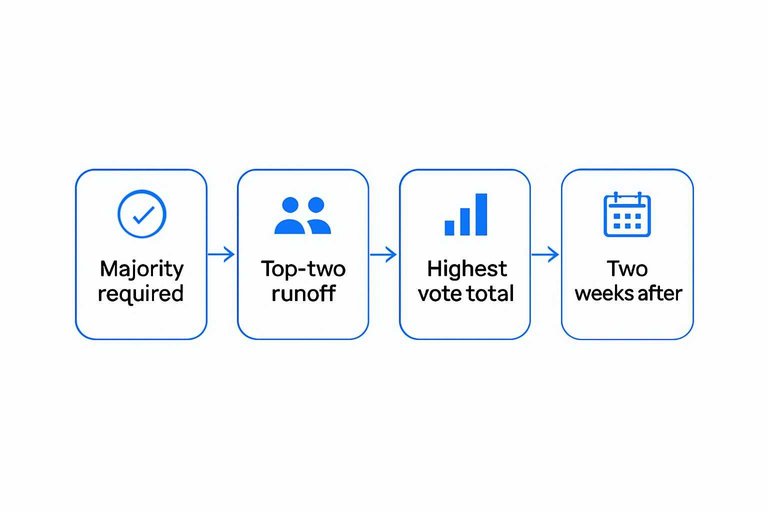
In South Carolina, “winning the primary” doesn’t mean “finishing first.” The South Carolina State Election Commission (SEC) says a candidate must win a majority of the votes cast for that office to clinch the nomination in the first round—more than half, not merely the largest share.
If nobody reaches that majority threshold, the race goes to a runoff (a second primary)—a follow-up election between the top candidates when no one wins the required majority in the first primary. Under the SEC’s 2026 primary FAQs, the top two vote-getters advance, and the runoff winner is simply the candidate with the highest vote total in that second round.
That “majority, then top-two runoff” structure is also the cleanest way to resolve a common misunderstanding: many people assume South Carolina primaries are decided by plurality (most votes wins). For statewide races like U.S. Senate, the SEC’s published rules point to the majority requirement first, with plurality only deciding the runoff.
The reason the runoff comes quickly is baked into South Carolina election law. The state’s “second primary” statute sets the runoff on a fixed schedule: two weeks after the first primary (S.C. Code of Laws § 7-13-50). That two-week gap is why South Carolina runoffs feel like a sprint—campaigning, recount chatter, and turnout efforts all compress into a narrow window.
You can see how it plays out in results: Ballotpedia reports Annie Andrews won the June 9, 2026 Democratic U.S. Senate primary with 61.5% (226,075 votes)—so no runoff was triggered.
Rules people misread
Three misunderstandings regularly warp how people read south carolina senate primary results—and the odds built on them.
-
“Open primary means anytime.” South Carolina’s setup lets you choose a party ballot when you vote, but it doesn’t turn a party nomination into a season-long free-for-all. Once you’re in a party’s nomination track for that office, later rounds (like a runoff) are not a chance to “re-pick” a party.
-
“Plurality wins.” Plurality means “most votes, even if it’s under 50%.” South Carolina’s SEC rule is majority-first: if nobody clears more than half in the initial primary, the contest isn’t “won,” it’s headed to a second primary (runoff). State law fixes the runoff timing at two weeks after the first round (S.C. Code § 7-13-50), which is why markets often swing again quickly after election night.
-
“The party just picks a replacement.” When there’s a vacancy in nomination and the original nominee was chosen by primary, South Carolina law uses a replacement primary process (S.C. Code § 7-11-55), not an internal party pick. And if that replacement contest needs a runoff, the winner is simply the top finisher in that runoff—for example, Ballotpedia reports Darline Graham defeated Ralph Norman in the Aug. 25, 2026 special Republican runoff, 52.6% to 47.4%.
When results are final
If you need settlement-grade answers for a south carolina senate primary, anchor yourself to the South Carolina State Election Commission (SEC) results on scVOTES—not a TV call, a social post, or a market screen. The SEC is the election administrator, and it’s also the place that publishes official statewide context (for example, it listed 3,422,737 registered voters in South Carolina as of Aug. 10, 2026).
On election night, what you’re seeing is a running tally. Numbers can change as precincts report and as pre-Election Day ballots are incorporated into what’s being shown. For example, ahead of the June 9, 2026 primaries, the SEC said 318,602 votes had already been cast during early voting as of June 5—before Election Day precinct totals began posting.
The point where the numbers stop being “live” and start being final is certification—the administrative step where election officials finalize and certify results after Election Day. Certification is when the election authority closes the books on the vote totals it will treat as official.
The other clock that matters is the protest deadline—the cutoff time for filing an election protest/challenge under the election calendar. Before that deadline, you can have a settled-looking result that is still legally contestable.
If you want a feel for how much counting and reporting happens around the edges, the SEC said that 61,000 votes had already been cast during early voting for the Special Republican Primary as of Aug. 10, 2026—numbers that exist before Election Day results even begin to post.
Name the contest before reacting
Treat “South Carolina Senate primary” as a label you have to decode, not a single event: first confirm whether the headline means U.S. Senate or a State Senate district, then whether it’s the June primary track or the GOP’s August replacement track. In 2026 that distinction isn’t cosmetic—your June ballot choice can determine whether you were even allowed to vote in the August GOP contest, and the majority rule can force a fast second round two weeks later. When you’re pricing outcomes or calling a winner, don’t anchor to election-night totals; anchor to the state’s certified results and remember a settled-looking tally can still be legally contestable until the protest window closes.
Frequently Asked Questions
- Is the August 2026 South Carolina Senate primary a “redo” of the June primary?
- No—the August 2026 contest is a separate GOP replacement primary triggered by a vacancy in nomination, run under South Carolina’s substitution statute (S.C. Code § 7-11-55). It exists to re-fill the party’s nominee slot for November after the original nominee is no longer eligible to be on the ballot.
- How long after the South Carolina Senate primary does the runoff (“second primary”) happen?
- Two weeks after the first primary, by statute (S.C. Code § 7-13-50). That fixed gap is why runoff campaigning and prediction-market repricing tends to compress into a short window.
- What is the filing fee to run in the 2026 U.S. Senate Special Republican primary in South Carolina?
- The filing fee is $10,440 for candidates in the U.S. Senate Special Republican primary. Confirm the current fee and filing instructions on the South Carolina State Election Commission’s special-primary filing page before you plan a run.
- If South Carolina appoints a U.S. Senator after a death, does that cancel the South Carolina Senate primary?
- No—an appointment fills the office temporarily, but the election still determines who holds the seat after the next general election under South Carolina’s U.S. Senate vacancy law (S.C. Code § 7-19-20). The primary determines who appears on the November ballot for the full-term decision.
- Where can I sanity-check South Carolina Senate primary betting odds against real vote totals once results start coming in?
- Compare what markets are implying against the official results feed, then use MarketsPrediction to scan cross-platform implied odds, volume, and liquidity to see where pricing is moving fastest. For a concrete reference point from the 2026 cycle, Darline Graham received 180,231 votes in the Aug. 25, 2026 Special Republican U.S. Senate runoff.