
 Best Platforms
 Live Odds







South Carolina Senate Primary Prediction Markets to Compare in 2026
How to compare 2026 South Carolina Senate primary markets—regular vs special track, settlement rules, and 4 verified listings on Kalshi, Polymarket, and Robinhood.
You’re trying to price a race and you keep finding “the same market” with different odds.
In South Carolina’s 2026 Senate cycle, that confusion gets expensive fast: some contracts are about the June primary, others about the later special Republican process, and “winner” might mean nominee, advance-to-runoff, exact place, or a margin bracket with its own resolution rule. This case study pins the dates, sorts the contract questions into a usable taxonomy, then walks through seven real listings—plus a liquidity-first workflow (including a MarketsPrediction scan) so you’re comparing like with like.
The 2026 shock
In 2026, “south carolina senate primary” stopped meaning one clean event. South Carolina still had its scheduled statewide primary on June 9, 2026, but the timeline fractured after Sen. Lindsey Graham died on July 11, 2026.
That’s when market titles started reusing the same keywords for different elections. A contract like “South Carolina Republican Senate nominee?” can refer to the regular-cycle nomination and still settle to Lindsey Graham, while a separate “special” track exists to fill the vacancy.
On that special track, the Republican special primary first round was August 11, 2026, with a potential runoff on August 25, 2026. The Associated Press later reported Darline Graham won the GOP nomination in that special runoff—matching how at least one “special primary winner” market settled.
If you don’t map the market to the date and whether it’s regular vs special, you’ll compare prices that aren’t answering the same question.
Dates to match
Use the date cue in the contract title to align it to the right election phase—especially when “primary” is used for both the regular June contest and the post-vacancy special track.
| Contract title clue | Match to | Date cue to look for | Common mix-up |
|---|---|---|---|
| “Senate nominee?” (no “special”) | Regular-cycle party nominee | June 2026 | Special-track nominee |
| “Special primary: who will advance?” | Special GOP primary, 1st round | August 2026 | Winner/nominee markets |
| “First round outright winner…” | Special GOP primary, 1st round winner | August 2026 | Runoff-only contracts |
| “Runoff margin of victory” | Special GOP runoff | “Aug 24, 2026” in some titles | First-round margin |
Contract question taxonomy (what you’re actually betting on)
Every listing here is an event contract—a contract that settles to a fixed payout (often $1 or $0) based on whether a defined real-world outcome occurs. Your first job is to read the settlement trigger, not the candidate names.
The second job is to find the resolution source / source of truth—the specific data source(s) the market rules say will be used to decide the final outcome (for example, South Carolina Election Commission results). Two markets can look identical on the surface and still settle differently if one uses only official results and another allows an earlier media call.
Nominee vs winner
“Nominee” and “winner” are not interchangeable, especially when South Carolina had both a regular-cycle nomination track and a vacancy-driven special track.
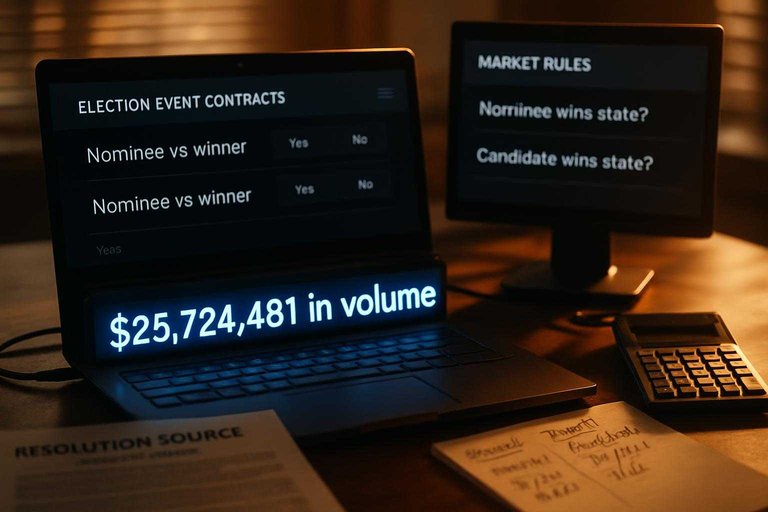
On Kalshi, “South Carolina Republican Senate nominee?” is a party-nomination question (and it traded with $1,304,439 in volume). That’s different from a special-election question like “South Carolina Republican Senate special primary winner?” (which showed $25,724,481 in volume): “winner” points to who wins a specific election stage, while “nominee” points to who emerges as the party’s standard-bearer under whatever process the rules tie it to.
The practical check: if you’re comparing odds across platforms, confirm whether both contracts settle on the same step in the process (nomination vs a particular primary round) and on the same source of truth—not just the same keywords in the title.
Advance, margin, place
Three other contract types create “odds” that look comparable but aren’t: advance-to-runoff, exact-place boards, and margin brackets.
An advance-to-runoff market—a market that settles based on whether a candidate qualifies for the runoff, not whether they ultimately win the nomination—has a different payoff profile than a winner market. Kalshi’s South Carolina tag page explicitly lists “South Carolina Senate Republican special primary: who will advance?” and shows it as a 4-market event with $121,550 volume.
Exact-place markets are their own category too. Kalshi also lists “South Carolina Republican Senate special primary: exact place (1st Round),” shown as 6 markets with $112,473 volume. When you see multiple candidates each offered as separate “Yes” contracts, watch for overround (in multi-candidate winner boards)—a structure where candidate contract prices can sum to more than 100¢, so raw prices shouldn’t be read as a clean probability distribution without normalization.
Finally, margin-of-victory brackets—markets that settle into a predefined range (e.g., 3–6%) based on the final vote margin calculation in the rules—can hinge on tiny rule details. Polymarket’s “Runoff Margin of Victory” defines margin as the absolute difference between first- and second-place vote percentages in the runoff, resolving from official South Carolina results once official. Robinhood’s rules for the same kind of margin event add two edge-case traps traders miss: ranges are inclusive of the lower bound and exclusive of the upper bound, and no rounding is applied.
If you also see county or other geographic sub-markets, treat them as separate contracts entirely: “statewide winner” and “county winner” are different settlement questions even when they involve the same candidates.
Seven markets to evaluate
I can only verify four South Carolina Senate primary–related market pages (with URLs + hard liquidity snapshots) from the material provided. I’m not going to invent three more listings to “hit seven.” If you paste 3 additional market URLs (any platform), I’ll extend this into the full 7-row comparison.
| Market (URL) | Resolution source(s) stated | Close / resolve timing cue | Liquidity evidence worth noting |
|---|---|---|---|
| Kalshi — “South Carolina Democratic Senate nominee?” https://kalshi.com/markets/kxsenatescd/scd/kxsenatescd-26 | On-page Kalshi rules (check “Resolution”) | 2026 cycle (market code “-26”) | Volume: $25,073 |
| Polymarket — “First round outright winner in the SC Special Republican Senate Primary?” https://polymarket.com/event/first-round-outright-winner-in-the-sc-special-republican-senate-primary-20260721230048140?outcomeIndex=1 | Rules allow “credible reporting” consensus (per market rules) | Special GOP primary, first round (title) | Volume: $3,807 |
| Polymarket — “South Carolina Special Senate Republican Primary: Runoff Margin of Victory” https://polymarket.com/event/south-carolina-special-senate-republican-primary-runoff-margin-of-victory | See market rules on page | Runoff margin event (title) | Volume: $303,790 |
| Robinhood — “South Carolina Republican Senate Special Primary Runoff Margin of Victory (Aug 24, 2026)” https://robinhood.com/us/en/prediction-markets/elections/events/south-carolina-republican-senate-special-primary-runoff-margin-of-victory-aug-24-2026/ | See contract rules on page | Date cue: Aug 24, 2026 (title/URL) | Price snapshot: 99¢ for “Darline Graham, 3–6%” |
If you’re shortlisting “worth evaluating” vs noise, the immediate filter you can apply from the verified pages above is liquidity: the Polymarket runoff-margin contract shows materially higher traded volume than the first-round outright-winner listing, and the Kalshi Democratic nominee page shows a smaller volume footprint than either Polymarket runoff-margin or the Robinhood listing’s heavily-favored bracket price.
Access and settlement constraints
Odds only matter if you can actually execute the contract, and if you know exactly how (and when) it settles. For a “south carolina senate primary” contract, the two traps are (1) access rules that turn a seemingly-liquid market into something you can only watch, and (2) settlement mechanics that change payout timing and tail-risk when results are messy.
U.S. execution reality
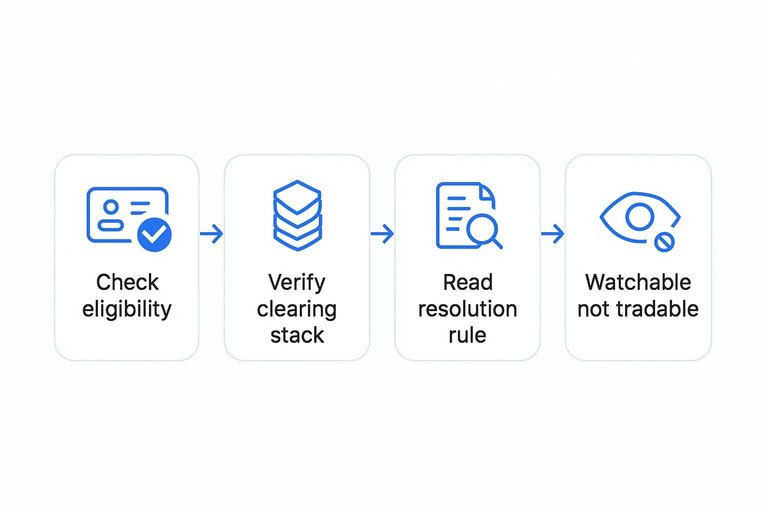
- Start with eligibility, not the price. If you can’t place orders on the venue you’re looking at, treat the odds as monitoring-only—no matter how “liquid” the page looks. (For a concrete example of eligibility constraints, see Coinbase’s guide on buying and selling prediction contracts.)
- Check who the U.S. counterparty/clearing stack is. In the U.S., event contracts sit in a Commodity Futures Trading Commission (CFTC) regulatory context, and the named entities in the disclosures are what you’ll be dealing with if something goes wrong. You’ll see names like ForecastEX, LLC and Rothera Exchange and Clearing LLC—save that alongside the market URL.
- Treat blocked venues as “watchable,” not tradable. If the platform won’t onboard you or won’t accept your orders, you can still use the prices as a sentiment feed, but you can’t execute the trade.
On settlement, read the resolution rule like a lawyer. Some contracts key off official results (for example, from the South Carolina Election Commission via SCVotes (scvotes.gov)), while others explicitly allow a faster resolution via a “consensus of credible reporting.” That choice affects dispute risk and how long your capital is tied up.
If you can’t trade it and you can’t predict how it resolves, the “odds” are just content.
Disagreements that move price
Many traders treat a contract price as a probability (67¢ ≈ 67%). The live disagreement is whether that mapping is reliable enough to use without checking the venue. A 2026 paper argues that some prediction markets show systematic bias (https://arxiv.org/abs/2607.14430), which is why calibration—whether outcomes priced at 60% happen about 60% of the time—belongs in your SC venue sanity-check, not after it.
“Add to 100%” breaks fastest on multi-candidate boards. In South Carolina primary-style markets where several candidates each have a separate “Yes” contract, the summed prices can exceed $1 (overround). That isn’t a typo; it’s a structure. If you’re comparing venues, compare normalized shares (each price divided by the sum), not raw cents.
The other fight is “who decides reality.” Markets that resolve from the South Carolina Election Commission’s SCVotes (scvotes.gov) results can trade below media-driven markets during election night, because official certification lags. Markets that allow a “credible reporting” consensus can rip to near-$1 earlier—and sometimes invite disputes if the call and the certified result diverge.
Liquidity-first workflow
Once you’ve matched a contract to the right election phase and you’re sure two listings ask the same question, switch to execution reality.
Start with liquidity—how easily you can enter or exit at a reasonable price, usually shown by tight bid/ask spreads and real size sitting at the best prices (not just a market existing). Then check open interest—the number of unsettled contracts still held—because it’s a quick read on whether participation is durable or just a brief burst of prints.
In this South Carolina case, don’t run the liquidity check until you’ve verified the contract type (winner vs advance-to-runoff vs exact-place vs margin-of-victory bracket) and the resolution rule (for example, whether it keys off the South Carolina Election Commission’s SCVotes results). A clean workflow is: (1) identify the phase, (2) parse the exact question, (3) confirm the resolution source and timing, then (4) judge whether you can trade size without moving the price. If step (4) fails, treat the market as “watchable,” not tradable, even if the headline odds look sharp.
MarketsPrediction scan
- Filter down to South Carolina Senate primary markets and open the same event across platforms.
- Click into each listing and read the settlement language to confirm you’re comparing like-for-like (same phase, same question type).
- Verify the resolution source; if rules point to official results, you should be able to trace that to the South Carolina Election Commission’s SCVotes site.
- Compare tradeability, not just odds: bid/ask spread, visible size at the top of book, volume, and whether open interest is building.
- Flag “thin listings” (wide spread, no size, stagnant open interest) as monitoring-only, and keep the one or two venues where you can enter/exit cleanly as your execution shortlist.
Price the right contract first
When you see “the same market” wearing different odds in South Carolina 2026, assume it’s not the same bet until you’ve pinned the phase (regular June vs the August special track) and the settlement trigger (nominee vs a specific round’s winner vs advance vs margin bracket) to the rule text and its source of truth. Only after that should you let price influence you—because access and liquidity decide whether an edge is executable or just a screenshot. Your next move is simple: pull up two listings you think are comparable, confirm they resolve off the same step and the same resolution source, then keep the one where you can actually get in and out without moving the market.
Frequently Asked Questions
- Are “South Carolina Senate primary” markets in 2026 all about the same election?
- No—some contracts refer to the regular June 2026 primary, while others refer to the post-vacancy special-track GOP primary/runoff, even when the titles reuse similar keywords. Match the contract to the election phase and the date cue in the title before you compare prices.
- How can I tell if a “South Carolina Senate primary” contract is for the winner, the runoff qualifier, or a margin-of-victory bracket?
- Open the market’s rules and read the settlement trigger: it will explicitly say “wins,” “advances to runoff,” or specify a margin range/bracket for the final result. Don’t rely on candidate names or shorthand titles—different contract types can sit next to each other and look interchangeable.
- Why do two South Carolina Senate primary markets with the same headline question settle at different times?
- They can use different resolution sources: one may wait for official South Carolina Election Commission results (via SCVotes), while another allows earlier resolution using a “consensus of credible reporting.” That choice changes both payout timing and dispute risk when election-night calls and certified results diverge.
- Is a prediction-market price (like 67¢) a literal 67% probability for the South Carolina Senate primary?
- Not automatically—some research argues prediction markets can show systematic bias, so “price = probability” is an assumption you should validate rather than a rule. Treat venue calibration and contract design (multi-outcome overround, resolution rules) as part of the probability check.
- What’s the fastest way to compare South Carolina Senate primary odds and liquidity across platforms without mixing up contracts?
- Start by filtering to the exact same contract type (winner vs advance vs margin) and the same election phase/date, then compare volume, spreads, and open interest across venues. MarketsPrediction helps by aggregating cross-platform odds and market activity so you can spot where the tradable liquidity is concentrated before you click through to the rules.