
 Best Platforms
 Live Odds








IYKYK Markets Pricing and Free Analytics Plan, Explained
IYKYK Markets pricing: $0/no signup. What the free Polymarket+Kalshi dashboards include, key limits/risks, and when to use paid data.
You’re trying to figure out whether a market-analytics site can be your main screen for finding trades, or just a quick place to sanity-check what you already saw elsewhere. When the “pricing” page is unclear—or search results mix it up with something else—you can’t tell what you’ll actually get for free, or what you’re giving up.
This breakdown maps the free analytics plan to real workflow steps (scan → validate → size → watch settlement), then calls out the non-price limits that still bite: platform coverage, what the “smart money” layer does and doesn’t cover, and the operational risks that matter once you rely on it daily.
Price and identity
If you’re googling “IYKYK Markets pricing,” be careful you’re not landing on results about an unrelated IYKYK crypto token. This article is about the prediction-market analytics website IYKYK Markets at IYKYK Markets official site—a browser-based analytics surface focused on prediction markets, not a coin.
As of today, the pricing shown on-site is simple: it positions itself as a free analytics platform, priced at USD $0/month, and it says you can use it without an account (no signup required). In other words, you can open the site and start using the public dashboards immediately.
One more identity check: IYKYK Markets explicitly frames its coverage around Polymarket and Kalshi (two platforms, not a broad multi-venue aggregator), and it also labels the product as beta/testing with an “informational only” disclaimer that warns data may be inaccurate or delayed. That combination—free, no-login access plus explicit scope and disclaimers—is what “pricing” means here in practice.
Free plan features (what you get without logging in)
IYKYK’s free, no-login surface is a set of read-only dashboards over two platforms (Polymarket + Kalshi), aimed at moving you through a repeatable workflow: scan → validate → size → resolution timing. The homepage positioning is scale-first (it claims 40K+ events tracked), but the day-to-day value is how quickly each surface answers one trading question. (If your “scan” step needs a broader, cross-venue view before you ever narrow to Polymarket/Kalshi, a discovery layer like MarketsPrediction can sit upstream—then IYKYK becomes the place you go deeper once you’ve found the most active prices.)
Two terms matter because they show up across multiple pages. Smart money (in IYKYK’s sense) is a scoring/ranking approach that tries to identify historically skilled wallets and highlight where their positioning differs from the current market-implied probability; the edge is the gap between that skill-weighted probability and the market price-implied probability. When you get to execution, liquidity/depth is how much size the order book can absorb near the current price without moving it much; spread is the gap between best buy and best sell (an immediate trading cost); slippage is your price getting worse as you try to trade size because displayed depth is limited. Finally, resolution/settlement timing is when and how a contract is expected to resolve and pay out, including delay/dispute risk tying up capital.
| Surface (free) | What it shows | Best for (workflow step) | What you act on |
|---|---|---|---|
| Screener | Market list + filters | Scan | Shortlist candidates |
| Signals | “Triage layer” flags | Scan → validate | Markets to inspect next |
| Smart Money Tracker | Polymarket smart-money scores | Validate | Disagreement vs price |
| Traders / leaderboard | Ranked wallet profiles | Validate | Wallets worth watching |
| Liquidity | Depth, spread, slippage view | Size | Tradeability check |
| Heatmap | Category movers snapshot | Scan | Where attention shifts |
| Events (clusters) | Related markets grouped | Scan → validate | Event-level positioning |
| Resolution calendar | Expected settlement + status | Resolution timing | Capital lock-up risk |
| Research hub | Methods + caveats articles | Validate | How to interpret signals |
Two operational notes make this workflow usable: IYKYK describes Signals as a triage layer that “do not replace market research,” and it says volume spikes still need independent verification—so treat a signal as a routing decision, not a trade decision. And when you’re deciding whose activity to even look at, the Trader Leaderboard explicitly ranks profiles by signal score, win rate, consistency, and historical activity, which is best used as an attention filter before you drill into any single wallet or market.
Hard scope limits
Even at $0/month, IYKYK’s “pricing limits” show up as hard scope boundaries: it’s a read-only analytics UI for two venues, not a general-purpose prediction-market data layer.
-
Venue coverage is fixed. If you need analytics across more than the two supported venues (think “venue” = the exchange/platform where the market trades), IYKYK won’t help—its stated coverage is 2 platforms.
-
Smart Money is not cross-venue. The Smart Money Tracker is framed as Polymarket smart-money scoring, so you shouldn’t assume the same scoring logic or wallet identity carries over to other venues.
-
Signals are routing, not answers. The “signals” layer is explicitly positioned as heuristic triage (a quick filter for what to inspect next). Treat it as a shortlist generator, not a substitute for market work.
-
Whale activity is partial by design. IYKYK’s own research (“Finding the Needle,” Feb 15, 2026) describes analysis across 7,655 Polymarket wallets and 1,337 markets, while also warning that whale-entry detector data are not complete trading ledgers—meaning you’re observing a subset of behavior, not the full story.
-
You can’t buy certainty about timing. The Resolution Calendar tracks expected settlement dates, delay risk, and disputed outcomes (with statuses like on track/overdue/disputed), but it can’t eliminate the underlying delay/dispute risk.
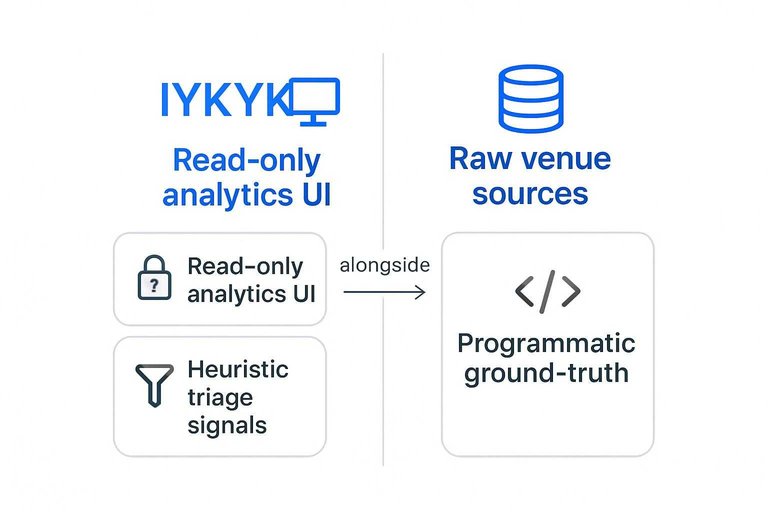
If your workflow requires programmatic, ground-truth data more than interpretation, you’ll end up leaning on raw venue sources (for Polymarket, that can mean the Polymarket Gamma API) alongside IYKYK—not instead of it.
Operational risk notes
-
Treat “beta” as a reliability constraint, not a label. IYKYK frames the product as informational and warns data can be delayed, incomplete, or noisy—so build your workflow assuming occasional bad prints and late updates, not continuous accuracy.
-
Signals need verification because the signal isn’t the ground truth. A “volume spike” (or any anomaly flag) is a prompt to check the underlying venue data before you trade or size. If you can’t independently confirm the move, your failure mode is acting on a dashboard artifact.
-
What’s missing for operational planning: freshness + latency. “Real-time” isn’t an SLA. The public copy doesn’t give a concrete update frequency, per-venue lag, or “last updated” timestamp you can operationalize for alerting, execution timing, or post-trade review.
-
Scale claims don’t remove inference risk. Even if a site scores thousands of wallets or analyzes large numbers of trades, that’s coverage—not a guarantee the ranking is a good “copy this trader” signal. Practitioners specifically warn that leaderboards sorted by win rate or raw P&L tend to select for variance/luck and near-decided bets, so treat those metrics as a starting point for inspection, not a decision rule.
-
Reuse rights are a hidden cost at $0. IYKYK’s crawlable legal pages are summary-style, so don’t assume you’re allowed to cache/export/republish outputs into a feed or product. Oddpool’s Terms of Service are explicit: its service/API data is licensed solely for personal, internal use, and it prohibits incorporating that data into a competing product, data feed, or commercial API—and it prohibits systematic downloading/caching/storing for redistribution.
Alternatives that win
Oddpool: priced API
Oddpool is the cleanest alternative when your “analytics” requirement is really programmatic access—an API (a way for software to request data) rather than a UI.
| Oddpool plan | Price | Published access limits | Data-use constraints (ToS) |
|---|---|---|---|
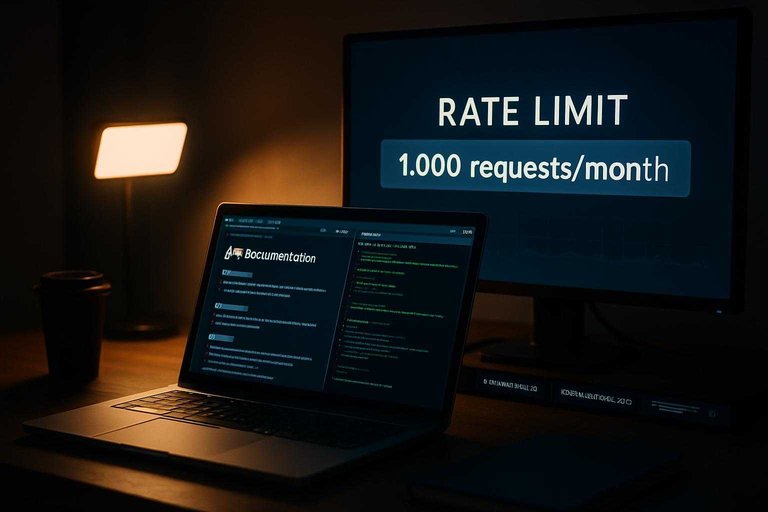
| Free | $0 | 1,000 requests/month | Personal/internal only; no redistribution/caching; no competing feed/API |
| Pro | $30/month | API/WebSocket limits shown | Personal/internal only; no redistribution/caching; no competing feed/API |
| Premium | $100/month | API/WebSocket limits shown | Personal/internal only; no redistribution/caching; no competing feed/API |
A WebSocket is a streaming connection (push updates without polling). The catch with Oddpool isn’t price; it’s the license: its Terms explicitly bar using its service/API data to build a competing product or redistributing it via a feed, and they prohibit systematic downloading/caching for redistribution.
OmniPred: gap alerts
OmniPred is built for arbitrage alerting: it matches equivalent markets across Polymarket and Kalshi and surfaces pricing gaps. The free piece is a Telegram bot that sends alerts on a schedule and uses a spread threshold (a minimum gap before it pings you).
The tradeoff is focus. It’s a cross-venue “tell me when the gap is big” tool, not a deep analytics surface for interpreting why a market moved or who drove it.
MarketsPrediction fit
MarketsPrediction wins on multi-platform discovery: a cross-platform view of live odds and activity, plus a trending feed, filters by platform/category, top-by-volume lists, and platform comparison tables (for things like deposit methods and payout speed). That combination makes it a practical default for the earliest step in the workflow—quickly answering “what’s moving, where is liquidity showing up, and which venue is offering the better price right now?” before you commit time to deeper analysis.
It’s not a wallet-scoring analytics layer, so if your workflow depends on trader-level interpretation on Polymarket/Kalshi, that’s where a UI-first tool like IYKYK stays in the stack and MarketsPrediction functions as the discovery and cross-platform comparison layer alongside it.
Decision triggers checklist
-
Use IYKYK alone if you’re making manual, UI-based decisions on Polymarket + Kalshi and you can tolerate “beta-grade” quirks because you’re double-checking before you act.
-
Pair it when a signal is your starting gun, not your proof. If IYKYK Markets Prediction Market Signals flags a move, confirm it in the underlying venue data before you size.
-
Don’t use it as your discovery layer if your job starts with “what’s moving across all venues?” Use a cross-platform scanner (MarketsPrediction) for broad discovery, then drop into IYKYK for trader/wallet interpretation on its two venues.
-
Move to a paid data/API product when you need an API (programmatic access for software) for automated alerts, backtests, dashboards you operate yourself, or any workflow where freshness/latency must be a defined requirement.
-
Treat redistribution as a hard gate. Oddpool’s Terms of Service license its service/API data solely for personal, internal use and explicitly prohibit incorporating Oddpool data into a competing product/feed/commercial API, and prohibit systematic downloading/caching/storing for redistribution—so “use it however you want” is not the contract. Also, don’t upgrade just to copy a leaderboard: practitioners argue that ranking by win rate or raw P&L selects for variance/luck and near-decided bets, not repeatable edge.
Use it as a verified layer
IYKYK Markets is genuinely priced at USD $0/month with no signup, so the real decision isn’t “is it free?”—it’s whether you can live inside a read-only, beta-grade analytics UI that covers only Polymarket and Kalshi (with the smart-money layer framed as Polymarket-specific) while you still verify signals against the underlying venue before sizing. If you trade those two venues manually and want a fast way to screen, check wallet behavior, sanity-check liquidity/spread/slippage, and watch settlement timing, it can be your primary analytics screen—but only if you treat it as routing plus verification, not ground truth. If your day starts with “what’s moving across all platforms?”, use MarketsPrediction for cross-platform discovery and odds comparison, then drop into IYKYK for the deeper trader-level read on the markets you’ve already shortlisted. The moment your workflow needs programmatic data, defined freshness/latency expectations, or redistribution rights, stop trying to force a free dashboard to do an API job and switch to a paid data layer instead.
Frequently Asked Questions
- Is IYKYK Markets the same thing as the IYKYK crypto token that shows up in Google results?
- No—those are different things. IYKYK Markets refers to the prediction-market analytics site at iykykmarkets.io, while the IYKYK token is a separate crypto asset with unrelated pages and “how to buy” listings.
- Does IYKYK Markets have an API, WebSocket, or export option for automated alerts and backtests?
- The public “free/no-signup” positioning is a browser-based, read-only analytics UI, not an API product. If your workflow needs programmatic access or streaming updates, you’ll need an API-first provider rather than IYKYK’s dashboards.
- How do I sanity-check an IYKYK “signal” before I place a trade?
- Use the signal as a routing cue, then confirm the move directly on the underlying venue (Polymarket or Kalshi) by checking the market page, recent trades, and current order-book/liquidity. Don’t size a position until the venue data matches what the dashboard is flagging.
- Can I trust the IYKYK trader leaderboard to copy trades from the top wallets?
- No—treat any leaderboard as an attention filter, not a copy-trading rule. Ranking by win rate or raw P&L selects for variance/luck and near-decided bets, so you still need to inspect what the wallet traded, when, and how liquid the market was (https://www.reddit.com/r/algotrading/comments/1uo6uhz/if_you_rank_traders_by_win_rate_or_raw_pl_youll/).
- What should I use if I want to scan what’s moving across more platforms before I drill into Polymarket or Kalshi?
- Use MarketsPrediction for cross-platform discovery (trending markets, filters by platform/category, and top-by-volume lists), then switch to IYKYK when you want deeper trader/wallet-style interpretation on its supported venues. That “scan first, analyze second” split keeps you from starting in a two-platform view too early.