
 Best Platforms
 Live Odds








What Are Betting Markets? A Beginner’s Guide
This beginner explainer settles what “betting markets” means in 2026 — sportsbook pricing, exchange matching, event-contract markets, reading odds as prices, settlement rules and safety checks, and a step-by-step way to compare venues responsibly so you can interpret quotes and know what you’re actually trading.
You’re staring at a board of odds and wondering what you’re actually buying when you click YES, back, or bet. Sometimes the house sets the price; other times you’re trading with other people, and the number can move the moment you enter.
Get the model wrong and you can overpay, misunderstand who’s on the other side, or miss the details that decide whether you get paid at all. This guide maps the three main market types, translates odds into prices, walks through how a trade and exit work, and shows what to check on settlement, legality, liquidity, and fees before risking money.
Three market models
“Betting markets” are any setup where prices (odds) are posted on event outcomes and you can take a position at those prices—either against an operator or against other participants. The odds may look similar across apps, but they behave differently depending on two things: who sets the price, and who you’re actually trading against.
Sportsbook pricing
A sportsbook (bookmaker)—an operator that sets the odds/lines and takes the other side of customer bets, embedding a margin in the pricing—is not a peer-to-peer market. You are trading against the book: you accept the posted odds, and your payout is determined by those house-set terms.
That’s why sportsbook odds are best read as an offer from a dealer, not a “market price” discovered by customers bidding and offering against each other.
Exchange matching
A betting exchange is a marketplace where members bet against each other rather than a bookmaker. Instead of accepting a house price, you’re matched with another customer who wants the opposite side at the same price.
That’s where “back” vs “lay” comes from: a back bet is taking the “for” side of an outcome, while a lay bet is taking the “against” side—functionally acting like the counterparty to someone else’s back. Because the price is created by who’s willing to trade, exchanges support “trading” in the plain sense: you can back at one price and later lay at another after the price moves.
Event-contract markets
An event contract—a contract whose value depends on a defined event outcome; on many venues it’s a yes/no contract that settles to a fixed amount if correct—looks like simple “YES/NO odds,” but it’s typically structured as a swap under U.S. derivatives framing. The Commodity Futures Trading Commission (CFTC) describes many event contracts as having only two outcomes (yes/no), a fixed payout (usually $1), and an expiration tied to a time or the event’s natural conclusion.
On regulated prediction-market venues, the CFTC also emphasizes that prices are market-driven: customers post real-time bids and offers in an order book (a live list of buy and sell offers), the market operator does not take a side of the trade, and traders can trade in and out before settlement at the current market price. In other words, you’re not “taking the house’s odds”—you’re buying or selling a contract to another participant, where YES and NO are the two sides that add up to that fixed $1 payout.
Once you can spot which model you’re in, the next step is treating the number you see—odds or price—as the thing you’re actually trading, not just a prediction.
Reading odds as prices
The number you see in betting markets is a price first and a forecast second. Your first move is translating that price into an implied probability (the probability you’d need for the trade to break even before costs).
On yes/no event contracts that settle to a fixed payout, the translation is almost literal. Kalshi describes contracts that pay $1 if the outcome is true and $0 otherwise; in that structure, a YES price of $0.70 lines up with about a 70% implied probability, because you’re paying $0.70 for a claim that’s worth $1 only if YES happens.
Sportsbooks need an extra step: the book embeds a margin, so the implied probabilities across all outcomes can add up to more than 100%. That doesn’t mean the event is “more than certain.” It means the odds are an offer with a built-in fee.
And even in market-driven venues, “price = truth” is a heuristic, not a guarantee. A widely discussed counterpoint is that with transaction costs and risk-averse liquidity providers, prices—especially near 0 or 1—can be pulled toward the beliefs of the most aggressive traders rather than the objective probability.
Manipulation can also persist longer than the folk story suggests: a large-scale field experiment studying 817 markets found manipulation effects still visible 60 days later (fading over time).
A disciplined way to use this is price shopping: estimate your own probability, compare it to the implied probability, and only take the trade when the gap is large enough to cover margin and fees; otherwise, you pass.
How a trade works
A “trade” is just opening a position at one price and later closing it at another (or holding it until it expires). Here’s the lifecycle in practice.
-
Pick a market and check tradability
Open the contract you want, then look at the order book (a live list of buy and sell offers—bids/asks—showing what other traders are willing to trade at right now). Note the bid/ask (spread): the bid is the best current buy offer, the ask is the best current sell offer, and the spread is the gap between them—a real cost of immediate execution. Finally, scan liquidity (how easily you can buy/sell at the quoted price size without moving the market). -
Choose your side and size
Decide whether you’re buying YES or NO, and how many contracts/shares. On some venues, contracts settle to a fixed $1 if correct and $0 otherwise, and your downside is limited to the funds you put at risk (no debt). -
Place an order (market vs limit)
A market order crosses the spread and fills immediately at the best available prices. A limit order posts your price and waits to be matched. -
Understand maker vs taker (and fees)
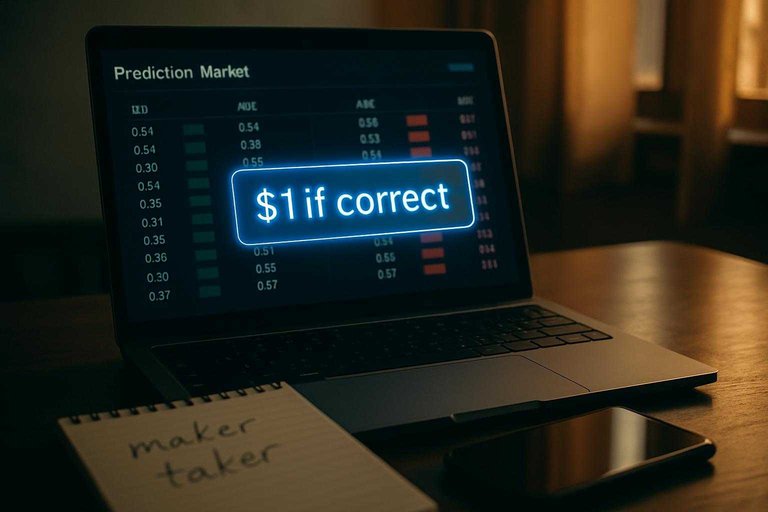
If your limit order rests in the book, you’re a maker (you add liquidity). If you immediately match someone else’s order, you’re a taker (you remove liquidity)—and fee schedules can differ. For example, Polymarket states makers are never charged fees, while takers pay a fee on certain markets calculated as: fee = C × feeRate × p × (1 − p). -
Exit early—or hold to settlement
To exit early, you place the opposite trade (sell what you bought, or buy back what you sold) at the current market. If you don’t close, you carry the position to settlement, where the payout is determined by the market’s written resolution rules (next section).
Settlement decides payout
Settlement (also called resolution) is the mechanism that turns a market question into a final payout decision based on the contract’s written rules, its chosen data source, and what happens if the outcome is disputed or delayed.
Start with the contract specs, not the headline. The market usually defines exactly what counts (the precise wording), when it’s evaluated (a cutoff time), and where “truth” is read from (an official source, a specific publication, or another named reference). If that source updates late, issues a correction, or never publishes a clean answer, settlement can pause while the venue applies its rulebook.
On on-chain prediction markets, that “who decides” piece is often an oracle—meaning a mechanism (sometimes a smart-contract process plus dispute voting) that records the outcome the contracts will pay on. Polymarket, for example, resolves markets through the UMA Optimistic Oracle: someone proposes an outcome and must post a bond in USDC.e, and that proposal can be disputed before it’s treated as final; once resolved, winning shares pay $1 per share and losing shares become worthless.
That’s why “event outcome” can differ from “paid outcome.” What you get paid on is the outcome the contract’s settlement process finalizes under its rules (including any proposal/dispute steps), especially when wording is ambiguous or the resolution path involves proposals, disputes, and resets. Read those rules first—then compare prices.
Legality and safety
Before you compare prices in betting markets—or deposit—run this quick legality/risk check.
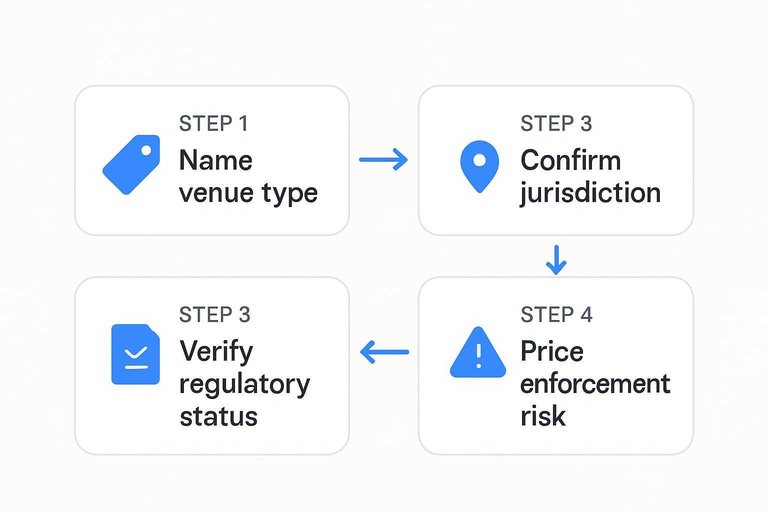
- Name the venue type you’re about to use. People use “betting sites” to mean everything from sportsbooks (DraftKings, FanDuel, BetMGM, Caesars, bet365, William Hill, PointsBet) to exchanges (Betfair Exchange) to event‑contract platforms (Kalshi, Polymarket). Different rules apply.
- Confirm your jurisdiction is allowed. Polymarket lists the United States as blocked and says blocked users can still view markets/data but cannot trade, and it prohibits using VPNs (it also lists 39 completely restricted countries).
- Treat “view-only” as a hard stop. If you can browse but can’t place an order, don’t plan a workaround—you’re looking at an access restriction, not a UX quirk.
- Verify regulatory status from the regulator’s register, not a banner. In the U.S., KalshiEX LLC has a CFTC Order of Designation as a Designated Contract Market (DCM) (a CFTC-registered trading venue).
- Check clearing, not just trading. The CFTC lists Kalshi Klear LLC as a registered Derivatives Clearing Organization (DCO).
- Price in enforcement risk. The CFTC ordered Blockratize, Inc. (Polymarket.com) to pay a $1.4 million civil monetary penalty and wind down non-compliant markets.
If a platform fails any item above, don’t “shop odds” yet—switch venues first.
Compare venues responsibly
The “same” event can price differently because you’re not buying the same thing everywhere: venues have different fee schedules, different liquidity (so you may cross a wider spread to get filled), and sometimes slightly different contract wording that changes what actually settles.
-
Match the contract first. Open both markets and verify the outcome definition, cutoff time, and settlement source are truly equivalent. If they aren’t, treat them as different products.
-
Compare fees on your likely order type. If you’ll be a taker (you fill immediately), note that Polymarket’s taker fee rate is listed as 0.04 for Politics, 0.05 for Sports, and 0.07 for Crypto.
-
Check tradability at your size. Look at the bid/ask and depth; a “better price” isn’t better if you can’t get filled without moving it.
-
Use a market scanner (an aggregator that surfaces live prices and activity across venues) to shortlist candidates fast; MarketsPrediction does this across multiple platforms, with a visible “Last updated” timestamp so you know how fresh the snapshot is.
Trade the rules, not headlines
When you click bet, back/lay, or YES/NO, you’re not buying the same product across venues—you’re either accepting a dealer’s offer, getting matched with another trader, or trading a contract that settles by written rules. Treat the quote as a price: translate it to an implied probability, then decide whether it’s actually cheap enough after margin, spreads, and maker/taker fees. Before you risk money, read the contract specs and resolution process like they’re the product—because payout follows settlement rules and the chosen source/oracle, not your interpretation of the headline. Only after you’ve verified access in your jurisdiction and confirmed there’s real liquidity at your size is “shopping odds” a decision instead of a gamble.
Frequently Asked Questions
- Are betting markets a new thing, or have prediction markets been around for decades?
- Prediction markets have been around for decades: the CFTC’s timeline traces modern U.S. prediction markets back to 1988 and notes they’ve been regulated by the CFTC since 2004.
- How much money can you put into a prediction market—are there any hard limits?
- Some regulated research-style markets have strict caps: the CFTC’s 1993 no-action letter for the Iowa Electronic Markets describes a $500 maximum investment per participant in a single submarket, with trader caps like 2,000 per election in political markets and 1,000 in certain other submarkets.
- Do prediction markets let you trade through a broker, or do you place your own orders?
- Some markets explicitly require self-directed trading: the CFTC’s 1993 Iowa Electronic Markets no-action letter states participants execute their own trades and that no brokerage service is available or allowed.
- What fees should I check before trading betting markets on event-contract platforms?
- Check both trading fees and funding fees: for example, Kalshi’s fee schedule shows formulas for fees on trades (including a general and a maker formula) and lists card deposits at a maximum fee of 2%.
- How can I verify a betting market platform is actually regulated in the U.S.?
- Verify it in the regulator’s own registers: for example, the CFTC has an Order of Designation for KalshiEX LLC as a Designated Contract Market (dated 2020-11-04) and lists Kalshi Klear LLC as a registered Derivatives Clearing Organization (dated 08/28/2024).