
 Best Platforms
 Live Odds







Predicted Odds vs Implied Odds: Which Is Better for Trading?
Compare predicted odds to executable implied odds—de‑vig books, use bid/ask + fees, and compute the minimum edge required before you trade.
You’ve got one number from a model and another number from a live market, and you need to decide which one to trust before you click buy or place a bet. The obvious move—compare your forecast to the displayed price—breaks fast once margin, spreads, and fees enter the picture, and you can end up “right” on paper while losing money in execution.
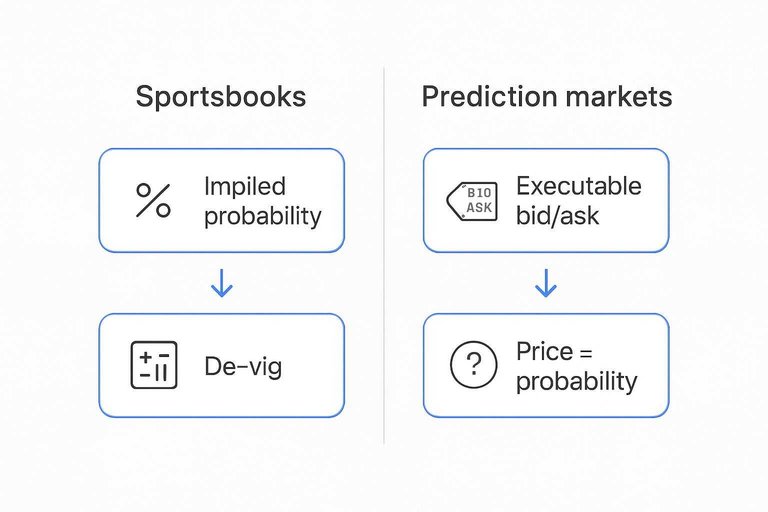
This collection makes the terms unambiguous, walks the two implied-odds pipelines (sportsbook lines vs tradable contracts), shows a breakeven-after-costs test, and gives a simple table and tracking list to pick a consistent anchor for how you actually trade.
Define the odds
Predicted odds
Predicted odds are your model’s forecast of an outcome’s probability, expressed as a number between 0 and 1 (or 0% to 100%). Traders usually convert that model probability into “fair” odds so it can be compared to a market price.
The clean comparison is always probability-to-probability. If your model says an outcome is 0.60 (60%), its fair decimal odds are 1 ÷ 0.60 ≈ 1.67; if a market implies 0.55, your model is calling it underpriced.
Two separate questions get mixed up here: whether your probabilities are calibrated (when you say 60%, it happens about 60% of the time) and whether a trade is profitable after execution costs. You can be well-calibrated and still lose money if you can’t buy or sell at prices that leave room for costs.
Implied odds
Implied odds (implied probability) are the probability you back out of a tradable price. In sportsbooks quoted in decimal odds, the implied probability is 1 divided by the decimal odds (for example, 1 ÷ 4.0 = 25%).
In $0–$1 “event-share” markets, the mapping is even more direct. Kalshi event contracts settle to $1 if you’re right and $0 otherwise, and Kalshi explains that a “Yes” price of p cents is typically interpreted as about p% market-implied probability.
One more gotcha: the number you see isn’t always the price you can hit. Polymarket describes its venue as a central limit order book where prices emerge from users trading with each other, and it says the UI shows the bid/ask midpoint—but if the spread is wider than $0.10, it shows the last traded price instead—so the executable implied probability comes from the bid when selling and the ask when buying, not the display.
Two implied pipelines
Sportsbook implied prob
Sportsbooks quote odds, but your model is a probability—so the only clean comparison is to convert the odds into implied probability and then remove the embedded margin.
Start with the mechanical step: for decimal odds, implied probability is 1 ÷ odds. OddScore’s worked example uses odds of 1.80 and 2.00, which convert to 55.56% (1 ÷ 1.80) and 50.00% (1 ÷ 2.00). Add them up and you get a 105.56% “book.”
That extra 5.56% above 100% is the overround (vig)—when the implied probabilities across all outcomes sum to more than 100%, representing embedded margin. If you compare your predicted odds to the raw 55.56%/50.00% numbers, you’re comparing to prices that include that margin.
So you run the next step: de-vigging, a method to redistribute the overround back into outcomes so probabilities sum to 100%, producing a “fair” baseline for comparison. One warning label matters here: OddScore explicitly separates overround from actual bookmaker profit, and academic work argues the “standard” odds-to-probability extraction can misrepresent real win rates (favorites vs. longshots). Treat de-vigged probabilities as a baseline for comparison, not a claim about truth.
Prediction market price
Prediction markets look simpler because many contracts are $0–$1, but the pipeline breaks in a different place: the number you see may not be the number you can trade.
On an order book, the tradable prices are the bid-ask spread / midpoint—the executable buy and sell prices (bid/ask); the midpoint is a display convention and may not be a tradable price. Your implied probability for a buy comes from the ask; for a sell, from the bid.
Then apply fees, and fees depend on whether you were maker vs taker—maker posts a resting limit order; taker executes immediately against resting liquidity—fees often differ. Kalshi’s fee schedule charges trading fees only when your order is immediately matched, and it gives a concrete example: 100 contracts at a $0.50 price costs $1.75 in trading fees.
Polymarket is even more explicit: fees are fee = C × feeRate × p × (1 − p), and makers are never charged fees (only takers pay). It also states some “Geopolitical and world events” markets are fee-free.
If you want to test predicted odds against “the market,” pick the right endpoint: de-vigged sportsbook probability, or executable bid/ask after the venue’s fee formula—not raw odds, not a midpoint, and not a convenient last print.
When implied misleads
“Implied” only means “backed out of a price.” On sportsbooks that’s odds → implied probability → de‑vig; on prediction markets it’s the executable bid/ask (not midpoint/last) plus the venue’s fee rule. It’s useful for trading only when you’re backing it out of the price you can actually hit; it’s useful for interpretation only when you accept the assumptions that make “price = probability” legitimate.
On sportsbooks, the first trap is treating overround (vig) like a clean, mechanical error term. A University College Dublin working paper argues the common “overround = bookmaker margin” model doesn’t describe how a monopolist bookmaker sets odds, and that the standard odds-to-probability extraction misses real win rates: longshots win less often and favorites more often than that method implies. That’s the line that gets crossed: your predicted odds start “beating the market” on paper because your implied baseline is biased.
The second trap is thinking there’s one correct de-vig. Practitioner calculators don’t just do proportional normalization; they offer alternatives like the Shin method, and those choices can move the resulting “fair” probabilities enough to flip whether your predicted edge survives.
On prediction markets, the mislead is conceptual: even after you use the executable bid/ask, treating that price as the probability is an extra assumption. In Manski’s NBER Working Paper 10359, that assumption can fail badly in theory. There’s also a live disagreement about how big the price‑vs‑belief wedge is in practice: Wolfers & Zitzewitz argue that in a broad class of models the wedge is usually small and prices are typically close to mean beliefs, while treating the Manski-style setup as a worst‑case scenario with practical caveats (especially near $0/$1 or when trading is constrained).
So compare predicted odds to a consistent de-vigged baseline (sportsbooks) or an executable price (prediction markets), and treat “market probability” as a tradable number—not automatic ground truth.
Breakeven after costs
Call a trade +EV (positive expected value) when your probability estimate implies a higher fair price than the market offers after all execution costs. The fastest way to stop “value” from being a vibe is to compute the minimum mispricing your predicted odds must clear.
-
Pick the executable market number (not the pretty one).
Sportsbook: use the actual decimal odds you can bet. Event-share markets: use the ask if you’re buying “Yes” and the bid if you’re selling. -
Sportsbook breakeven (vig is already in the line).
If the book is offering decimal odds O, your breakeven win probability is p* = 1/O.
If you also de‑vig to a “fair” baseline probability p_fair for that outcome, the line’s built-in tax in probability terms is (1/O − p_fair)—your model’s edge vs the baseline must be bigger than that to be worth taking. -
Event-share breakeven before fees (spread handled by Step 1).
For a $0–$1 contract at executable price p, buying 1 share has gross edge q − p, where q is your predicted probability. -
Subtract venue fees to get the real threshold.
Polymarket taker fees use fee = C × 0.07 × p × (1 − p) (rounded to 5 decimal places); makers aren’t charged.
Kalshi fees use round up(M × 0.07 × C × P × (1−P)) for taker matches, or the maker coefficient 0.0175—so your minimum edge is q − p > fee_per_share at your trade size. -
Add funding friction if it’s unavoidable.
If you fund via card on Kalshi, the fee schedule lists a maximum 2% deposit fee; treat that as extra cost your edge must cover before you call anything +EV.
Choose your anchor
In practice, you’re choosing which number is your benchmark: your model probability q (converted into a net‑of‑cost fair price) or the market’s executable implied probability p (the side of the bid/ask you can actually trade, fees included). If you’re trying to trade mispricing, anchor on predicted odds; if you’re trying to trade execution, anchor on implied odds (the price you can actually hit).
| Trading intent | Better anchor | Use it when… | Failure mode to watch |
|---|---|---|---|
| Line-shopping / cross-venue arb | Implied odds | You can lock prices now | Non-executable quotes (mid/last) |
| Directional +EV (model-led) | Predicted odds | Model is stable + calibrated | “Edge” is just vig / spread |
| Hedging an existing exposure | Implied odds | Goal is payout shape, not alpha | Hedging at the wrong side (bid/ask) |
| Market-making / spread capture (CLOB) | Implied odds | You control fills with limits | Adverse selection vs informed flow |
| “Market is wrong” conviction | Predicted odds | You accept being early | Price ≠ belief; wedge can matter |
Rule of thumb: if you can’t point to the exact line (sportsbook) or bid/ask + fee calculation (prediction market) your anchor implies, you don’t have a trading workflow—you have an opinion.
Tooling and tracking
Treat this like an audit log that lets you reconstruct the exact predicted probability you acted on and the executable bid/ask + fee rule you could have traded.
- Predicted odds snapshot: timestamp, event/market ID, your probability, fair-odds conversion, and the exact model version used.
- Executable implied odds snapshot: venue, contract, bid, ask, and size available at those prices (so you can separate “pricing” from “liquidity”).
- Fee schedule archive (by venue): save the fee rules you were operating under that day. Source them from the Kalshi Fee Schedule (PDF) and the Polymarket Help Center.
- Order + fill record: order type, submitted price, fill price(s), fills/partials, and whether you were maker vs taker (fees often differ).
- All-in costs line items: trading fees, plus any funding/deposit fees you incurred, recorded separately from trading P&L.
- Outcome + net P&L: settlement result, gross vs net, and the predicted-vs-executable edge at entry.
- MarketsPrediction: use it to screen where implied odds and liquidity are live across venues, then confirm and log the executable bid/ask and fees on the venue itself.
Anchor on what you can trade
If you’re deciding which number to trust before you click, treat the executable implied odds as the non-negotiable reality—bid when you sell, ask when you buy, with the venue’s fees baked into your threshold—because anything else is a display, not a price. Predicted odds only deserve to be your “better” anchor when they’re calibrated and you’ve converted them into a net-of-cost breakeven that clears vig, spread, and fees at the size you’ll actually trade. Your first move is simple: write down the exact line or bid/ask you can hit and compute the minimum edge your model must show after costs; if you can’t do that, you’re not trading an advantage—you’re trading a narrative. Use a cross-platform odds screen to find where the price and liquidity look best, then verify the executable bid/ask and fee rule on the venue before you place the order.
Frequently Asked Questions
- Are predicted odds the same thing as implied odds on a prediction market?
- No—predicted odds are your model’s probability, while implied odds are the executable price you can trade (the bid/ask on a Central Limit Order Book), then adjusted for fees.
- Do predicted odds already account for sportsbook vig, or do I need to adjust them?
- Predicted odds don’t include sportsbook vigorish (vig), so compare your model probability to a margin-free baseline (de-vigged implied probability) or evaluate edge directly against the offered line’s breakeven probability.
- If the market price is an implied probability, why not just treat it as the “true” probability instead of using predicted odds?
- Because “price = probability” is an extra assumption that can break in theory (Manski’s NBER Working Paper 10359) and is debated in practice (Wolfers & Zitzewitz’s FRBSF Working Paper 2006-11), especially when trading is constrained or prices cluster near $0/$1.
- How do I check whether my predicted odds are actually good enough to trade, not just accurate on paper?
- Backtest calibration (do events you rate at 60% win about 60% of the time) and separately track trading performance net of spread/fees/vig, logging the exact price you could execute when you placed the trade.
- What’s the fastest way to find where my predicted odds disagree most with the market across platforms?
- Use MarketsPrediction to scan the same event across venues and filter by platform/liquidity, then verify the executable bid/ask on the venue before comparing it to your predicted odds.