
 Best Platforms
 Live Odds








How to Compare Sports Prediction Market Odds: 6 Steps in 15 Minutes
A fast, practical guide to comparing sports prediction market odds in 15 minutes—set a clear goal, normalize odds into implied probability, align contract/settlement terms, adjust for fees, compute the best net price, and sanity-check liquidity and limits before you trade.
If you’ve ever compared odds across prediction markets and felt like you were reading different languages, you’re not alone. One platform shows “Yes” shares, another shows American odds, and a third buries fees and settlement rules in the fine print.
This guide gives you a repeatable, 15-minute workflow to make those numbers comparable. You’ll convert everything to the same probability basis, verify you’re betting the same outcome under the same rules, account for fees, and finish by checking whether you can actually get filled at the price you want.
Set Your Comparison Goal
Odds comparisons only work when they end in one decision. Decide what you will do if Market A beats Market B, then compare only what affects that action.
Pick one market
Comparing multiple games or contract types muddies the signal and wastes time. Pick one event and one contract so every price is directly comparable.
- Choose one event, like a single game or match.
- Choose one contract type: moneyline, spread, total, or a player prop.
- Confirm the exact side and line, like -3.5 or Over 47.5.
- Write the contract in one line, including league and start time.
If the contract text differs, you are comparing different bets.
Lock your timeframe
Prices move fast, and “best” depends on when you measure. Pick one timing rule and stick to it.
- Compare right now, same minute.
- Compare a pregame close snapshot.
- Compare at a set timestamp.
- Compare live odds at a trigger.
Without a fixed time, you are measuring motion, not value.
Define success criteria
“Best odds” can mean different things, depending on your goal. Decide your definition before you look at any numbers.
You might optimize for highest payout, cheapest entry price, lowest implied probability, or the best hedge price. You might also prefer the venue with more liquidity, because you plan to exit early.
Once you pick your definition, you stop debating and start selecting.
Prepare quick tools
You need speed and consistency to avoid misreading a line. Set up the same inputs across tabs before you start comparing.
- Open a calculator for implied probability and payout checks.
- Open a notes sheet to record prices and timestamps.
- Open 2–4 market tabs for the same event and contract.
- Verify contract specs match: line, side, and settlement rules.
The tool setup is the difference between a comparison and a scramble.
Normalize Odds Formats
Comparisons fail when each platform speaks a different odds language. Convert every line into decimal odds and implied probability, then compare like-for-like.
Convert to decimal
Pick one working format for your sheet, then convert everything into decimal odds. Decimal makes later math clean, especially when you compare multiple markets.
- For American +A: decimal = 1 + (A/100).
- For American -A: decimal = 1 + (100/A).
- For fractional X/Y: decimal = 1 + (X/Y).
- Copy the decimal value next to each platform’s price.
- Keep 2–4 decimals for consistency.
Once every line is decimal, the rest becomes simple arithmetic instead of guesswork.
Implied probability
Decimal odds tell you payout, but implied probability tells you the market’s belief. You want both, side-by-side, for each platform.
- Use: implied probability = 1 / decimal odds.
- Convert to percent: probability % = (1 / decimal) × 100.
- Compute it for every platform’s price.
- Put probabilities in one column for quick scanning.
- Mark the highest and lowest probability for the same outcome.
The platform with the lowest implied probability is offering the best price for that outcome.
Handle favorites/underdogs
American odds are where most conversion mistakes happen. The sign tells you whether the number is a favorite or underdog, so treat + and - differently.
A quick tell: underdogs should have bigger decimals and lower implied probabilities. Favorites should have smaller decimals and higher implied probabilities.
If those directions flip, you have a sign error, not a market edge.
Sanity-check outputs
Do fast checks before you trust any comparison. One wrong cell can poison the whole sheet.
- Probabilities fall between 0% and 100%.
- Decimal odds are always greater than 1.00.
- Bigger decimal means smaller implied probability.
- American + converts to decimal above 2.00 often.
- Converted odds match the displayed side.
Catch the math bug now, or you’ll chase a fake “value” later.
Align Market Terms
Before you compare prices, confirm you’re comparing the same bet. Small wording differences change what gets paid, when it gets paid, and whether it ever pays at all.
Match contract definition
Two markets can look identical and still settle differently. You’re matching the underlying claim, not the headline.
- Same team or player
- Same side or outcome
- Same condition language
- Same time scope
- Same tiebreak logic
If any bullet differs, you’re not price-shopping. You’re switching products.
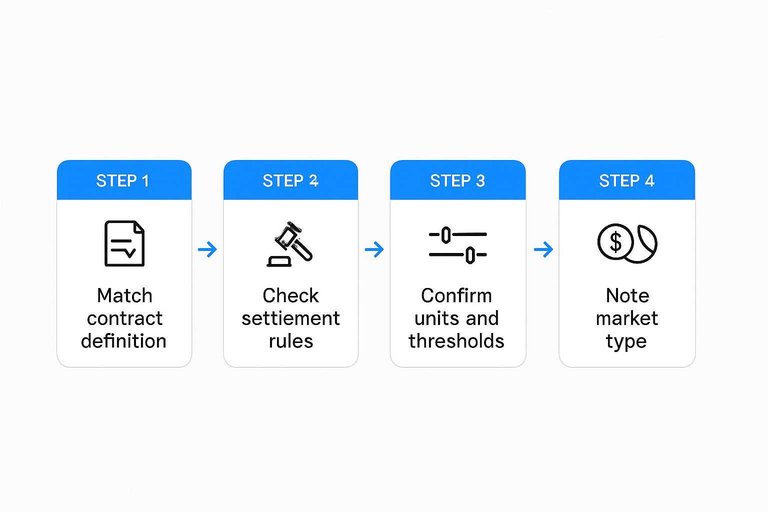
Check settlement rules
Settlement terms decide the weird cases, which is where bad comparisons hide. Read the rules for voids and delays like you’re looking for traps.
Common settlement checks:
- Postponed or suspended games
- Player doesn’t start or participate
- Overtime and shootouts
- Stat corrections and re-grades
- House rule for “official” results
A one-line settlement clause can flip a good “arb” into a loss. That’s the line that gets crossed. See an example of detailed sportsbook house rules covering voids, postponements, and resettlements.
Confirm units and thresholds
Lines must match exactly, or you’re comparing different probabilities.
- Write the line number and sign (e.g., -3.5, +120.5).
- Verify the unit (points, sets, rounds, yards, goals).
- Check push rules at whole numbers (win/lose vs win/push/lose).
- Confirm scope (player only, team only, full game, first half).
- Re-check rounding and minimums for props.
If pushes are possible on one platform and not the other, your “edge” is usually imaginary.
Note market type
A sportsbook price is usually odds on a graded outcome with a built-in margin. An exchange or binary market price often represents a tradable probability and may add fees separately.
If you can’t say what one unit returns and when it settles, you can’t compare the quotes. First translate both into the same payoff model.
Adjust for Fees
You’re not comparing odds. You’re comparing what lands in your account after every cut.
Use this quick fee check to convert headline odds into net expected payout.
| Fee type | Where it shows up | What to capture | Quick adjustment |
|---|---|---|---|
| Trading commission | Each matched trade | Percent per side | Apply on entry/exit |
| Spread / slippage | Bid–ask gap | Price difference | Use worse side |
| Withdrawal fee | Cashing out | Flat or percent | Subtract at end |
| Funding fee | Deposits / FX | Card, wire, FX | Include in bankroll |
If two markets look equal before fees, the cheaper one usually wins after them.
Compute Best Net Price
You can compare platforms in one pass if you convert everything into the same units. Your goal is simple: highest net payout for the same outcome, with the odds translated into implied probability.
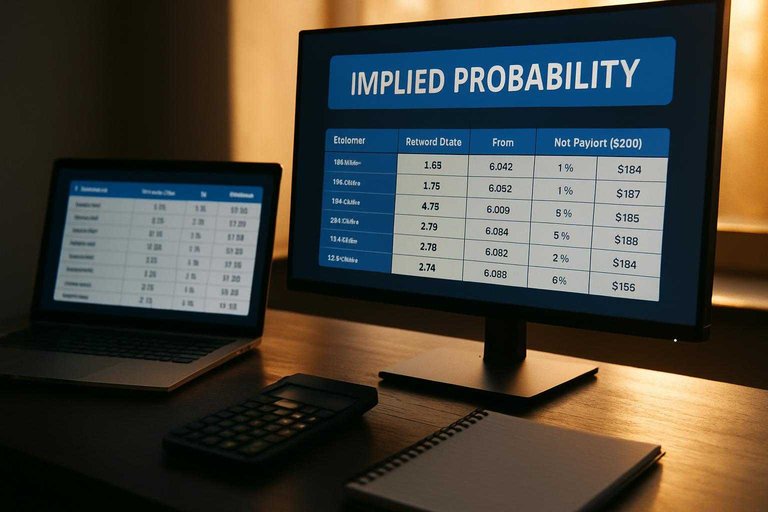
Create a mini grid
Use a grid so you stop doing mental math and start making clean decisions.
- List each platform as a row for the same exact outcome.
- Record the quoted price and convert to decimal odds.
- Compute implied probability: 1 ÷ decimal odds.
- Add all fees and frictions: spreads, commissions, withdrawal costs.
- Calculate net payout on a $100 stake after fees.
Once the grid is filled, the best option usually jumps out in seconds.
Compare like-for-like
Compare only identical outcomes, at the same market and settlement rules.
- Pick the highest net payout for that exact outcome.
- Prefer lower implied % for the same side.
- Note the cheapest opposing price for a hedge.
- Check limits that cap your stake.
If the hedge is cheap enough, you’re no longer choosing “confidence,” you’re choosing structure.
Flag timing effects
Your grid is a snapshot, and snapshots can lie when markets move.
A stale line can disappear mid-click, and a fast move can mean you’re late.
If odds are jumping, decide upfront: wait for a better print, split orders, or hit now.
That choice matters more than squeezing one extra tick.
Decide your action
Make the decision mechanical so you don’t negotiate with yourself in the moment.
- Place the bet if net payout meets your threshold.
- Place a hedge if the opposing price meets your hedge rule.
- Pass if timing, limits, or fees break your criteria.
- Log the grid and your choice for review.
The real edge is consistency: the same rules, every market, every time. If you need a refresher on the math, Smarkets’ guide to calculate implied probability is a clean reference.
Check Liquidity and Limits
Odds aren’t real until you can get filled. Before you compare markets, confirm the price survives your order size, the book has depth, and fills happen fast enough for your workflow. For a deeper look at where thin volume and market structure can create misleading signals, see sports prediction market odds limitations.
Subsections: [
{
“subheading”: “Test order size”,
“content”: “Start with a small order to see if the displayed price is executable. You’re testing slippage, partial fills, and how quickly the market responds.\n\n1. Place a tiny limit order at the displayed price.\n2. Watch whether it fills instantly, partially, or not at all.\n3. Increase size one notch and note the new fill price.\n4. Cancel any leftovers and record worst fill seen.\n5. Repeat on the other side of the market.\n\nIf a “great” price disappears on contact, it’s not a price. It’s a mirage.”,
“description”: “Attempt a small order to confirm the displayed price is real and to estimate slippage.”
},
{
“subheading”: “Review limits and depth”,
“content”: “<a href="https://marketsprediction.com/glossary/liquidity">Liquidity is a mix of venue rules and real depth. Check what you’re allowed to place and what the book can absorb.\n\n- Check maximum stake or share cap.\n- Scan available shares at top price.\n- Look two to five levels deep.\n- Note price jump at larger size.\n- Watch for frequent spread flicker.\n\nIf size forces you down the book, your “edge” was just shallow liquidity.”,
“description”: “Check max stake, available shares, and order book depth; note how price changes with size.”
},
{
“subheading”: “Plan execution”,
“content”: “Once you know the depth, choose an execution style that protects your price. The goal is boring fills, not heroic clicks.\n\nUse limit orders when you can, especially around news. Split larger orders into smaller clips, and route across venues when one book is thin.\n\nExecution is part of the bet. Treat it like one.”,
“description”: “Use limit orders where possible; split orders across venues when size would move the price.”
}
]
Calculate Implied Probability and Market Overround
Headline prices can look “better” simply because one market is priced with a wider spread. Converting each side into implied probability lets you compare sports prediction market odds on a like-for-like basis, and calculating the market overround (also called vig or spread) helps you spot which venue is pricing more efficiently.
At a high level:
- Implied probability translates an odds quote into the market’s estimated chance of that outcome.
- Overround measures how much the probabilities add up to above 100% (a built-in cushion). In a perfectly “fair” two-outcome market, the implied probabilities would sum to 100%. In real markets, they often sum to more than 100%.
Use this step after you’ve normalized formats and aligned the market terms, but before you decide which net price is truly best.
Implied probability formulas (decimal, American, and “yes/no” prices)
Pick the odds format you’re working in and convert to implied probability:
Decimal odds (D)
- Implied probability: p = 1 / D
American odds
- For positive odds (+A): p = 100 / (A + 100)
- For negative odds (-A): p = A / (A + 100) where A is the absolute value (e.g., -150 → A = 150)
Prediction market “Yes” price (Y) quoted per $1 payout (often shown as 0.00–1.00 or 0–100 cents)
- Implied probability is typically close to the quoted price: p ≈ Y (or Y/100 if quoted in cents)
Notes:
- Some venues use different contract specs (e.g., $1 payout vs another notional). Make sure the price you’re using is directly comparable to a $1 payout before treating it as probability.
- In two-outcome markets, you’ll usually have a Yes and No price. Converting both helps you see the spread directly.
How to compute overround (vig/spread)
Once you have implied probabilities for all mutually exclusive outcomes in the same market, add them up.
- Overround = (p1 + p2 + … + pn) − 1
For a common two-outcome market (Outcome A vs Outcome B):
- Convert each side’s odds to pA and pB
- Overround = (pA + pB) − 1
Interpretation:
- Lower overround generally means a tighter, more competitive market (better for bettors/traders).
- Higher overround means you’re paying more “spread” to get in/out, even if one headline price looks attractive.
Important nuance for prediction markets:
- In some order-book style markets, the “Yes” and “No” quotes you see may represent best available bids/asks, not a single fixed price. The effective overround depends on whether you’re crossing the spread (taking) or posting (making). Use the prices that match how you plan to execute.
Remove the overround to compare fair odds
To compare two venues fairly, you can normalize implied probabilities by removing the overround. This converts the market into a “fair” probability set that sums to 100%.
- Fair probability for outcome i:
pᶠᵃⁱʳᵢ = pᵢ / (p1 + p2 + … + pn)
Why this helps:
- If Venue A has a tighter spread than Venue B, its odds will often look better across the board. Normalizing lets you compare your target outcome’s price relative to that venue’s overall pricing, rather than being misled by a wider or narrower market.
Practical workflow:
- Convert each outcome’s odds to implied probability.
- Compute the sum of probabilities (the “book”).
- Divide each outcome probability by the sum to get fair probabilities.
- Compare fair probabilities across venues for the same outcome, then go back to the venue’s actual prices to decide where the best executable edge is.
Quick check: spot misleading “best price” situations
Use implied probability and overround as a fast sanity test before committing:
- If one site shows a noticeably better headline price for your side but has a much higher overround, the “value” may be illusory.
- If two venues have similar overrounds but one offers a materially lower implied probability (higher odds) on your outcome, that’s a stronger signal you’ve found the better deal.
This step is especially useful when comparing markets with different mechanics (AMM-style pricing vs order books), where raw quotes can be hard to interpret without a probability lens.
Make Your 15‑Minute Comparison Routine
- Pick one market, one timeframe, and one definition of “success,” then open your quick tools (converter + notes).
- Convert every quote to decimal and implied probability, and sanity-check favorites/underdogs for obvious errors.
- Verify you’re comparing the same contract: outcome definition, settlement rules, units/thresholds, and market type.
- Subtract fees to get net prices, then choose the best like-for-like net probability for your intended side.
- Validate execution: test your order size, review depth/limits, and decide whether to place now, split orders, or wait for better liquidity.
Frequently Asked Questions
- Are sports prediction market odds the same as sportsbook odds?
- No. Prediction markets price contracts based on market supply and demand, while sportsbooks set lines and bake in a house edge, so the same outcome can show different prices and implied probabilities.
- Do sports prediction market odds account for injuries and late-breaking news automatically?
- Often yes, but only as quickly as traders react and liquidity allows. Check the timestamp, recent trade history, and order book movement to see whether the market has actually repriced the news.
- How do I compare sports prediction market odds across platforms when contract rules differ?
- Don’t compare until you confirm each contract’s settlement source and resolution criteria (league rules, overtime/shootout handling, void conditions). If those don’t match, treat them as different markets and avoid “best price” conclusions.
- Can I use implied probability to find value in sports prediction market odds without a predictive model?
- Yes—start by comparing the market’s implied probability to a trusted baseline like a consensus sportsbook line (after removing vig) or an aggregate from multiple markets. If the market probability is meaningfully higher or lower than your baseline, that’s the spot to investigate.
- How often should I re-check sports prediction market odds before placing a trade?
- Re-check right before you submit and again if your order doesn’t fill quickly, because prices can move with new information and order flow. If you’re placing larger size, monitor for partial fills and widening spreads that change your effective price.