
 Best Platforms
 Live Odds








9 Implied Probability Calculator Errors That Misprice Your Bets
A practical troubleshooter for fixing implied probability calculator mistakes that skew your pricing—identify odds format mixups, American sign errors, decimal return-vs-profit confusion, fractional conversion pitfalls, and overround (vig) you forgot to remove.
If your implied probability math looks “right” but your bet pricing keeps feeling off, the issue is often the calculator—not the market. A single format toggle or sign mistake can turn a fair line into a phantom edge.
This troubleshooter helps you diagnose what went wrong fast. You’ll triage your setup, spot impossible outputs, and then fix the most common input errors across American, decimal, and fractional odds. You’ll also learn when you must de-vig (remove overround) so your probabilities reflect true prices, not the book’s margin.
Triage Your Calculator
Before you hunt for edge, confirm your calculator isn’t the problem. A tiny format mismatch can flip a “value bet” into a guaranteed overpay.
Confirm market format
Different odds formats look similar under pressure, and markets mix them more than you think.
- Check if the book shows decimal, American, or fractional.
- Verify every selection uses the same format.
- Match your calculator’s format setting to the market.
- Re-enter one line and confirm the odds display unchanged.
If format is wrong, every “probability” after that is fiction.
Sanity-check a favorite
Use a known, boring example to validate the math before trusting anything else.
- Enter -200 and confirm it returns about 66.7%.
- Enter 1.50 and confirm it returns about 66.7%.
- Flip to +200 and confirm it returns about 33.3%.
- If results differ, check format settings and sign entry.
One clean sanity check beats ten “maybe” value spots.
Spot impossible outputs
Some errors announce themselves if you know what can’t happen. Probability math has hard borders.
Anything below 0% or above 100% is a broken input, a broken tool, or both. Totals that explode when you sum all outcomes usually mean you mixed formats, missed a minus sign, or double-counted a selection.
Treat impossible outputs like a smoke alarm, not a rounding quirk.
Record your inputs
Reproduction beats memory when you’re debugging mispricing.
- Exact odds as shown
- Market and selection name
- Stake basis used
- Commission, fee, or vig
- Timestamp and source
If you can’t recreate the numbers, you can’t fix the leak.
Error 1: Odds Format Mixup
Odds calculators fail quietly when they guess the wrong format. The output still looks reasonable, so you trust it and price the bet wrong. This error usually starts with a tiny input detail.
Common mixup patterns
Most format mistakes look harmless at entry time. They become expensive when your calculator auto-interprets without telling you.
- Decimal entered as American odds
- Missing plus sign on positive American
- Fractional typed as decimal
- Commas and periods swapped
If the number “looks right” instantly, double-check harder.
Quick correction steps
Fix the format first, then calculate. Treat the conversion screen as part of the bet.
- Set the calculator to the intended odds format.
- Re-enter odds with correct signs and separators.
- Use the converter view before implied probability.
- Confirm the displayed equivalent odds look plausible.
If conversion looks off, probability will be off too.
Verification habit
Do one manual conversion on any new book, market, or tool. Pick a clean number and confirm the calculator matches your expectation. Then proceed.
You’re not checking math. You’re checking interpretation.
Error 2: Wrong American Sign
Reversing plus and minus on American odds breaks your implied probability at the source. One stray keystroke can turn a +180 dog into a -180 favorite, and your calculator will “prove” a bet you never actually found.
Symptoms to notice
A sign error usually looks like a reality glitch. Your outputs won’t just be a little off; they’ll be backwards.
Common tells:
- Underdogs show as heavy favorites
- Implied probabilities flip sides
- Payouts don’t match your bet slip
- Break-even looks “too easy”
Treat any upside-down result as a sign problem first, not a math problem.
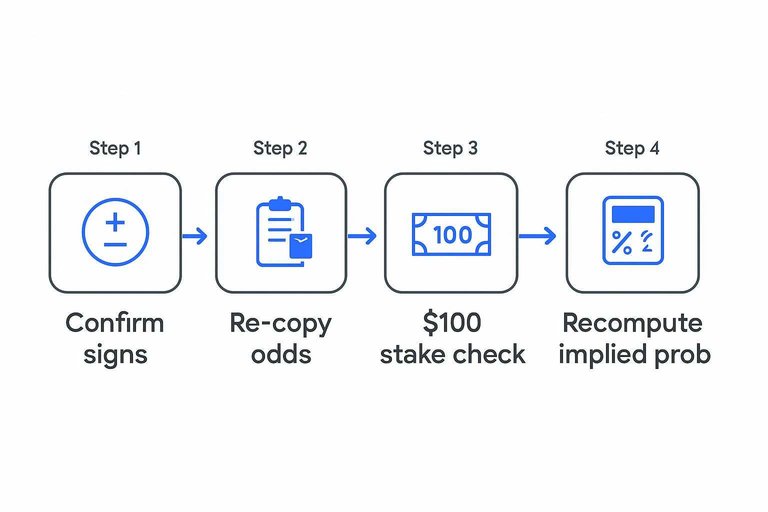
Sign-check routine
Do a fast sign audit before you trust any edge number.
- Confirm favorites display with a minus sign.
- Confirm underdogs display with a plus sign.
- Re-copy odds from the sportsbook, including the sign.
- Sanity-check with a $100 stake payout estimate.
- Recompute implied probability after the check.
If your $100 “win” math disagrees with the slip, the sign is wrong. (You can cross-check quickly with a sports betting odds calculator.
Prevent future sign errors
Most sign errors come from typing and retyping. Remove the chance to improvise.
- Copy-paste odds directly from the book
- Avoid manual entry whenever possible
- Store odds with “fav” or “dog” labels
- Keep the sign in every note
- Use one consistent odds format
Fix the workflow. The sign will stop “mysteriously” changing.
Error 3: Decimal Odds Misread
Decimal odds already include your stake in the return. Treat them as profit-only and you’ll misprice the bet fast.
Return vs profit
Decimal odds quote total return, not net profit. At 2.00, a 1-unit stake returns 2 units total, which is 1 unit profit.
If you treat 2.00 as “profit is 2,” you’ll compute probability from the wrong base. Your implied probability inflates, and any real edge looks smaller than it is.
That’s the line between a correct model and a silent tax on every decision.
Fix the input model
Use one formula for pricing, and a different one for profit math.
- Convert odds to implied probability with 1 / decimal.
- Keep stake included when comparing price to your true probability.
- Use (decimal - 1) only when you need net profit per unit.
- Label fields “decimal return” and “net profit” to prevent drift.
Fix the inputs once, and your edge stops disappearing in the spreadsheet.
Spot-check with 1.50
Run a quick sanity test with 1.50. Implied probability is 1 / 1.50 = 0.666…, or about 66.7%.
If your calculator says 50%, it’s treating 1.50 like “profit is 1.50” instead of “return is 1.50.”
One spot-check catches the most common decimal-odds failure before it costs you real money.
Error 4: Fractional Odds Confusion
Fractional odds are compact, but they are easy to flip, truncate, or reformat. One tiny entry mistake can turn a value bet into a mispriced bet.
Typical fractional pitfalls
Fractional odds look like simple math, so your brain “helps” in the wrong direction. Catch these before you trust any implied probability.
- Reversing numerator and denominator
- Dropping the “+1” in conversion
- Treating “5:2” as 5.2
- Entering fractions as plain division
- Rounding the fraction too early
If any of these happen, your calculator is fine. Your input is not.
Conversion steps
Use one clean path from fractional to probability. No shortcuts.
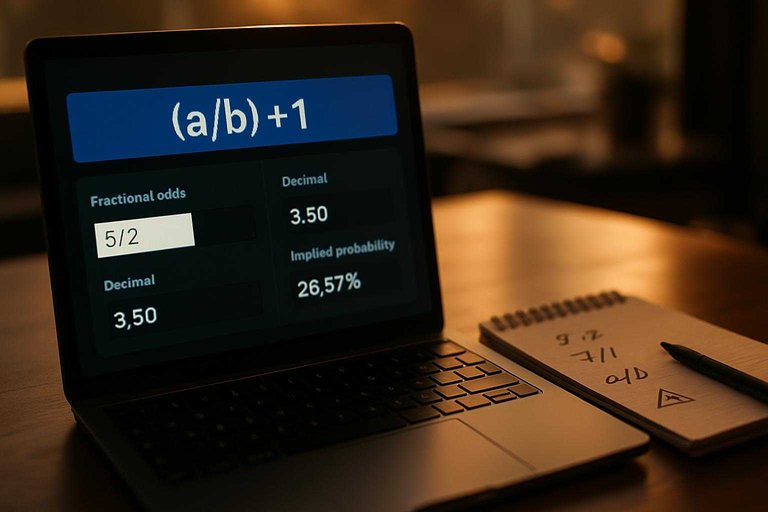
- Write the odds as a/b, not a:b.
- Convert to decimal: (a/b) + 1.
- Convert to implied probability: 1 / decimal.
- Convert to percent: probability × 100.
Once you standardize the path, mistakes stand out fast. (Here’s the standard fractional-to-decimal conversion in more detail.)
Consistency check
If your sportsbook shows both fractional and decimal, use it as a built-in validator. Convert your fraction to decimal, then compare it to the displayed decimal before calculating probability.
A mismatch means you swapped parts, dropped the +1, or misread the separator.
Error 5: Overround Ignored
Using raw implied probabilities treats the sportsbook’s price as the truth. It isn’t. The extra baked-in margin (the overround/vigorish) makes every outcome look more likely than reality, which is exactly how an implied probability calculator misprices bets even when you enter the odds correctly.
The fix is simple: don’t evaluate a market until you’ve removed the margin. If your “edge” disappears after de-vigging, it was never an edge.
Recognize margin signals
Most markets add up to more than 100% once you convert odds to implied probabilities. That gap over 100% is the book’s margin, and it quietly inflates every number.
A quick workflow:
- Convert each outcome’s odds into implied probability.
- Add them up.
- If the total is over 100% (often 102%, 105%, or higher), your calculator is showing vig-in probabilities.
Two common tells that you’re accidentally pricing with margin:
- Every side looks “too likely.” You can’t make the market sum to 100% without adjusting.
- Small “value” pops up everywhere. Especially on thin-edge bets, ignoring overround turns noise into fake EV.
De-vig method
You de-vig to back out the margin so you can compare apples to apples. Below are clear, current workflows for both two-way and multi-way markets.
Step 0 (always): convert odds to implied probabilities
- Decimal odds: (p = 1/\text{odds})
- American odds:
- Positive (+X): (p = 100/(X+100))
- Negative (-X): (p = X/(X+100))
Two-way markets (moneyline without draw, totals, spreads)
Workflow A: Proportional (simple normalization) — the default
- Compute implied probabilities (p_1) and (p_2).
- Sum: (S = p_1 + p_2).
- De-vig: (p’_1 = p_1/S), (p’_2 = p_2/S).
This is what many calculators mean by “remove vig.” It assumes the margin is distributed proportionally across outcomes.
Workflow B: Additive (equal margin per side) — useful when pricing feels symmetric
- Compute (p_1), (p_2) and (S = p_1 + p_2).
- Compute the excess: (m = S - 1).
- De-vig: (p’_1 = p_1 - m/2), (p’_2 = p_2 - m/2).
If the resulting probabilities fall outside ([0,1]), the assumption doesn’t fit that market/price—use proportional instead.
Three-way and multi-way markets (1X2, outrights, props with many outcomes)
Workflow: Proportional normalization (recommended)
- Compute each outcome’s implied probability (p_i).
- Sum all outcomes: (S = \sum_i p_i).
- De-vig each one: (p’_i = p_i/S).
This is the cleanest workflow for multi-way markets because it forces the set to sum to 100% without making extra assumptions about which outcomes “carry” more of the vig.
Practical checklist before you trust your numbers
- After de-vigging, the probabilities should sum to exactly 100% (allowing for rounding).
- Use de-vigged probabilities for EV, comparing books, modeling, and tracking line moves.
- Keep your calculator consistent: mixing vig-in probabilities from one book with de-vigged probabilities from another is a fast way to manufacture an “edge.”
If you can’t explain your edge after de-vig, you don’t have one. If you want a few quick drills, see implied probability calculator examples.
When de-vig matters
De-vig isn’t optional when the margin can decide the bet.
- Betting thin edges near fair price
- Pricing two-way markets where a few points of vig flips EV
- Pricing three-way or multi-way markets (draws, outrights, multi-outcome props)
- Comparing different sportsbooks (different margins, different shapes)
- Tracking line moves across markets without confusing “vig changes” for “opinion changes”
- Converting odds into “true” probabilities for models, hedges, or portfolio sizing
Do it first, then decide if the bet is real.
Run a 60-Second Final Check Before You Price Any Bet
- Confirm the market format (American/decimal/fractional) and match it in your calculator.
- Sanity-check one known price (a clear favorite) and verify the implied probability is plausible.
- Do a sign/definition check: American needs the correct +/−, decimals should be total return (not profit), fractionals should be consistent (A/B means profit on stake).
- Scan for impossible outputs (negative probabilities, >100%, or a book with “no margin”), then re-enter inputs exactly as shown.
- If the market is two-way or multi-way and the implied probabilities sum above 100%, de-vig first—then price your bet off the adjusted (fair) probabilities.
Frequently Asked Questions
- Is an implied probability calculator the same as an odds converter?
- Not exactly. An odds converter changes the display format (American/decimal/fractional), while an implied probability calculator converts odds into a probability percentage and may also include features like vig/overround removal.
- How do I check if an implied probability calculator is removing vig (overround) correctly?
- Verify it offers a “no-vig,” “fair odds,” or “normalize probabilities” option, then test it with a market that has multiple outcomes (like a 3-way soccer line) and confirm the adjusted probabilities sum to about 100%.
- Can an implied probability calculator tell me if a bet has value?
- Only if you supply your own estimated true probability (or fair odds). Compare your probability to the calculator’s implied probability from the book to see whether your edge is positive after accounting for vig.
- What inputs does an implied probability calculator need for parlays or accumulators?
- Use the decimal odds for each leg (or convert first), multiply them to get combined decimal odds, then convert that final decimal number to implied probability. For correlated legs, this method misprices the true probability because independence is assumed.
- Why does my implied probability calculator show probabilities over 100% when I enter multiple outcomes?
- That’s usually the sportsbook margin showing up in the raw implied probabilities. Remove vig/overround (or normalize the set) to get a fair 100% market view before comparing outcomes.