
 Best Platforms
 Live Odds








What Is the Michigan Primary and How Does It Work?
An explainer of Michigan’s primary election system and why it can feel confusing—how party rules intersect with state law, how candidates get on (or off) the ballot, how voting and tabulation work on Election Day, and how delegates are ultimately allocated (including split-rule scenarios).
Ever shown up to vote and wondered why the “primary” doesn’t seem like a single, simple election? In Michigan, the answer is that two systems run side by side: state-run election administration and party-run nomination rules.
This explainer walks you through what’s actually happening—from how candidates qualify and how ballots are chosen, to how votes are counted and when recounts kick in. You’ll also see how delegate math, thresholds, and last-minute rule shifts can change what the results mean.
Primary Power Map
Michigan’s primary is two things at once: a state-run election and a party-run gateway. You cast a ballot through the state, but parties decide how that vote converts into delegates and influence. A few rules around timing, ballot choice, and delegate allocation do most of the real work.
Two elections inside
Michigan runs primaries for president and for state and local offices, but they don’t behave the same. The presidential primary feeds a national nomination process, while other primaries mostly decide who reaches the general election. Different stakes invite different rules, and the calendar pressure is not equal.
For president, parties care about delegate allocation, threshold rules, and whether results bind delegates. For state and local races, the key mechanics are filing deadlines, district lines, and how many candidates advance. A crowded county race can turn on ballot placement and turnout pockets, while a presidential race turns on party math.
Track the office first. The rulebook changes with it.
Parties vs state
Some levers are owned by the parties, and others are owned by the state. Knowing who controls what tells you where outcomes can be negotiated.
- Set delegate allocation and thresholds
- Run conventions and internal rules
- Print ballots and assign precincts
- Count votes and certify results
Argue with the right referee, or you’ll lose by default.
Participation boundaries
Michigan functions like an open primary in practice because you can choose a party ballot at the polling place. You do not need to be a registered party member to vote in that party’s primary. The tradeoff is simple: you pick one party’s ballot for that election.
Your boundary is procedural, not ideological. You cannot vote in both parties’ primaries on the same day, and your ballot choice is recorded as part of the public election record. In party-registration states, the boundary is set earlier, and switching often requires paperwork or waiting.
In Michigan, the “commitment” is your ballot selection, not your membership card.
Where confusion starts
Most confusion comes from mixing processes that look similar on TV. The labels are close, but the power flows differently.
- Primary vote versus caucus meeting
- Primary result versus convention decision
- Turnout totals versus delegate math
- One ballot style versus another
If you can’t name the decision point, you can’t predict the outcome.
Ballot Access Mechanics
Getting on Michigan’s primary ballot is mostly procedural, until it isn’t. The edge cases are where deadlines, paperwork, and court orders start deciding outcomes.
Filing paths
Michigan gives candidates a few ways onto the primary ballot, depending on office and party rules. The differences show up in signatures, fees, and who does the certifying.
| Path | What you submit | Who reviews | Common failure point |
|---|---|---|---|
| Nominating petitions | Signature sheets | Election officials | Invalid signatures |
| Filing fee option | Fee and form | Election officials | Missed deadline |
| Party convention route | Party paperwork | Party committees | Internal party dispute |
| Unopposed filing | Basic filing form | Election officials | Eligibility mismatch |
When campaigns treat these as “just admin,” that’s when opponents find leverage.
For the official overview, see the state’s ballot access portal.
Challenge windows
Challenges are the pressure test for ballot access, and timing is the weapon. A valid claim filed late can still cause chaos.
- Identify the challenger: candidates, parties, and qualified voters may have standing.
- File within the statutory window tied to the filing deadline.
- Present evidence: signature validity, residency, eligibility, or form compliance.
- Get a ruling from the proper forum: election officials, a board, or a court.
- Implement the remedy: removal, reprinting, notices, or post-election handling.
Late rulings don’t just change ballots; they can change how recounts and certifications play out.

Withdrawal substitutions
Candidates can exit after filing, and sometimes after ballots are printed. Michigan’s replacement rules depend on the office, the party, and the point in the calendar when the vacancy happens.
If a candidate withdraws, dies, or becomes ineligible late, parties may be allowed to name a substitute through a designated committee process, or the ballot may proceed with notices and the votes treated under the applicable vacancy rules. The hard cases are when the withdrawal is timely for party action but too late for printing, or when eligibility is litigated while ballots are already in voters’ hands.
If you’re running a campaign, plan for the “ballots already out” scenario, not the clean one.
Name order quirks
Ballot order isn’t random in the way people assume, and Michigan uses rules that can rotate or vary order by jurisdiction. Those rules can interact with cues like incumbency labels or how a name is presented, which becomes meaningful when voters know little about the race.
In low-information contests, being first on the list can act like a tiny endorsement from the format itself, so campaigns watch order-setting events and litigation closely. When margins are thin, “boring” layout rules start looking like strategy.
Treat ballot order like a real variable, especially down-ballot.
Michigan’s candidate name rotation mechanics are laid out in the Election Officials Manual.
Voting Day Logistics
Voting in the Michigan primary is shaped by a few operational rules that affect how ballots get issued, processed, and reported. Know these rules and the election-night noise makes more sense.
Ballot style selection
In-person primary voting starts with one key choice: which party’s ballot you want. The poll book process is designed to record your selection without turning it into an interrogation.
Poll workers can ask you to choose a party ballot. They can’t ask why you chose it, how you’ll vote, or which candidates you support.
If you get the wrong ballot, tell a worker before you cast it. They can spoil it and issue a replacement so the scanner never counts the mistake.
Your real risk isn’t fraud. It’s a silent error that becomes final once the ballot is tabulated.
Absentee edge cases
Absentee voting is straightforward until something looks off. Then the rules decide whether you get a fix or a rejection.
- Signature missing or mismatch: cure process may apply
- ID verification issue: follow clerk instructions, resolve promptly
- Ballot arrives after deadline: not counted
- Ballot damaged or torn: request replacement ballot
- Inner/outer materials mismatch: reviewed under clerk procedures
Most absentee problems are solvable, but only before the legal deadline closes the door.
Tabulation pipeline
Results move through a chain of custody from precinct to county. Each link adds verification, and each link can add delay.
- Precinct scans ballots on tabulators and records totals.
- Memory devices and reports are secured and transported per procedure.
- County-level canvass reviews precinct returns and resolves discrepancies.
- Unofficial totals update as precincts report, then stabilize as late precincts finish.
If you want signal, watch the reporting completeness and canvass updates, not the first headline.
Recounts triggers
Recounts are driven by margins and process, not vibes. You usually need a close result, plus a formal petition filed under the election rules.
In practice, recounts rarely move statewide outcomes because the vote pool is large and errors tend to net out. Local primaries are different: fewer ballots, tighter margins, and small tabulation issues can matter.
Treat recount talk as a seriousness test. If there’s no eligible margin and no filed petition, it’s just noise.
Delegate Allocation Core
Michigan’s presidential primary isn’t just a popularity contest. It’s a rules-driven way to turn votes into delegates, with thresholds, district buckets, and rounding that can surprise you.
Imagine two candidates split the vote closely statewide. One can still come out ahead on delegates by clearing thresholds everywhere and winning the right districts.
Statewide thresholds
Parties usually set a viability threshold, often a percentage cutoff, for earning delegates statewide. That cutoff decides who gets counted in the delegate math and who gets ignored.
In proportional allocation, votes for non-viable candidates don’t vanish politically, but they don’t earn delegates. The viable candidates then split the delegate pool using only the viable vote totals, which effectively “redistributes” the delegate shares upward.
A small candidate missing the threshold can be the hidden reason the leaders’ delegate shares jump.
The Democratic rules are spelled out in the Michigan Delegate Selection Plan.
District delegates
District-level delegates can make a “narrow win in the right places” beat a bigger statewide margin. That’s because delegates are awarded in separate buckets by congressional district.
- Win big in a few districts, bank delegates early
- Lose narrowly statewide, still win delegate-rich districts
- Target media buys where district margins are movable
- Build turnout operations around favorable districts
If your map is strong, you can lose the headline and win the math.
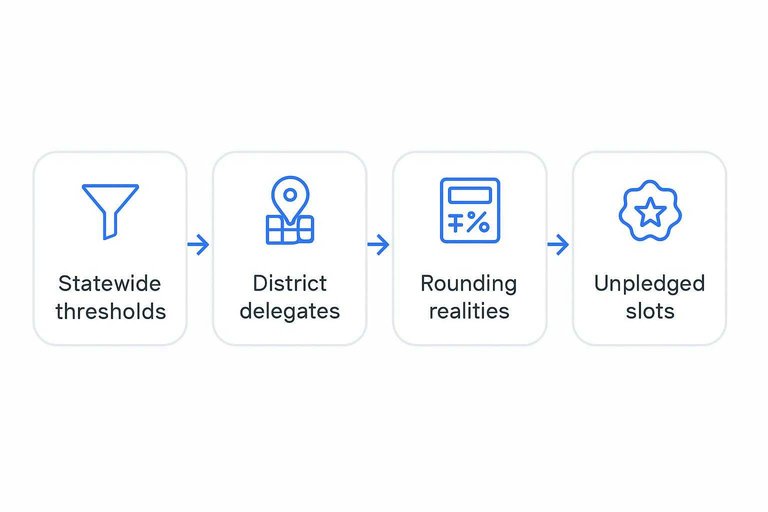
Rounding realities
Delegates come in whole numbers, but vote shares don’t. So the rules need rounding, and rounding creates cliffs.
Some systems use largest remainders, others use rounding to nearest, and many add tie-breakers like comparing raw vote totals. When two candidates sit near a rounding boundary, a tiny vote shift can flip the last delegate in a district or statewide pool.
That’s why campaigns obsess over “one more delegate” districts, not just one more percent.
Unpledged slots
Automatic or unpledged delegates are not awarded by primary vote totals. They exist under party rules and can have different freedom to support candidates.
- Sometimes free to choose at the convention
- Sometimes expected to follow party signals
- Sometimes irrelevant in lopsided races
- Most visible in close delegate counts
They matter most when the pledged math is tight and every convention vote becomes leverage.
Split-Rule Scenarios
Michigan’s primary can stay simple until someone changes the rules. When dates move or parties run parallel contests, the real fight shifts to recognition and enforcement.
National committees and courts don’t “run” the election. They decide which outcomes count, and under what conditions.
Date penalties
National parties set a calendar, then punish states that jump the line. The tool is delegates, because delegates are the currency of nomination power.
A state party can accept penalties to keep an early spotlight. Or it can comply to protect its delegation’s clout.
Compliance is rarely moral. It’s a negotiation over leverage.
Dual contests
Parallel processes happen when one side distrusts the other’s rules or timing. The failure modes are predictable.
- Produce conflicting winners and narratives
- Split activists, money, and media attention
- Confuse voters on where to participate
- Trigger challenges over which contest “counts”
- Undercut legitimacy for the nominee
If two pipes feed one nomination, someone has to choose which pipe is real.
Certification conflicts
State officials certify election results under state law. Parties can still decide that a certified result won’t translate into delegates.
That gap shows up when party rules require different eligibility, timing, or allocation methods than the state used. Deadlines then compress everything, because challenges and re-rules must finish before credentials are locked.
When the clock runs out, “right” matters less than “final.”
Rules changing late
Late rule changes don’t just tweak strategy. They change who can win delegates.
- Confirm the qualifying threshold for delegates, statewide and by district.
- Recheck district weights and any bonus or penalty allocations.
- Verify ballot access rules, including filing and substitution deadlines.
- Identify the actual delegate selection method and who votes in it.
- Read the challenge process and its deadline, not just the rule text.
When rules move, treat every assumption as broken until you re-verify it.
How Traders Should Read Michigan Primary Prediction Markets
If you’re trading a Michigan primary market (winner, margin, delegates, or “qualifies” style contracts), the election mechanics above matter because prediction markets settle on specific rules, timestamps, and data sources—and those can differ by platform. Michigan’s combination of party-specific rules, delegate thresholds, and reporting timelines creates avoidable pricing errors when traders compare odds across apps.
Use this section as a checklist for translating “how the primary works” into “what the contract is actually paying on.”
Calendar risk: when price moves are about the clock, not the vote
Primary markets often reprice around deadlines rather than new information about voter preference. For Michigan, pay attention to:
- Ballot and party deadlines (candidate qualification, withdrawals, substitutions): markets can gap when a status change becomes official, even if it was rumored earlier.
- Early/absentee voting windows: once votes are already cast, “late-breaking momentum” narratives may have less impact than traders assume.
- Election-night reporting: prices can swing on partial returns, and different counties can report at different times.
Trading implication: before you compare odds across platforms, align your view of what time risk you’re taking (deadline risk vs. election-night risk) with the contract’s trading hours and settlement window.
Rule-change risk: party rules and state procedures can shift the target
Many Michigan-primary outcomes depend on rules that aren’t “vote totals = winner.” Delegate allocation methods, thresholds, and eligibility rules can change how a market should be interpreted.
What to verify in each contract:
- What outcome is being priced: statewide winner, district winner, delegate count, “wins the nomination,” or “wins Michigan.” These can diverge.
- Which party’s rules apply: Democratic vs. Republican processes can differ, and markets sometimes mix voter-facing language (“wins Michigan”) with delegate-facing settlement (“most delegates”).
- Contingencies: recounts, challenges, disqualifications, or party decisions can alter what “wins” means.
Trading implication: if two platforms show different implied odds, it may be contract-definition drift, not a mispricing. Treat “same headline” markets as non-comparable until you’ve matched the settlement definition line-by-line.
Reporting lags: unofficial results vs. certified results
Michigan results typically arrive in stages: media projections, unofficial tabulation, then certification. Prediction markets don’t all settle at the same point in that pipeline.
Before you trade, check:
- Settlement source (state election site, certified canvass, named media org, or a platform’s internal determination).
- Settlement timing (immediate on projection vs. after certification).
- What happens if results change (e.g., recount alters totals after an initial call).
Trading implication: a contract that settles on certification can trade “cheap” during election night because it embeds duration risk (capital tied up) and reversal risk (a call changing). Don’t compare it directly to a contract that settles on a projection.
Market structure: liquidity, limits, and how to compare prices across platforms
Even with identical rules, market structure can make one venue look “better priced” than another.
Key structure checks when shopping Michigan primary odds:
- Liquidity and slippage: low-liquidity order books can show sharp implied odds that disappear at small size.
- Volume vs. depth: high recent volume doesn’t always mean you can enter/exit without moving the price.
- Fees, spreads, and settlement mechanics: these change the true expected return even when headline odds match.
- Contract granularity: one platform may list a single winner market while another splits by party, district, or margin—fragmenting liquidity and affecting price discovery.
Trading implication: when comparing odds, use a “tradeable price” mindset: what price can I actually get for my size, and what price can I get out at? If you can’t size in or out without moving the market, the best-looking implied odds may be illusory.
A fast pre-trade checklist for Michigan primary markets
Before placing a trade, confirm:
- Outcome definition: popular vote, delegate win, or nomination step.
- Scope: statewide vs. district vs. party-specific.
- Settlement source and timing: projection, unofficial results, or certification.
- Edge drivers: deadline events (ballot changes) vs. vote-count updates.
- Execution reality: liquidity, spread, and exit path.
If any of these are unclear, treat the position as a rules-and-settlement bet—not just an election forecast.
Use This Mental Model Before You Follow the Results
- Separate the layers: Michigan runs the election logistics, but parties define what the primary means for nomination and delegates.
- Check ballot access details: Filing, challenges, and substitutions can change who appears—and in what order—before voters ever cast a ballot.
- Understand the voting pipeline: Ballot selection rules, absentee edge cases, tabulation steps, and recount triggers affect when results are final.
- Read delegate math carefully: Thresholds, district-by-district allocation, rounding, and unpledged slots can make “winning the vote” differ from “winning delegates.”
- Watch for split-rule scenarios: Dates, penalties, dual contests, certification disputes, and late rule changes can reshape how outcomes are counted and reported.
Frequently Asked Questions
- Is the Michigan primary the same thing as the Michigan caucus?
- No. The Michigan primary is a state-run election where voters cast ballots, while a caucus is a party-run meeting process that can be scheduled separately and follow different rules.
- Do I have to be registered with a party to vote in the Michigan primary?
- No—Michigan does not require party registration. You choose which party’s primary ballot to vote when you’re issued a ballot (and you can only vote one party’s ballot).
- Can I vote in the Michigan primary if I’m an independent or a first-time voter?
- Yes. If you’re eligible and registered (or register where permitted), you can vote in the Michigan primary and select either party’s ballot regardless of whether you consider yourself independent.
- How can I check my Michigan primary polling place, registration status, and absentee ballot status?
- Use the Michigan Voter Information Center (MVIC) to look up your registration, polling location, and absentee ballot tracking. Your local city or township clerk can also confirm status and deadlines.
- How long does it take for Michigan primary results to be finalized and certified?
- Unofficial results usually come in on election night as precincts report, but final certification takes longer as absentee ballots are verified and canvassed. Check the Michigan Department of State and your county clerk for the official certification timeline and updates.