
 Best Platforms
 Live Odds








What Is the Michigan Senate Primary and How Does It Work?
An explainer to understand the Michigan Senate primary and how it works—primary vs. general election basics, who can vote in Michigan’s open primary, what appears on the ballot (including write-ins), how winners are determined and certified, and the voting methods you can use to cast your ballot.

If you’ve ever looked at a Michigan primary ballot and wondered why you’re picking between candidates within a party—not between parties—you’re not alone. Primaries can feel like an extra election with unfamiliar rules.
This explainer walks you through what the Michigan Senate primary is for, who’s eligible to vote and how party choice works, what races and candidate names you’ll see on the ballot, how winners are decided (and what happens in rare edge cases), and the main ways you can vote.
Why This Primary Exists
Michigan’s U.S. Senate primary is the election where voters pick each party’s nominee for the U.S. Senate. Parties use primaries to choose one standard-bearer for November, instead of letting insiders decide.
A primary is about nomination. The general election is about who actually gets the job.
Primary vs general
A primary decides who represents a party on the November ballot. The general election decides which nominee becomes Michigan’s U.S. Senator.
Think of the primary as the tryout. November is the championship game.
Why parties run them
Parties use primaries to pick one nominee, and they do it for specific reasons.
- Signal legitimacy through broad participation
- Gather voter input on direction and priorities
- Narrow the field before November
- Test candidates under real scrutiny
- Build early campaign infrastructure
The tradeoff is real: primaries can reward factions, and low turnout can pick the nominee.
Michigan’s role
Michigan runs the election, even though the result picks party nominees. The rules, ballots, and counting happen under state election law, not a party-run caucus.
That setup makes the process more uniform. It also makes the state the referee.
What voters decide
On primary day, you’re choosing a party’s U.S. Senate nominee. You are not ranking candidates, and you are not allocating delegates like a presidential contest.
Your vote is a straight pick: which name wins your party’s line in November.
Who Can Vote
Michigan runs an open primary, so you do not register by party to participate. You still must meet the basic voter eligibility rules, and you must choose one party’s ballot when you vote.
Eligibility baseline
You can vote in the Michigan Senate primary if you meet the same baseline requirements as any other Michigan election. Your ballot depends on eligibility, registration status, and voting method.
In practice, that means:
- You are a U.S. citizen.
- You meet Michigan’s age requirement by Election Day.
- You are a Michigan resident at the address you register.
- You are registered to vote by the required deadline.
If your registration is not active, fix that first. Everything else follows.
Open primary mechanics
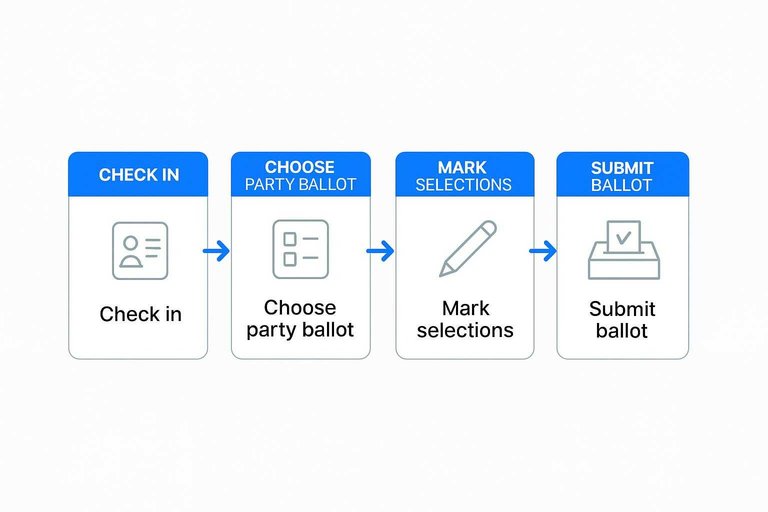
Michigan’s primary is “open” because you choose a party ballot when you vote, not when you register. That choice controls which primary contests you can participate in.
- Check in and receive the ballot options available for that primary.
- Choose one party’s ballot to vote that party’s primary contests.
- Mark selections only on that one ballot.
- Submit your ballot like any other vote.
Pick one. Split-ticket primary voting across parties is the line that gets crossed.
Party choice effects
Choosing a party ballot in the primary does not mean you “joined” that party. It is a one-election choice about which primary you want to participate in.
Your choice can still have practical effects. For example, your ballot selection may be recorded in election records, and some political outreach may infer your interests from it.
Decide based on the race you want to shape, not on fear of a permanent label.
Unaffiliated voters
If you consider yourself independent, Michigan’s primary still gives you a path to participate. You just have to pick which party’s nomination fight you want to influence.
- Pick a Democratic ballot and vote those primaries only.
- Pick a Republican ballot and vote those primaries only.
- Vote down-ballot primaries only on your chosen ballot.
- Skip contests you do not want to decide.
Your power is real, but it’s scoped. One ballot sets your lane for that election.
What’s On The Ballot
Michigan’s Senate primary ballot usually mixes one big headline race with several smaller ones. You’ll see separate party choices, plus other contests that share the same sheet and the same attention.
Senate contest basics
The Michigan Senate primary is for the U.S. Senate, a six-year term in Washington. You vote inside your party’s contest, not against the other party’s candidates.
In a typical primary, the Democratic field appears on the Democratic ballot and the Republican field appears on the Republican ballot. If other parties hold primaries, they appear on their own ballots too.
Your primary vote picks a nominee, not the senator.
Multiple races together
A primary ballot rarely contains only the U.S. Senate race. It bundles several contests because election administration runs on one election date and one ballot style.
You might see U.S. House contests, state offices, county-level positions, local proposals, and nonpartisan items in the same election. Some races are “vote for one,” while others ask you to pick multiple seats or decide a yes-no question.
If the ballot is long, the down-ballot races compete with the Senate race for your focus.
Candidate qualification
Candidates don’t appear on the ballot by vibe. They have to meet filing rules that election officials can verify.
- File the required paperwork by the deadline.
- Submit required signatures and/or pay any required fee, if applicable.
- Provide required disclosures and eligibility information, as required by law.
- Undergo review by election officials for completeness and compliance.
- Resolve challenges or errors, if a process allows corrections.
If you’re scanning a ballot, that qualification pipeline is why the list is finite.
Write-in rules
Write-ins can matter, but only when they follow the rules for that election.
- Count only for eligible offices on that ballot.
- Require the voter to mark the write-in target correctly.
- Often require the candidate to file write-in paperwork ahead of time.
- Must match the candidate’s filed name closely enough to identify them.
If you plan a write-in, verify the filing status first, not after Election Day.
How Winners Are Chosen
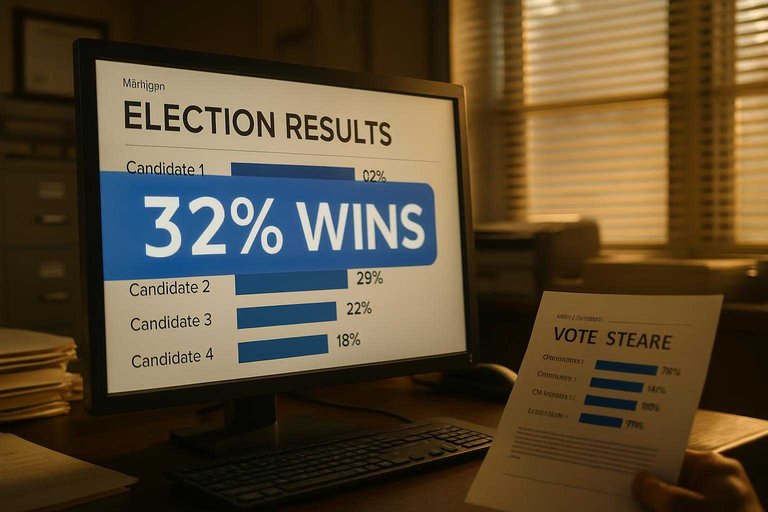
Michigan Senate primaries pick each party’s nominee using a simple rule: the most votes wins. That’s plurality, not “must clear 50%,” which is why crowded fields can produce winners with less than a majority.
Plurality is common in U.S. primaries because it’s fast, decisive, and fits tight election calendars. If you want to predict outcomes, watch how many candidates are in the lane you care about.
Plurality explained
Plurality means you win by getting more votes than anyone else. You don’t need a majority.
Imagine four candidates split the vote: 32%, 28%, 22%, 18%. The 32% candidate wins because they finished first.
In a multi-candidate field, similar candidates can split support and hand victory to the best-organized rival.
No runoff norm
Michigan primaries usually stick with one election per party contest. Runoffs are rare because they add friction.
- Adds a second statewide election cost
- Compresses deadlines before November
- Creates ballot-printing and staffing strain
- Risks lower turnout in the runoff
- Complicates recount and audit windows
So the real “runoff” is often the campaign before Election Day, when candidates try to clear the field.
Ties and edge cases
Very close races can trigger recounts, but the goal stays the same: confirm the true plurality leader. The state also has procedures for rare ties, plus a formal certification process before results become final.
If your margin is tiny, the fight shifts from persuasion to process.
Certification pipeline
Results move from fast unofficial reporting to slower official sign-off. Each step narrows uncertainty.
- Counties report unofficial election-night totals as ballots are tabulated.
- Local officials complete post-election checks and finalize returns.
- County and state canvass boards review and canvass the results.
- The state certifies the outcome and names each party’s nominee.
- Nominees are placed on the general-election ballot.
If you’re tracking a tight primary, certification dates matter more than cable-news calls.
Voting Methods
Michigan’s Senate primary gives you a few practical ways to cast a ballot. Each method uses different checks to confirm you’re eligible and your ballot is accepted.
| Voting method | How you cast it | Main verification | Common pitfall |
|---|---|---|---|
| In-person (Election Day) | At polling place | ID check or affidavit | Wrong precinct |
| Early in-person | At clerk site | ID check or affidavit | Missing hours |
| Absentee by mail | Mail return envelope | Signature match | Late postmark/arrival |
| Absentee drop box | Secure drop box | Signature match | Unsigned envelope |
Pick the method you can execute cleanly, because most problems are process mistakes, not politics.
How Michigan Senate Primary Results Map to Prediction Markets
For traders, the Michigan Senate primary isn’t just an election procedure—it’s an event that can be expressed as a set of clear, tradable “yes/no” questions with specific settlement rules. The key is to understand what the market is actually asking (primary winner vs. nominee vs. general-election winner), what counts as the official source, and how to read prices in terms of probability and tradability.
Most election markets around the michigan senate primary fall into a few repeatable templates. Before trading, open the market details and confirm the exact wording and resolution criteria—two markets can sound similar but settle differently.
Common market questions you’ll see
A Michigan Senate primary can be represented in markets in several ways, including:
-
“Will Candidate X win the Democratic/Republican primary?”
Typically resolves to Yes if that candidate is the party’s certified primary winner (i.e., the nominee), and No otherwise. -
“Who will win the Democratic/Republican primary?” (multi-outcome)
These markets list multiple candidates as separate outcomes; only the certified winner settles as the winning outcome. -
“Will Candidate X be the party’s nominee for U.S. Senate in Michigan?”
This often tracks the primary, but read carefully: it may also incorporate contingencies like withdrawals, disqualifications, or replacement nominees depending on the platform’s rules. -
“Will there be a recount/contest?” or “Will the margin be within X?”
These are less common and are highly dependent on the platform’s definition and official reporting source.
What matters most is whether the market is tied to primary results (party nomination) or something broader (e.g., general election winner). Don’t assume—verify the settlement language.
How to interpret odds as implied probability
Most prediction markets express prices as a probability-like number. In simple “Yes/No” markets:
- A Yes price can be read as the market’s rough implied probability that the event happens, after fees and frictions.
- The corresponding No side reflects the opposite outcome, but the two sides won’t always add to exactly 100% once you account for fees, spreads, and market microstructure.
Two practical takeaways:
- Compare the same question across platforms before treating a price as “the” probability—different platforms can diverge because of different trader bases, fee models, and liquidity.
- Treat odds as tradable prices, not pure forecasts. A market can be directionally right while still offering a poor trade if spreads are wide or liquidity is thin.
Liquidity vs. volume: what they tell you (and what they don’t)
Traders often mix up liquidity and volume, but they answer different questions:
- Liquidity is about how easily you can enter/exit at reasonable prices. Higher liquidity generally means tighter spreads and less price impact for larger orders.
- Volume is about how much has traded over a time window. High volume can signal attention and information flow, but it doesn’t guarantee you can get filled at the displayed price right now.
How to use both:
- If you plan to trade size or react to fast-moving news, prioritize liquidity (and check the bid/ask depth if the platform shows it).
- If you’re scouting where the crowd is paying attention, volume helps identify which primary markets are actively being debated and repriced.
Also watch for “headline” volume spikes that occur around major news updates—those can coincide with wider spreads and sharper short-term moves.
Reading spreads, order books, and fill risk
Even when two platforms show the same implied probability, the trade may not be equivalent.
- Spread (difference between best buy and best sell): A wide spread is an immediate cost to get in and out.
- Depth: Thin depth means your order can move the price quickly (slippage).
- Fill risk: In thin markets you may not get filled, or you may have to accept a worse price.
Practical workflow:
- Identify the exact question (primary winner vs. nominee vs. general).
- Check whether the market is actively quoting both sides (not just a last-trade price).
- Size positions with slippage in mind—especially close to election night or during fast updates.
Settlement basics and the “official result” problem
Primary markets typically resolve on an officially certified outcome rather than early media calls. That gap between “projected winner” and “certified winner” is where many misunderstandings come from.
Before trading, look for:
- The resolution source (e.g., a specific government authority, official canvass/certification, or a defined reputable publication—varies by platform).
- Whether the market settles on the winner at certification, not at the time of concession, projection, or preliminary count.
- How the platform handles edge cases like candidate withdrawal, disqualification, replacement nominees, or delayed certification.
If the market’s settlement language is ambiguous, treat that ambiguity as risk—because it is.
Cast a Confident Primary Vote
- Confirm you’re eligible and registered, then decide which party’s primary you want to participate in—your choice determines which Senate candidates appear on your ballot.
- Review what’s on the ballot ahead of time (Senate plus other races), including any write-in rules that apply in your precinct.
- Remember how the outcome is decided: Michigan primaries generally use a simple plurality with no runoff, followed by official canvass and certification.
- Pick the voting method that fits your situation (in-person, absentee, etc.), and follow the ballot instructions closely so your vote counts as intended.
Frequently Asked Questions
- When is the Michigan Senate primary election, and where do I find my exact polling hours?
- The Michigan Senate primary date is set on the state’s election calendar for that cycle. Check the Michigan Voter Information Center (MVIC) to see your polling place, hours, and any local details tied to your address.
- Can I vote in the Michigan Senate primary if I don’t belong to a political party?
- Yes. Michigan uses an open primary, so you can participate without party registration by selecting one party’s ballot at the polls (or requesting that party’s ballot when voting absentee).
- If I choose a party ballot in the Michigan Senate primary, does that make me a member of that party?
- No. Selecting a party ballot only applies to that primary election and does not register you with a party in Michigan.
- What happens if there’s a tie in the Michigan Senate primary?
- A tie is rare, but it’s resolved using procedures in Michigan election law—typically a recount process and, if still tied, a formal tie-breaking method administered by election officials.
- How do I verify my Michigan Senate primary ballot was received and counted if I vote absentee?
- Use the Michigan Voter Information Center (MVIC) to track your absentee ballot status, including when it was sent, received, and whether it was accepted for counting.