
 Best Platforms
 Live Odds








What Is a Presidential Nominee? For Beginners
This beginner explainer clears up what “presidential nominee” actually means in U.S. politics — the party nominee vs an appointment nominee, candidate vs nominee, the delegate-and-convention path, when the nomination becomes official, why a nominee isn’t president, and what happens if the nominee changes.

You keep seeing “presidential nominee” in headlines and market labels, and it sounds like it should mean “the person running for president.” But the same phrase is also used for something completely different in government.
If you take it literally, you can misread news updates, misunderstand when a race is actually decided, and place a trade on the wrong interpretation. This explainer gives you a quick context test for which meaning is intended, then walks through how a party pick becomes official, what “presumptive” means, and what changes if the nominee drops out.
Two meanings, fast
Party nominee meaning
In election coverage, a presidential nominee usually means the political party’s official pick for president, chosen at the party’s national convention. USAGov describes the typical path as winning a majority of convention votes via delegates—party-selected representatives who vote at the convention—earned through primaries and caucuses. One quick headline test: if you see “primaries,” “caucuses,” “delegates,” or “convention,” you’re in the party-nominee meaning.
This is also why wording gets slippery: the Associated Press says it holds “nominee” for when convention delegates formally vote, and uses “presumptive nominee” earlier when counts show a candidate has enough support to win.
Appointment nominee meaning
In government staffing stories, presidential nominee can mean something completely different: the President’s nomination—the president’s selection of a person for an executive or judicial office that requires Senate confirmation. Here the context test is even simpler: if the label sits next to “Senate,” “confirmation,” “judge,” or “cabinet,” it’s about an appointment, not the election.
Same phrase, two systems. Anchor it to the event being described: party convention vote versus Senate confirmation process.
How parties get there
Primary season mainly allocates convention delegates—party-selected representatives who cast votes at the party’s national convention for president/vice president and other party business—so the convention vote (not a primary-night headline) is what produces a party’s presidential nominee.
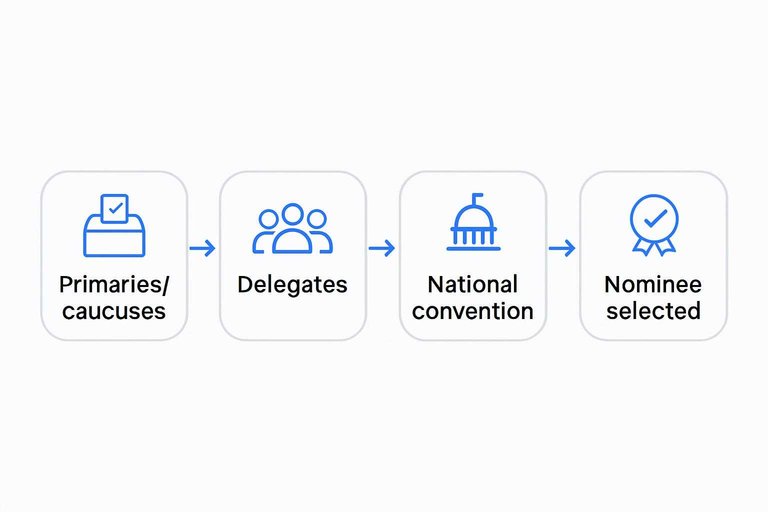
Primaries/caucuses → delegates → convention
In most coverage, the translation is: primary and caucus results determine how many delegates each candidate gets, and then those delegates vote at the national convention—a national party meeting where delegates vote and the party’s nominee for president and vice president is officially selected.
Technically, that’s why you’ll sometimes hear a civics stickler say “voters pick delegates, delegates pick the nominee.” The Election Assistance Commission describes primaries and caucuses as the process of selecting delegates to the national convention, where the party formally chooses its nominee.
Not all delegates are the same. A pledged (or bound) delegate is a delegate whose convention vote is tied—by party rules and/or state law—to a primary or caucus result, at least for some initial ballot(s). An automatic delegate / superdelegate is a delegate position assigned by party rules (often party leaders/elected officials) that may have different voting rules than pledged delegates.
The headline threshold to watch is “a majority of delegates.” For example, the Republican Party’s rules say the convention chair declares the nominee once a candidate receives a majority of the votes entitled to be cast; if nobody has a majority, the roll call is repeated until someone does. And before a name can even be presented for nomination at the Republican convention, that candidate must show plurality support from delegates in five or more states.
Candidate vs nominee
“Candidate” and “nominee” sound interchangeable, but they’re triggered by different rulebooks. Under Federal Election Commission rules, someone becomes a federal “candidate” for registration purposes once they raise or spend $5,000—which can happen long before any convention vote. A party “nominee,” by contrast, is a status created inside the party’s convention process, where delegates vote and a majority is the number that matters.
Primaries/caucuses → delegates → convention
In most coverage, the translation is: primary and caucus results determine how many delegates each candidate gets, and then those delegates vote at the national convention—where the party officially selects its ticket. Delegate types matter (pledged vs automatic), but the headline number to track is whether someone has a majority of delegates.
Candidate vs nominee
FEC “candidate” status is a campaign-finance threshold ($5,000 raised or spent). Party “nominee” status comes from the convention’s delegate vote under party rules.
When it becomes official
A party’s presidential nominee is created by a convention vote and the chair’s declaration—not by a primary-night projection.
On the convention floor, the process turns into a formal tally. Candidates are placed in nomination, and there are rules that keep even the “ceremony” tightly bounded—for example, Republican convention rules cap the total time for nominating and seconding speeches for any candidate for president or vice president at 15 minutes. Then comes the roll call vote—a formal vote where each state and territory delegation announces and records its votes, often in a set order, used for nominations at conventions. Those announced numbers are added up in real time.
What makes the moment “official” is the majority requirement plus the chair’s declaration. A candidate has to receive a majority of the votes the convention is entitled to cast, and the convention chair announces the result. That declaration is the switch-flip from “still a contest” to “the party’s nominee.”
That’s also why “presumptive” is not “nominee.” A presumptive nominee is a media label for the candidate projected to become the nominee based on delegate counts, before the convention’s formal vote. It’s a strong signal, but it’s not the same thing as the convention actually recording and certifying the votes.
If no one has a majority heading in, you can get a brokered/contested convention—a convention where no candidate has a delegate majority going in, so multiple rounds of voting may be required to pick the nominee. Party rules can matter a lot in that scenario: the Democratic Party’s 2020 convention call, for instance, specifies that on the first ballot only pledged delegates vote unless a candidate has been certified as having enough pledged delegates to equal a majority of all pledged and automatic delegates; if the contest goes beyond the first ballot, pledged and automatic delegates can vote on subsequent ballots.
That’s why coverage can sound inconsistent: some outlets treat a delegate-count projection as the finish line, while others reserve “nominee” for the roll call vote and the chair’s declaration.
Nominee isn’t president
A presidential nominee is your party’s pick, not the person who will take office. Nomination answers “who is this party running?” The election answers “who actually wins?”—and those are separated by more steps than the word “nominee” makes it sound.
After a convention, the nominee still has to get onto actual ballots. Ballot access is handled through state-run election administration, so the paperwork and timelines are handled state by state, not by the party convention.
Then comes the Electoral College—the system where states appoint electors (the people who cast the formal votes for president). The National Archives describes two key documents in that process: a Certificate of Ascertainment (a state document naming who the electors are) and a Certificate of Vote (the electors’ signed record of their votes). States must issue and send Certificates of Ascertainment 6 calendar days before electors meet, and electors execute 6 Certificates of Vote.
So when you see “nominee” in news or on MarketsPrediction, read it as “party’s chosen candidate,” not “elected president.”

If the nominee changes
A late change is real, and it isn’t handled by the Constitution. The U.S. Senate notes the Constitution has no provision for nominating presidential candidates in the first place, because the framers didn’t anticipate political parties—so the parties’ own rules govern what happens next.
If a Democratic nominee for president or vice president dies, resigns, or becomes disabled after the convention adjourns, the Democratic National Committee (the party’s national governing body between conventions) is authorized to fill the vacancy, after the DNC Chair confers with Democratic congressional leadership and the Democratic Governors Association.
Republican rules (Rule 9) authorize the Republican National Committee to fill a vacancy caused by “death, declination, or otherwise,” or to reconvene the convention. RNC members vote by state, and the replacement needs a majority of votes cast.
So when you see “nominee replaced,” look for which committee is actually empowered to vote.
Anchor “nominee” to the event
“Presidential nominee” isn’t a single thing you can take literally: first decide whether the story is about a party’s convention pick or the President’s Senate-confirmation pick, using the surrounding words as your tell. In election coverage, the label becomes real at the national convention—when delegates record the roll call vote, a majority is reached, and the chair declares the result—so “presumptive” is still only a projection. And even then, a nominee is just the party’s choice, not the person who will take office. If the nominee changes late, stop guessing and look to the party committee that the rules empower to fill the vacancy.
Frequently Asked Questions
- Is the presidential nominee always from a “major party,” and what counts as a major party in federal rules?
- No—any party can have a presidential nominee under its own rules. For presidential public-funding rules, federal regulations define a “major party” as one whose candidate received at least 25% of the popular vote in the prior presidential election (11 C.F.R. § 9008.2).
- If I’m trading a “presidential nominee” market, how do I know whether the odds are actually live right now?
- Check whether the site shows a “Last updated” timestamp next to the prices, and treat that time as the freshness of the odds. MarketsPrediction displays a “Live Data” timestamp (for example, “Last updated: October 8, 2026 at 9:42 AM UTC”).
- Are superdelegates the same thing as regular delegates when picking a presidential nominee?
- No—superdelegates (also called automatic delegates) are a separate category created by party rules and can have different voting rules than pledged (bound) delegates. When a convention goes beyond the first ballot, those rule differences can change who gets to vote and when.
- Where can I compare presidential nominee odds across platforms like Kalshi and Polymarket without checking each app manually?
- Use an aggregator that lists the same event across multiple platforms so you can compare prices and activity side by side. MarketsPrediction tracks markets across platforms including Kalshi, Polymarket, Foregate, and Trendle.
- After someone becomes a presidential nominee, what’s the next official step that actually decides the presidency?
- The next decisive step is the Electoral College process, where states appoint electors and the electors cast the official votes for president. Those steps produce formal documents handled through the National Archives and the Office of the Federal Register.