
 Best Platforms
 Live Odds








What Is a Presidential Election Prediction Market?
This explainer defines what a presidential election prediction market is and what the “odds” really represent — “president market” vs grocery/results confusion, a one-sentence definition of an event contract, how contract price maps to implied probability, what “wins” means in contract rules, regulated vs offshore venues, why election markets are disputed, and a pre-trade safety checklist so you can interpret and share election prices correctly.
You’ve seen a screenshot of “presidential odds” and you’re not sure whether it’s a poll, a bet, or something else entirely. If you treat that number as a simple prediction, you can end up repeating misleading takes—or putting money on the wrong outcome without realizing it.
This guide shows you what a presidential election prediction market actually is, how a price becomes an implied probability, what “wins” can mean (candidate vs party, state vs national, popular vote vs electors), why some markets settle later than election night, how regulated and offshore venues differ, and the safety checks to do before you trade.
Define “president market”
Not supermarkets
Search results for “president market” often point to President/Presidente grocery stores (locations, addresses, franchise details), not politics. This article isn’t about retail store counts in Florida or whether a specific supermarket brand is franchised—it’s about markets that trade on election outcomes. If you want the election version, search phrases like “presidential election prediction market,” “US president event contract,” or “election outcome contracts.”
One-sentence definition
A presidential election prediction market is a prediction market—a market where people trade contracts whose value depends on the outcome of a real-world event—where the event is an election result, and you’re trading “event contracts” on who wins under the contract’s written rules. The CFTC describes prediction-market products as event contracts (typically structured as swaps), and on CFTC-regulated venues the platform provides the trading venue rather than taking the other side of your bet; you’ll usually see an order book with live bids and asks. The key detail is that the price only means anything relative to the contract’s resolution rule: what outcome counts, and how it’s verified.
Not supermarkets
Search results for “president market” often point to President/Presidente grocery stores (locations, addresses, franchise details), not politics. This article isn’t about retail store counts in Florida or whether a specific supermarket brand is franchised—it’s about markets that trade on election outcomes. If you want the election version, search phrases like “presidential election prediction market,” “US president event contract,” or “election outcome contracts.”
One-sentence definition
A presidential election prediction market is a prediction market—a market where people trade contracts whose value depends on the outcome of a real-world event—where the event is an election result, and you’re trading “event contracts” on who wins under the contract’s written rules. The CFTC describes prediction-market products as event contracts (typically structured as swaps), and on CFTC-regulated venues the platform provides the trading venue rather than taking the other side of your bet; you’ll usually see an order book with live bids and asks. The key detail is that the price only means anything relative to the contract’s resolution rule: what outcome counts, and how it’s verified.
Price means probability
A presidential election prediction market is usually built from a simple tradable instrument: an event contract (a contract tied to a future outcome that settles under written rules, often paying $1 for YES and $0 for NO). Once you see how $0–$1 pricing maps to payoff, a quote stops looking like “a poll” and starts looking like a trade.
-
Start with the payout shape. On Kalshi, an event contract settles to $1 if your answer is correct and $0 if it’s wrong, and Kalshi says you’ll never have debt there (you can only lose funds you used to trade).
-
Read the price as an “all-in cost” for $1 of payoff. Some election contracts are listed between $0.01 and $0.99 with a $1.00 Settlement Value, moving in $0.01 ticks.
-
Convert price to implied probability. Implied probability is the shorthand where a $0.58 YES price is read as roughly a 58% market-implied chance—because it pays $1 at settlement if YES happens.
-
Compute profit/loss if you hold to settlement. If you buy YES at $0.58: you pay $0.58 now; you receive $1.00 if YES, for +$0.42 profit per contract. If NO, it settles to $0, for a −$0.58 loss.
-
Or exit early like any other trade. On CFTC-regulated venues, the CFTC notes you’ll often see an order book with real-time customer bids and asks. If the YES price rises after you buy, you can sell before settlement; your P/L is the price difference.
A poll is a survey snapshot; this is a price formed by people putting money on the line—and you can trade out before the rules-based resolution.
What “wins” means
Two “presidential winner” markets can disagree because they’re not always betting on the same outcome. Before you treat a price as “the odds,” read the contract’s rules summary (on Kalshi: a venue-provided summary of what’s being measured, the market timeline, and the verification source used to determine outcomes).
-
Party vs. candidate (who the contract is about). Some contracts are explicitly party markets, not “this specific person” markets. For example, Kalshi has listed contracts in the form “Will <political party> win the American presidential election in <state>…?” and its payout criterion can be written as “a member of the named party won the most votes” in that state.
-
State vs. national (where the win is measured). A state contract can resolve YES even if that party’s candidate loses the presidency nationally. A national “presidential winner” contract can be defined on a different yardstick entirely, so you can’t assume “President” automatically means “50-state overall result.”
-
Popular vote vs. electors (what counts as winning). Many people mentally map “wins” to election-night headlines. But media calls are not the same thing as contract settlement/resolution—the moment the market’s outcome is determined under the contract’s rules and the winning side is paid per the contract’s settlement value.
-
Verification trigger (what document/event settles it). Some election contracts key off formal records like a certificate of ascertainment (a state-issued certification identifying the appointment of presidential electors and related results) and can reference the joint session of Congress (the formal session where electoral votes are counted) in the verification chain.
-
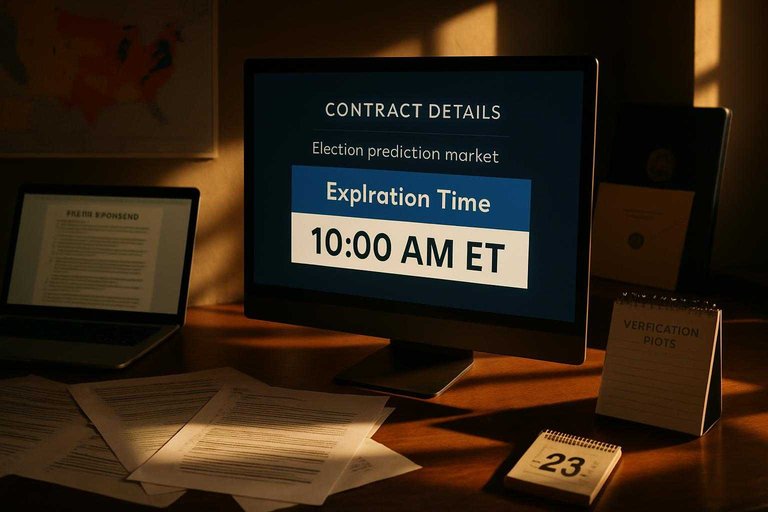
Timing and edge cases (why it may not settle on election night). The Associated Press says it “does not make projections” and only calls races when it’s fully confident there’s no path to victory for the trailer—useful journalism, but not a settlement rule. In Kalshi’s party-in-state filing, if no official certificate of ascertainment exists by the contract’s Expiration Date, the market resolves to NO (and that filing specifies a 10:00 AM ET expiration time).
Regulated vs offshore
A big beginner split in a “president market” is whether you’re looking at a CFTC-regulated venue or an offshore/crypto-native one. On the regulated side, a Designated Contract Market (DCM) is a CFTC-regulated exchange category under the Commodity Exchange Act with a rulebook and market-surveillance obligations; event contracts are typically structured as swaps (a type of derivatives contract). You’ll also see Eligible Contract Participant (ECP)—a U.S. legal category for sophisticated participants—because some position limits differ.
In its consumer fact sheet on prediction markets, the CFTC says CFTC-regulated exchanges and intermediaries providing access to prediction markets do not take a side of the trade (they provide a platform for trading), and that order books often show real-time customer bid and ask prices.
| What changes | CFTC-regulated event-contract venue | Offshore / crypto-native venue |
|---|---|---|
| Registration / oversight | Registered (DCM/SEF), CFTC oversight | Not registered as DCM/SEF |
| Who’s your counterparty | Platform doesn’t “take a side” | Often off-exchange offering |
| Market plumbing | Order book; live bids/asks | Venue rules vary by operator |
| Contract permissioning | CFTC can review/prohibit contracts | Not pre-cleared under CFTC |
| Trading restrictions | Explicit prohibited-participant lists | Restrictions may be lighter |
| Example stake cap (IEM) | Iowa Electronic Markets (IEM): $500 maximum investment by any single participant in any one submarket (per CFTC Staff Letter 93-66) | No comparable CFTC staff-letter cap |
| Example participant cap (IEM) | IEM Political Markets: maximum 2000 traders for any particular election (per CFTC Staff Letter 93-66) | No comparable CFTC staff-letter cap |
| Failure mode to know | Rules enforced; filings visible | U.S. enforcement risk exists |
If two “odds” disagree, first ask: are you comparing a CFTC rulebook product to an off-exchange one?
Why it’s disputed
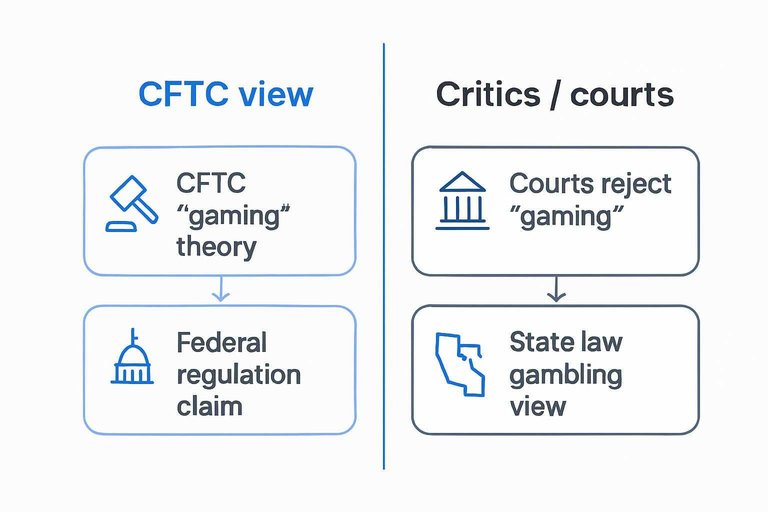
The real fight is over whether U.S. election event contracts are “gaming” products the Commodity Futures Trading Commission (CFTC) can prohibit under the Commodity Exchange Act (CEA) (specifically CEA 5c©(5)© and CFTC Rule 40.11). The CFTC has taken the view that certain election-related contracts fall into that category—for example, its September 22, 2023 order against KalshiEX’s “Congressional Control Contracts”.
The counterargument is that not every election contract fits the CFTC’s “gaming” theory. Courts have rejected the CFTC’s application of “gaming” to at least some election contracts (including in KalshiEX v. CFTC, as summarized by Cornell’s Legal Information Institute), which is part of why political prediction markets keep resurfacing.
There’s also a jurisdictional dispute: CFTC materials frame CFTC-regulated prediction markets as federally regulated products that can operate in all 50 states, while critics (including some state officials) argue many sports- and politics-style contracts function like gambling and should be governed by state law; the Associated Press has reported that this disagreement has produced litigation and enforcement actions in multiple states.
That’s why “president market” odds can be both real prices and a legal flashpoint—depending on the venue’s rulebook and oversight.
Pre-trade safety checks
Before you trust (or repost) “president market” odds, click into the actual contract. MarketsPrediction can help you compare where the same headline event is trading across venues, but you still need to read the underlying rules before treating any price as meaningful.
-
Resolution criteria: Find the exact condition that makes the contract settle YES vs NO (party vs candidate, state vs national, electors vs popular vote).
-
Settlement source: Identify what evidence will be used to resolve it (a specific official record or named decision/verification source), not election-night commentary.
-
Cutoff + settlement timing: Check the expiration/cutoff timestamp and whether the rules allow a later resolution event; “wins” can be defined in a way that settles after the news cycle.
-
Contract type + price mechanics: Confirm what the contract pays at settlement and how the price is formed; on CFTC-regulated venues, the CFTC notes the exchange provides a platform (not a house side) and you’ll often see an order book (live customer bids/asks).
-
Can you exit, and are you allowed to trade?: Verify you can sell before settlement—and scan trading prohibitions (for example, Kalshi’s PRESPARTYSTATE rules bar categories like vote-tallying personnel, campaign contractors, decision-desk employees at major media organizations, presidential electors, and foreign nationals).
Treat the “odds” as a contract
Those presidential “odds” aren’t a poll and they aren’t magic foresight—they’re a price for an event contract that only pays out under its written resolution rule. Before you repeat a screenshot or place a trade, open the contract and confirm what “wins” actually means, what source triggers settlement, and when the cutoff and resolution happen (which may be well after election night). If you skip that step, you’re not interpreting the market—you’re guessing what the contract says.
Frequently Asked Questions
- Is a president market the same thing as online political betting?
- Not quite—many “president market” contracts are structured as event contracts on regulated exchanges with specific rulebooks and limits (for example, the Iowa Electronic Markets caps any single participant’s investment at five hundred dollars in any one submarket). If you treat every venue as generic betting, you’ll miss the contract rules that control what “wins” means and how it settles.
- Why do president market odds sometimes change even after the news “calls” a race?
- Because a media call isn’t a settlement trigger for an event contract; markets move until the contract’s written verification rule is satisfied. The Associated Press says it only calls races when it’s fully confident the trailing candidates have no path to victory, but that’s still separate from how a contract resolves.
- How can I compare president market odds across Kalshi, Polymarket, and Nadex without mixing up different contract rules?
- Start by matching contracts that resolve on the same outcome (same jurisdiction, same “winner” definition, same verification source) before comparing prices across KalshiEX, Polymarket, or Nadex. MarketsPrediction helps by putting cross-platform odds, volume, and liquidity side-by-side so you can spot where the same headline event is trading differently.
- What does “SEF” mean when people talk about a regulated president market?
- SEF stands for Swap Execution Facility, a regulated trading venue category created under the Dodd-Frank Act for certain swaps. If your “president market” is offered through a SEF or similar regulated venue, the contract format and market access rules are tied to that regulatory framework.
- How do I find the most liquid president market for a specific election question?
- Use a cross-platform view that shows both volume and available liquidity for the same event, then pick the venue where the market is actively trading and the order book depth supports your intended position size. MarketsPrediction surfaces top markets by volume and per-platform liquidity so you can identify the most active listing faster.