
 Best Platforms
 Live Odds







What Are Crypto Prediction Market Odds and How Do They Work?
A pillar guide to crypto prediction market odds and how they work—odds-as-prices, order books vs AMMs, implied probability and EV, settlement/oracles, and the main forces that move markets across platforms.
Odds on crypto prediction markets look simple—until you try to answer a basic question: is “0.62” a forecast, a price, or a promise of payout?
This guide makes the odds readable in plain English. You’ll learn the mental model (shares as claims on outcomes), how odds are formed on order books and AMMs, how to convert prices to implied probabilities and expected value, and what can go wrong at settlement when oracles, ambiguity, and timing risk enter the picture.
Odds in Plain English
Crypto prediction market odds are the market’s best current guess, expressed as a price. You’re not reading a pundit’s confidence level. You’re reading what traders will pay right now for a specific outcome to happen.
Odds matter because they compress messy information into one number you can compare, trade, and track. Traders use them to take risk. Forecasters use them to test beliefs. Observers use them as a live, updateable signal.
Odds as prices
In crypto prediction markets, “odds” usually equal the price of a share that pays out if an outcome happens. If a YES share trades at $0.62, the market is implying about a 62% chance of YES, before fees and frictions.
You’ll see the same idea in different formats: 0–1 (0.62), 0–100% (62%), or $0–$1 ($0.62). Different wrapper, same meaning. The number is the going rate for one unit of payoff.
Treat the odds like a price tag on uncertainty. When the tag moves, beliefs just got repriced.
What odds predict
Odds aim to predict the probability of an outcome, not your expected profit. You can buy a “70%” contract and still lose money if you overpay, misjudge fees, or can’t exit.
Profit depends on your entry price, exit price, position size, and whether the market lets you trade smoothly. Thin liquidity can make odds jumpy. Incentives can skew behavior. Uncertainty never disappears.
Read odds as a forecast first. Then do the trading math second.
Key vocabulary
Words vary by platform, but the mechanics repeat. Here are the terms you’ll see in almost every market.
- Outcome: the event result being traded
- Share: a unit paying if outcome occurs
- Contract: the full market instrument
- Strike: the threshold defining YES/NO
- Settlement: final payout after resolution
- Oracle: the resolver of truth
- Order book: bids and asks list
- AMM: automated pool-based pricing
- Spread: gap between bid and ask
- Liquidity: ease of trading size
If you can define these cleanly, you can spot where the risk hides.
Mental model
Think of it as buying a probability, not buying a story. You pay today for a claim that becomes $1 if you’re right, or $0 if you’re wrong.
Prices move because beliefs compete under constraints. New information shifts traders’ views. Capital and liquidity decide how loudly those views speak. The displayed odds become a rough consensus forecast.
When you disagree with the consensus, that’s your moment. Either trade it, or update your belief.
Market Basics
A prediction market is a marketplace where prices reflect the crowd’s best guess about an outcome. You buy and sell outcome-linked contracts, and the final payout depends on what happens.
Crypto prediction markets keep the same core idea but change the rails. Wallets replace accounts, smart contracts replace some intermediaries, and settlement can happen automatically once an outcome is verified.
Market structure
Most prediction markets boil down to contracts that pay based on an outcome. The contract price acts like a live odds signal, because traders push it up or down.
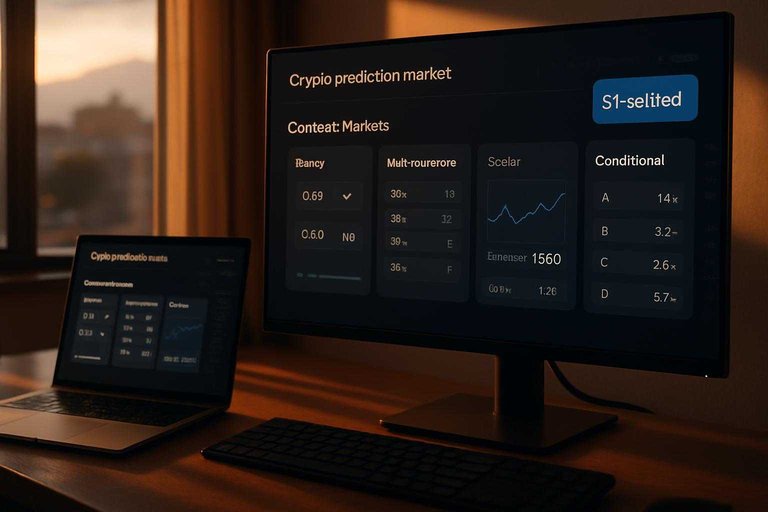
Binary markets have two outcomes, like YES or NO, and contracts settle to 0 or 1. Multi-outcome markets split possibilities into separate buckets, like “Candidate A,” “Candidate B,” or “Other,” with each outcome as its own contract. Scalar markets pay along a range, like “final value above or below a threshold,” or a payout curve tied to the measured result.
If you can describe the result precisely, you can usually turn it into a tradable contract.
Crypto-specific pieces
Crypto prediction markets add new plumbing and new trade-offs. You get more portability, but you also inherit blockchain frictions.
- Wallets hold your positions and funds
- Stablecoins often serve as the quote currency
- Gas fees add cost to each action
- On-chain custody reduces intermediary control
- DeFi composability enables looping, hedging, and collateral reuse
If it can live in a wallet, it can usually plug into something else.
Lifecycle stages
Every market has a start, a trading window, and a finish. The main differences are how resolution is proven and how disputes work.
- Create the market with a clear question and resolution rules.
- Trade contracts as beliefs and information change.
- Resolve the outcome using an oracle, admin, or community process.
- Settle positions by converting winning shares into payout.
- Distribute funds from the market’s collateral pool.
- Handle disputes through escalation or challenge windows.
The resolution rule is the product, not the UI.
Why people participate
People show up for different reasons, and that mix shapes the odds you see. Some want insurance, others want exposure, and some want the signal.
Hedgers use markets to offset real-world risk, like a business exposed to a regulatory decision. Speculators trade mispriced odds for profit, especially when they think others are overconfident. Researchers and operators watch prices to aggregate information, or to signal conviction with capital instead of words.
When serious money shows up, the market stops being a poll.
How Odds Are Formed
Odds in crypto prediction markets are prices, and prices come from trading pressure. When more people want “Yes” than “No,” the “Yes” side gets bought up, the price rises, and the implied probability increases.
Order book pricing
Order books turn opinions into odds through bids and asks. You see a best bid (buyers), a best ask (sellers), and trades happen where they meet.
The last trade is the most recent matched price. The mid price is halfway between best bid and best ask, and many UIs quote it as “the odds.” The spread is the gap between bid and ask, and depth is how many shares sit at each price level.
If the spread is wide or the depth is thin, one aggressive order can move “odds” fast.
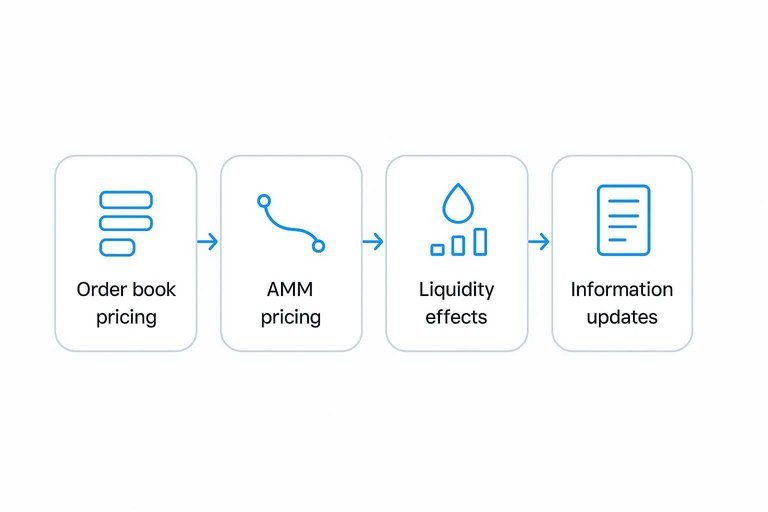
AMM pricing
AMMs replace the order book with a pool that always quotes a price. Traders push the pool balances around, and the bonding curve adjusts the next price automatically.
When you buy “Yes,” you remove “Yes” exposure from the pool and add the counter-side value, so the “Yes” price ticks up. The larger your trade relative to the pool, the more you travel along the curve.
That price movement is slippage, and it is the AMM’s built-in cost of immediacy.
Liquidity effects
Liquidity decides whether odds move smoothly or snap around. Thin markets reveal themselves quickly when you try to trade.
- Wide bid-ask spreads
- Low size at top levels
- Jumpy last-trade prices
- High slippage on market orders
- Easy-to-push prints and charts
When liquidity is thin, treat the displayed odds as a suggestion, not a guarantee.
Information updates
Odds shift when beliefs shift, and beliefs change with new information. News drops, reports update, and traders rebalance positions to reflect the new state of the world.
As expiration approaches, time decay matters because there is less time for reversal. Traders who were comfortable holding risk earlier may demand a different price when the clock is short.
If you want to understand a sudden move, look for the new information, not the new chart.
Reading Odds Correctly
Odds in crypto prediction markets usually look simple: a price and a payout. The trick is that the same quoted number can imply different probabilities once you include contract design, fees, and resolution risk.
Implied probability math
Most markets price a contract as a fraction of its maximum payout. Convert fast, then sanity-check what the quote really implies.
- Identify max payout: $1 at resolution, or 1 token.
- Read the “Yes” price: $0.62 implies about 62%.
- Convert to odds: p = price ÷ payout cap.
- Convert back: price ≈ p × payout cap.
- Example: $0.40 “Yes” on a $1 contract implies 40%.
If the conversion feels too easy, you’re probably missing fees or a different payout cap. (Here’s how prices are calculated in an order book in practice.)
Payout and EV
A prediction market bet is a payoff curve, not a vibe. Your expected value comes from your true probability, not the crowd’s.
Imagine a $1 “Yes” contract trading at $0.45. If you think the event happens 60% of the time, your EV before fees is (0.60 × $1) − $0.45.
Positive EV only exists when your probability estimate beats the market price, consistently.
Fees and frictions
The quote is the sticker price. Your break-even price is what you pay after all the sand in the gears.
- Trading fees on each fill
- Gas costs for on-chain actions
- Bid–ask spread and slippage
- Funding or borrowing for leverage
- Opportunity cost of locked collateral
If fees move your break-even by a few cents, that can erase your entire edge.
Time and resolution risk
A contract can be “right” and still be a bad trade if settlement is messy. Long resolution windows, oracle delays, and disputes can turn clean probabilities into capital traps.
Ambiguous criteria are worse. If the wording leaves room for interpretation, the market price may reflect legalistic risk, not event likelihood.
When the rules are fuzzy, you’re trading governance and process, not odds.
Settlement and Oracles
Odds only matter if everyone agrees what “won.” Settlement is the machinery that turns a headline into payouts, and it’s where trust shows up.
Resolution sources
A market needs a single, verifiable answer source, or you’re pricing vibes. Different systems pick different judges because they’re optimizing for different failures.
Centralized platforms often settle from an official source, like a government results page, or from an internal operator. That’s fast and predictable, but you’re trusting one party not to bend the call. Decentralized markets lean on crowd voting or oracle networks that report outcomes on-chain. That reduces single-party control, but can add delays, coordination risk, and edge cases when data is messy.
Pick your poison: speed and simplicity, or censorship-resistance and process overhead.
Dispute process
Disputes exist because reality is noisy, and contracts are brittle. A good process makes “wrong settlement” expensive and “right settlement” easy.
- A resolver proposes the result using the stated source.
- A challenge window opens for objections and evidence.
- Disputes escalate to a higher-stakes vote or arbitration layer.
- The outcome finalizes after rules and deadlines are met.
- Payouts execute to winning shares, and losers expire.
If the challenge window is unclear or costly, you’re not dispute-ready.
Ambiguity pitfalls
Most settlement drama comes from sloppy wording, not bad actors. You can’t oracle your way out of a vague question.
- Time zones mismatch at the cutoff
- Data source revises results later
- “Announced” versus “occurred” confusion
- Partial completion of an event
- Force majeure breaks assumptions
If you can argue both sides in one minute, traders will.
Designing clear markets
Clear markets settle cleanly because they leave less room to lawyer. Write the question like you’re trying to prevent future-you from panicking.
- Name the exact resolution source, with a fallback source.
- Specify the timestamp, time zone, and cutoff condition.
- Define key terms with concrete thresholds and units.
- List edge cases, including cancellations and partial outcomes.
- State the settlement method, including dispute and finality rules.
Do this upfront, and your “oracle problem” shrinks into paperwork.
Common Market Types
Crypto prediction markets package “odds” differently depending on the contract shape. Read the price like a probability only after you know what kind of market you’re in.
Binary markets
A binary market has two outcomes, usually YES and NO, and one of them will settle at full value. Because the payout is fixed, the traded price often maps cleanly to an implied probability.
In a $1-settled contract, YES at $0.62 implies about a 62% market-implied chance. NO at $0.40 can coexist if fees, spreads, or frictions exist. Some venues also quote prices as 0–1 instead of dollars.
Treat binary prices as probabilities only after accounting for fees and wide spreads.
Multi-outcome markets
A multi-outcome market has several mutually exclusive outcomes, each with its own contract. The “odds” live across a set of prices, not a single number.
In a clean world, the implied probabilities across all outcomes sum to 1. In practice, they can sum above or below 1 due to fees, stale quotes, or thin books. Liquidity also fragments, so one outcome can be sharp while another stays mispriced.
If the sum is far from 1, you’re reading market plumbing, not collective belief.
Scalar markets
A scalar market resolves to a number, like a value within a range, and shares often correspond to a payoff curve. Odds become “probability mass” over an interval, not a single YES/NO bet.
Many designs let you interpret prices like a CDF: a contract for “value ≤ X” implies the probability the final value is at most X. To get an interval probability, subtract two CDF points. For example, P(a < value ≤ b) ≈ price(≤ b) − price(≤ a).
Once you can take differences, scalar markets turn into flexible tools for risk ranges.
Conditional markets
Conditional markets pay out only if a condition holds, so the “odds” are probabilities with a built-in dependency. You’re pricing an outcome through the lens of another outcome.
What Moves the Odds
Odds move for two broad reasons: new information, or trading mechanics. Your job is telling a real signal from order-flow noise before you overreact.
When you watch odds, separate three layers: the headline, the tape, and the book. The headline changes beliefs, the tape shows who hit bids, and the book reveals how thin things are.
Subsections: [
{
“subheading”: “News vs flow”,
“content”: “Odds jump after news, but they also jump after someone shoves size through a thin book. The difference matters because one changes the world, and one just changes the price.\n\nA clean info shock usually leaves a trail outside the market. Think: an official announcement, a court filing, a verifiable on-chain event, or a major venue changing policy. Flow-driven moves look different: one-sided market buys, a hedge leg getting dumped, or a liquidity provider rebalancing inventory after taking too much exposure.\n\nIf the move fades when the pressure stops, you mostly saw flow, not truth.”
},
{
“subheading”: “Whales and limits”,
“content”: “Big traders can move odds, but they cannot ignore constraints. Those constraints shape how whales enter, exit, and sometimes wait.\n\n- Hit position limits and split exposure\n- Post collateral and manage liquidation risk\n- Accept partial fills in thin books\n- Time entries around liquidity windows\n\nWhen you see \u201cpatient\u201d size, you\u2019re often seeing risk management, not secrecy.”
},
{
“subheading”: “Arbitrage links”,
“content”: “Prediction markets rarely live alone. When the same event is priced in multiple places, traders connect them.\n\nArbitrage happens when one venue implies a higher probability than another, after fees and frictions. It also happens across related contracts, like \u201cCandidate A wins\u201d versus \u201cParty wins,\u201d or a \u201cYes\u201d contract versus a synthetic built from complements. If trading is feasible, the mispricing becomes someone\u2019s free lunch, so it gets eaten.\n\nConvergence is the default when capital can move and settlement terms match. See research on arbitrage in prediction markets for examples of mispricings and why related prices can deviate.”
},
{
“subheading”: “Manipulation realities”,
“content”: “Manipulation is expensive when other traders can lean against you. It\u2019s cheaper when the book is thin, participation is low, or the contract is hard to hedge.\n\nA manipulator must keep paying to hold a distorted price, because anyone with conviction sells into it. They also risk getting trapped if they need to exit fast, since they become their own liquidity. In healthier markets, distortions tend to snap back once the buying pressure ends.\n\nFor a sports-focused look at how thin volume, lagging news, and correlation can create misleading odds, see <a href="https://marketsprediction.com/blog/11-sports-prediction-market-odds-limitations-worth-knowing-in-2026">sports prediction market odds limitations.\n\nWatch <a href="https://marketsprediction.com/glossary/liquidity">liquidity first; it tells you whether a \u201cweird\u201d print can survive.”
}
]
Odds Across Platforms
Different prediction platforms produce different odds because their plumbing differs. If you trade across venues, you need to know what changes the price and what just changes the UX.
Here’s a quick map of core mechanisms and how they shape odds and trading.
| Platform mechanism | How odds are set | Odds quality driver | Trader experience impact |
|---|---|---|---|
| AMM pool | Formula vs liquidity | Depth of liquidity | Higher slippage risk |
| Order book | Bids and asks | Market participation | Better price control |
| Market maker | Quotes from agent | Inventory management | Tighter quotes sometimes |
| Oracle settlement | External resolution | Clarity of rules | Less settlement confusion |
| Fee design | Static or variable | Cost to trade | Changes break-even |
When odds look “off,” check the mechanism first, not the crowd.
Use Odds Like a Trader, Not a Spectator
- Treat odds as prices, not prophecy: ask what a “share” pays at resolution and what you’re paying now.
- Convert price → implied probability, then sanity-check it against your own estimate and the market’s liquidity.
- Price in frictions: fees, spreads, funding/bridge costs, and the chance you can’t exit when you want.
- Underwrite settlement: read the resolution criteria, oracle source, and dispute rules as carefully as the odds.
- Compare across platforms: if the same outcome trades at meaningfully different implied probabilities, investigate why before assuming an easy arbitrage.
Frequently Asked Questions
- Are crypto prediction market odds the same as sportsbook odds?
- No. Crypto prediction market odds usually come from a tradable contract price (implied probability), while sportsbook odds are set by a bookmaker and include built-in margin and risk management rules.
- Do crypto prediction market odds include fees and slippage, or is that separate?
- Fees and slippage are usually separate from the quoted odds, but they affect your real break-even point. Check the platform’s trading fees, spread, and expected price impact before sizing a trade.
- How do I calculate expected value (EV) using crypto prediction market odds?
- Convert the current contract price into an implied probability, then compare it to your own probability estimate and incorporate fees. If your estimated probability is meaningfully higher than the market’s after costs, the trade has positive EV.
- Can crypto prediction market odds be manipulated, and how can I spot it?
- Yes—thin liquidity makes odds easier to push around temporarily. Look for low volume, wide spreads, abrupt moves without new information, and whether the price quickly reverts once liquidity returns.
- How are crypto prediction market odds treated for taxes and accounting?
- Often as trading gains/losses on a derivative-like position, but the exact treatment depends on your country, platform structure, and whether settlement pays in crypto or stablecoins. Export your trade history and consult a tax professional familiar with crypto and derivatives in your jurisdiction.