
 Best Platforms
 Live Odds








How to Find the Best Prediction Markets: 8 Steps
A step-by-step guide to finding the best prediction markets for your needs—define success criteria, shortlist platforms, verify legality, evaluate market quality, measure liquidity, and compare fees and trading friction before you commit real capital.
“Best” prediction market depends on what you’re trying to achieve—hedging risk, expressing a view, or learning from crowd probabilities. If you skip that step, you’ll end up on a platform that’s illiquid, hard to access, or full of poorly written markets that resolve badly.
This guide walks you through a practical, repeatable process: set your criteria and red flags, narrow the field, confirm legal fit, test market quality and liquidity, and then compare fees and friction so you can trade with fewer surprises.
Define “Best” Criteria
“Best” depends on what you’re trying to do and what you refuse to tolerate. You need decision criteria before you compare platforms, not after. Otherwise, you’ll optimize for vibes and regret.
Pick your goals
Different goals want different markets, rules, and tools. Write yours down so you stop switching standards mid-search.
- Choose one primary objective: hedging, discovery, profits, or fun.
- Add one secondary objective you’ll accept as “good enough.”
- Write a time horizon: short, medium, or long.
- Define your edge: research, speed, or patience.
- Note your constraints: geography, KYC, or payment methods.
Your goals become your filter, not your post-hoc justification.
Set risk limits
Prediction markets feel small until they’re not. Set limits now so one bad week can’t rewrite your plan.
- Set a max stake per market you won’t exceed.
- Set a total budget for all open positions.
- Define a drawdown limit that triggers a pause.
- Decide on leverage or margin: yes or no.
- Write one rule for adding to losers, or forbid it.
If you can’t state your limits in one breath, you don’t have limits.
Scorecard fields
You need a repeatable rubric that fits on one page. A simple scorecard keeps you honest when a flashy market distracts you.
Include fields like regulation, liquidity, fees, market clarity, resolution rules, withdrawals, data access, and trust signals. For each field, use a consistent scale, like 1–5, plus a one-line note. Add an overall “Would I trade this again?” checkbox.
Treat the scorecard as your memory, not your mood.
Red-flag list
Some issues aren’t “trade-offs.” They’re dealbreakers that turn a good idea into a bad habit.
- Unclear resolution source or timing
- Withdrawal friction or surprise holds
- Hidden fees or confusing spreads
- Low transparency on order books
- Signs of manipulation or wash trading
One red flag is enough to walk away and keep shopping.
Shortlist Platforms
Start by filtering platforms to the ones you can legally access and actually want to trade. Then turn that filter into a 5–10 name shortlist you can compare later.
- Confirm your jurisdiction and access limits before you browse.
- Choose your asset preference: fiat, crypto, or both.
- Pick your topic lanes: politics, sports, macro, tech, or niche.
- List candidates that match all three filters, aiming for 5–10 platforms.
- Add one note per platform on “why it fits” in plain language. If event discovery is your main goal, see CoinRithm vs MarketsPrediction for event discovery to sanity-check two common options.
A tight shortlist prevents you from optimizing the wrong platform with perfect diligence.
Verify Legality Fit
You can’t judge a prediction market until you know you’re allowed to use it. Your goal is simple: produce a per-platform legality checklist you can reuse before depositing.
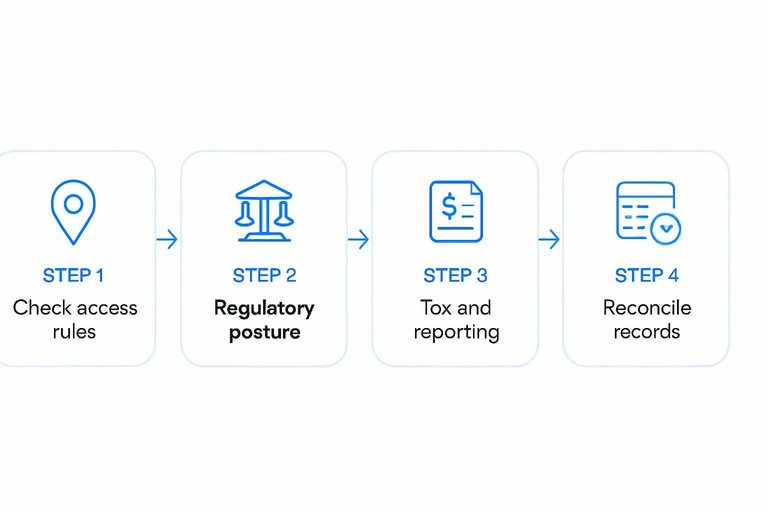
Check access rules
Start with access, because the cleanest platform is useless if you’re blocked. Capture the rules in writing, and avoid anything that requires ToS gymnastics.
- Check your country and state in the platform’s restricted-jurisdictions list.
- Confirm minimum age and whether it varies by location.
- Record KYC steps: ID type, address proof, and source-of-funds prompts.
- Verify deposit and withdrawal availability for your region and payment rails.
- Flag any VPN, proxy, or travel edge cases against the ToS.
If you need a workaround to log in, you’re already in the danger zone. (See Polymarket’s geographic restrictions for an example of how platforms spell out blocked jurisdictions and VPN rules.)
Regulatory posture
Regulation isn’t binary; it’s posture plus proof. Write down what the platform claims, then separate it from what you can independently verify.
Look for explicit statements about licensing, registration, or oversight on the platform’s legal pages. Cross-check those claims against the relevant regulator’s public registers when possible, and keep screenshots or links for your records.
Treat vague language as risk, not reassurance.
Tax and reporting
Taxes are where “I didn’t know” becomes expensive. Decide upfront what you’ll record, even if the platform issues no tax forms.
- Classify gains using your local tax rules.
- Export trade history on a schedule.
- Save deposit and withdrawal confirmations.
- Track fees, spreads, and incentives.
- Keep a simple reconciliation spreadsheet.
If you can’t reconstruct your positions later, you don’t control your risk today.
Inspect Market Quality
Good prediction markets start with good market design. You’re checking for clarity, scope, and cheap ways to break the incentive model.
Your output is simple: pass or fail. Then write one line saying why.
Market wording test
Bad wording creates free money for lawyers and chaos for traders. Good wording makes the contract tradeable, resolvable, and boring.
- Confirm outcomes are binary or bounded ranges.
- Check the end date is explicit and timezone-aware.
- Verify all key terms are defined or link-defined.
- Ensure the resolution condition is observable.
- Flag any “best efforts” or subjective phrasing.
If you can’t resolve it in one sentence, fail it.
Resolution source check
Resolution is where markets go to die. You want a source anyone can verify, without private access.
- Identify the primary resolution source and confirm it’s public.
- Check the source is stable and likely to persist.
- Read the resolver role and confirm it’s specified.
- Verify the dispute process exists and is time-bounded.
- Find the tie-break rule when sources conflict.
If resolution depends on one person’s judgment, price it like a rumor.
Manipulation resistance
Some markets are easy to bully. Thin order books, vague criteria, and circular sources invite low-cost attacks.
Look for thin liquidity near key prices, where small orders swing probabilities. Check for self-referential resolution like “according to this market” or “per our announcement.” Watch for criteria that can be gamed by the very traders betting on them.
When you spot an attack surface, treat the price as a strategy game, not a forecast.
Topic coverage fit
A high-quality platform can still be wrong for you. You need enough markets in your domains to diversify and learn.
- List your core topics and must-have categories.
- Scan category depth, not just top-level labels.
- Check for repeatable market templates you understand.
- Note missing areas that block your edge.
- Flag categories dominated by insider-ish information.
If your best questions don’t exist there, your “edge” becomes boredom.
Measure Liquidity
Liquidity is how easily you can enter and exit without donating edge to the spread. You can’t guess it from reputation, so you score it from what you can observe.
Volume and depth
Use a small sample of representative markets, because liquidity varies by topic and maturity.
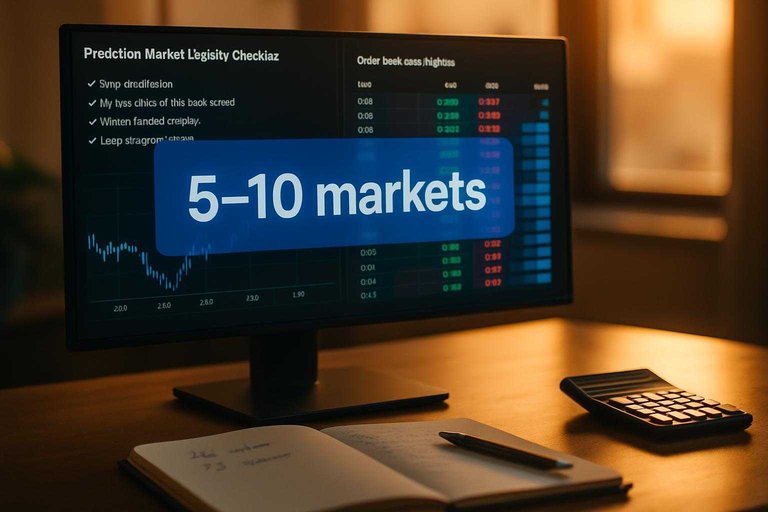
- Pick 5–10 markets across categories and maturities.
- Record 24h and 7d volume and trade count.
- Inspect order-book depth near midprice, if visible.
- Note the bid–ask spread at typical size.
- Simulate a small order and estimate slippage.
If spreads widen and depth vanishes at your size, the “platform is liquid” story is over.
Active participation
Liquidity needs people, not just past volume.
- Count distinct traders, if displayed.
- Watch how often prices update intraday.
- Check how fast prices move on news.
- Flag markets with long quiet stretches.
- Prefer markets with continuous two-sided quotes.
If price only moves when you trade, you’re the market maker now.
Position sizing
Liquidity is only useful when it becomes a rule you follow under pressure. Set a sizing cap tied to what you can exit, not what you can enter.
Imagine a market where depth is thin and spreads jump when you place orders. Your max size should be whatever you can unwind in chunks without moving the price against yourself.
Write the rule down before you’re excited, then treat it like a circuit breaker.
Compare Fees and Friction
You’re not paying “a fee.” You’re paying a bundle of tiny tolls that add up fast.
Add them up per platform so you can compare an all-in cost per trade and per withdrawal.
One table beats a vague gut-check.
| Cost component | Where it shows up | What to capture | Count it as |
|---|---|---|---|
| Trading fee | Each fill | % or flat | Per trade |
| Spread / slippage | Entry and exit | Typical fill gap | Per round trip |
| Deposit friction | Funding step | Card, bank, crypto | Per deposit |
| Withdrawal friction | Cash-out step | Fee, minimum, delay | Per withdrawal |
| Conversion cost | Fiat or token swap | FX, swap fee | Per conversion |
If you can’t estimate it in one line, you can’t control it.
Make Your Final Pick—and Start With a Small, Trackable Trial
- Choose your top 1–2 platforms using your scorecard (goals, risk limits, legality fit, market quality, liquidity, and fees).
- Paper-test 5–10 markets on each: check wording clarity, resolution sources, and whether prices move smoothly with news.
- Run a small real-money pilot within your position-sizing rules to experience deposits/withdrawals, slippage, and fee impact.
- Review after a set period (e.g., after several trades): keep what meets your criteria, and drop anything that triggers your red-flag list.
Frequently Asked Questions
- Are prediction markets the same as sports betting or online gambling?
- No. Prediction markets trade contracts tied to real-world outcomes (often on politics, economics, or tech), while betting usually uses fixed odds set by a bookmaker; the legal classification can differ by jurisdiction.
- What’s the difference between centralized prediction markets and decentralized (crypto) prediction markets?
- Centralized platforms typically control custody, KYC, and dispute resolution, while decentralized prediction markets use smart contracts and wallets with on-chain settlement; the trade-off is usually ease of use versus self-custody and on-chain risk.
- How do I verify a prediction market will resolve fairly if the outcome is disputed?
- Check the platform’s resolution policy, data sources, dispute process, and who has final authority (platform team, an oracle, or token-holder voting), then read past resolved markets to see how edge cases were handled.
- What security risks should I look for when choosing the best prediction markets?
- Look for clear custody practices, account protections (2FA, withdrawal whitelists), audited smart contracts for on-chain markets, and a track record of handling incidents transparently.
- Do I need to pay taxes on prediction market profits, and how should I track them?
- Usually yes, but the rules vary by country and by whether it’s treated as trading, gambling, or capital gains; export your trade history (fills, fees, deposits/withdrawals) and keep a dated log of positions and settlements for a tax professional.