
 Best Platforms
 Live Odds








9 FIFA World Cup Team Roster Limits Worth Knowing in 2026
World Cup 2026 roster rules for traders: provisional vs final vs matchday lists, 24h outfield cutoff, and goalkeeper replacement exceptions.
You’re trying to adjust a World Cup bet the moment an injury rumor, late call-up, or surprise omission hits your feed. The obvious move—treating any “squad list” as final—can leave you pricing players who can’t be added, or ignoring depth that changes late-game volatility.
This collection breaks down the three lists that get conflated (provisional, final tournament roster, and the per-match team sheet), then snapshots nine key limits, the trade-offs they force, what replacements are actually permitted and when, and the matchday constraints that shape rotation. It ends with a checklist to verify headlines before you move your odds.
Squad Lists, Explained
When people search “all team in fifa world cup,” they usually mean one of two things: the list of national teams in the tournament, or the list of players those teams can actually use. For 2026, the tournament is 48 teams (not 32), which FIFA framed as 1,248 players made available across the competition (48 teams × 26-player squads).
The part traders get burned by is mixing up “team news” with the three different player lists FIFA’s rules treat very differently.
Provisional list
The first layer is the provisional release list: each participating association must submit 35–55 players, and it must include at least four goalkeepers. Associations can also include up to 75 team officials (coach, doctors, managers) for processes like visa and accreditation checks.
This list is real inside the tournament machinery, but it’s not a public roster: FIFA’s regulations say it’s for internal use and won’t be published.
Final roster
Next is the final release list: the official tournament roster FIFA locks in for eligibility. It must contain 23–26 players, including at least three goalkeepers, plus up to 27 team officials.
Crucially, FIFA’s regulations say the final list must be made up of players who were on the provisional list, unless FIFA approves an exception. That’s the line between “in the wider camp pool” and “actually selectable in the tournament.”
Match start list
Finally, each match has a start list (the team sheet). It names 11 starters and allows up to 15 substitutes, and it has to be submitted at least 90 minutes before kick-off (with changes allowed up to that point).
If a headline doesn’t tell you which layer it’s about, you don’t know whether it changes who can play—only whether someone might.
“32 teams” vs 48, and why “all teams” isn’t “all players”
A lot of SERP confusion comes from mixing two different questions:
- How many teams are in the FIFA World Cup? For 2026, it’s 48 teams (not 32).
- Who can actually play for those teams? That’s not answered by a team list—it’s answered by FIFA’s player-list layers.
So if you’re searching “all team in fifa world cup” because you want the 48 qualified teams, you’re in team-qualification mode. This section is the next step: once you have the teams, FIFA’s rules determine which players are even eligible to appear (the 35–55-player provisional list vs the 23–26-player final roster vs the match-by-match start list). That’s why a headline about a “call-up” or “injury replacement” can be market-moving—or completely non-binding—depending on which list it affects.
Nine Limits Snapshot
| Roster limit traders misread | Hard rule (2026 regs) | What headlines get wrong |
|---|---|---|
| Provisional pool must include goalkeepers | Minimum 4 goalkeepers | “Only 3 in the camp list” |
| Final tournament roster must include goalkeepers | Minimum 3 goalkeepers | “They registered only 2 keepers” |
| “Three GKs” is not a maximum | A 4th GK isn’t banned | Treats it as a mistake |
| Late goalkeeper change timing | GK replaceable any time (approval) | Assumes a universal deadline |
| Where a replacement GK can come from | Must be from provisional pool | “Emergency call-up from outside” |
| Why a GK replacement is allowed | Serious injury/illness + assessment | Frames it as tactical rotation |
| Shirt numbers you can assign | Only 1–26 allocated to players | “He’ll wear #30/#99” |
| Who can wear shirt number 1 | #1 reserved for a goalkeeper | Gives #1 to an outfielder |
| Numbering a replacement goalkeeper | Next unused number (e.g., 27) | Assumes numbers must stay 1–26 |
Roster Size Trade-offs
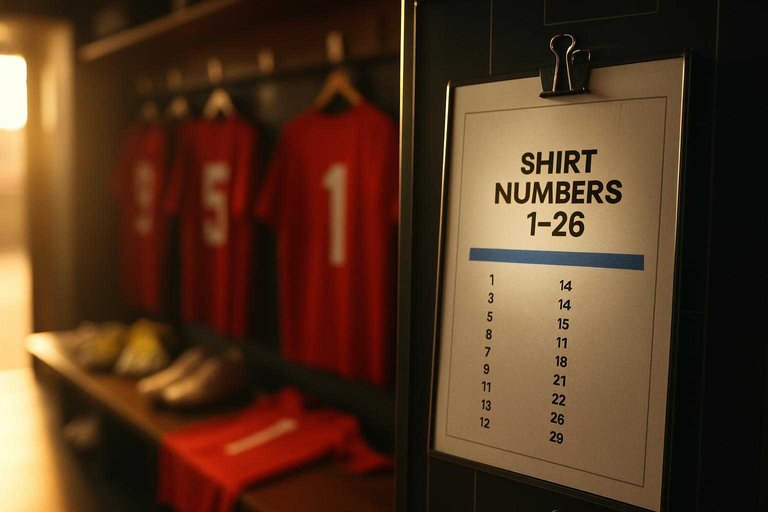
At World Cup 26, registration is finite: players are allocated only shirt numbers 1–26, and #1 is reserved exclusively for a goalkeeper. That’s why “take the maximum” is really about how you spend a fixed set of 26 usable player slots—not a philosophical stance.
The one time you’ll see a player number above 26 is a replacement goalkeeper approved during the competition: the incoming keeper is assigned the next possible unused shirt number (for example, 27).
Goalkeepers are where those trade-offs get loud. Teams talk about “three keepers” as the baseline, and that’s why a fourth goalkeeper triggers argument: one camp calls it wasting a spot and creating awkward minutes and hierarchy; the other treats it as a training-and-workload method that protects performance over a long tournament.
But eligibility insurance is weaker than it looks. The rule that breaks the usual intuition is that a goalkeeper on the final roster can be replaced by another goalkeeper from the provisional pool at any time during the competition (for serious injury/illness, with FIFA approval and medical assessment). So carrying four is less about what FIFA will allow and more about how they want to run camp and manage risk day-to-day.
Replacements: What’s Allowed
Use this quick decision-tree when a “late swap” rumor hits, so you know whether it can still change who actually plays.
- Find the timing anchor: has the team’s first match started?
- Before the 24-hour pre–first-match cutoff: outfield changes can still be made.
- After that cutoff (and even once the tournament is underway): treat outfield swap rumors as noise. From here on, the only special pathway you should keep on the table is the goalkeeper exception.
- Identify the position: outfield player or goalkeeper?
- If it’s outfield → the clock is the whole story.
- If it’s goalkeeper → timing alone doesn’t kill the rumor.
-
If it’s an outfield change (before the cutoff): check what’s being filed, not what’s being tweeted.
A real change means the association updates its submitted tournament lists—and the outgoing player is no longer part of the credentialed tournament group. -
If it’s a goalkeeper change (any time): look for the required “paper trail.”
- It has to be goalkeeper-for-goalkeeper.
- It requires FIFA approval and a medical assessment process involving tournament medical oversight (you’ll see references to bodies like the FIFA Medical Committee or the FIFA Tournament Medical Lead).
- Sanity-check the accreditation implication.
Accreditation (a FIFA-issued tournament credential tied to the submitted lists) is the tell: when an injured player/goalkeeper is replaced, they must return their accreditation. If reporting suggests both players remain “with full credentials,” you’re not looking at a completed replacement.
If you’re pricing Matchday 1: after the outfield cutoff, lineup risk is mostly “who starts,” not “who’s eligible”—except at goalkeeper, where a late injury can still flip the depth chart.
Matchday Depth Constraints
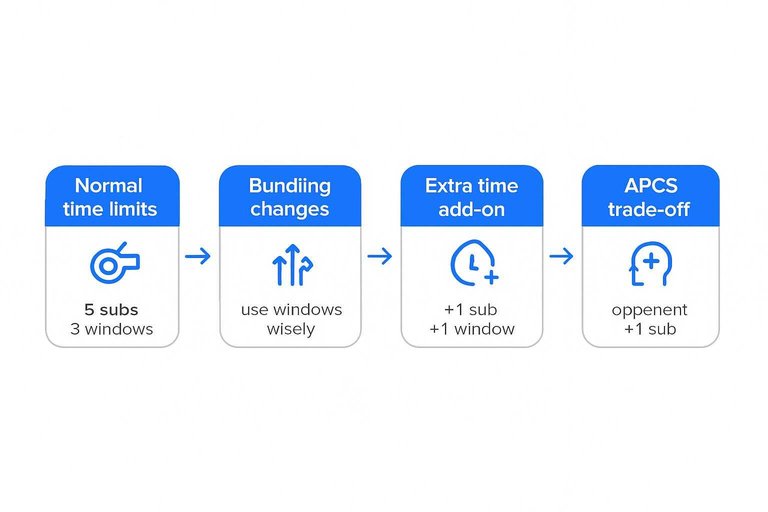
Matchday edge isn’t just “who’s on the roster.” Even with a deep squad, World Cup 26 constrains what a coach can do once the match starts: five substitutes maximum in normal time, and only three substitution opportunities (windows) to use them.
In normal time, teams are capped at five substitutes, but those changes have to fit into three substitution opportunities—a substitution opportunity is a “window” to make subs during normal time, and FIFA caps it at three (a half-time sub doesn’t use a window). That structure pushes coaches toward bundling changes (two or three at once) instead of drip-feeding fresh legs, because you can run out of windows before you run out of subs.
Extra time adds a new layer: if a match goes beyond 90 minutes, FIFA allows one additional substitute and one additional substitution opportunity. That’s where depth stops being abstract. A team that can bring on a sixth body in extra time can change pressing intensity, protect a lead, or chase a goal without cannibalizing earlier plans.
Then there’s the Additional permanent concussion substitution (APCS)—a competition-optional rule framework used at World Cup 26 that allows one extra, permanent concussion sub that doesn’t count as a normal substitution. The catch is strategic: once APCS is used, the opponent gets an additional regular substitute option too, which can swing late-match volatility even when only one player took a head knock.
Verification Checklist
Before you trade a “squad news” headline, pin it to rule text and a verifiable filing.
- Match the claim to the right list. Confirm it’s either the officially published tournament roster or the matchday start list filed via FIFA’s electronic start list system—anything else is commentary.
- Label “provisional pool” stories as unknowable. If the whole thesis is “he wasn’t on the provisional list,” you can’t verify it publicly; wait for the final roster publication.
- Kill kit/number panic trades. If the narrative is “illegal shirt/number forces a roster swap,” check the World Cup 26 shirt-number constraints: only #1–26 may be allocated to players, and #1 is reserved for a goalkeeper. The edge-case that’s actually allowed is a replacement goalkeeper during the competition, who takes the next unused number (for example, 27).
- Treat “quiet suspension → replacement” as noise. Eligibility discipline should track to FIFA Disciplinary Committee communications, not whispers.
- Don’t model a ‘planned concussion sub.’ For any “extra sub” angle, go to the IFAB Laws of the Game (Law 3) and the additional permanent concussion substitutions protocol; the medical trigger isn’t knowable in advance.
Trade squad news like rules
When squad chatter hits, don’t price it until you’ve pinned it to the right layer: the published final tournament roster or the match start list filed 90 minutes before kick-off—everything else is just camp noise. After the 24-hour pre–first-match cutoff, outfield “replacements” shouldn’t move your numbers; the only late-change pathway worth reacting to is a goalkeeper-for-goalkeeper swap from the provisional pool, with the medical/approval trail and the replaced player’s accreditation returned. If a story can’t clear those filters, treat it as volatility bait and keep your probability where the rules say eligibility actually is.
Frequently Asked Questions
- When people search “all team in fifa world cup,” are they asking for the list of 48 national teams or the players each team can use?
- They’re often mixing two different things: the tournament’s qualified national teams and each team’s eligible player roster. For trading, the roster is what matters, because it controls who can actually appear in a match.
- Why can’t I verify a rumored call-up just by checking a published “all team in fifa world cup” player list?
- Because not every roster layer is public: the provisional pool used for approvals and accreditation is not published, while the final tournament roster and match start list are the only lists you can reliably validate. If a report doesn’t say which list changed, you can’t treat it as eligibility news.
- How many substitutes can a team actually use in a World Cup 2026 match, and why does that matter for player-prop markets?
- A team can use 5 substitutes, but only across 3 substitution opportunities (windows) during the match. That constraint changes how often bench players get minutes, because coaches can run out of windows even if they still have unused subs.
- If a team names a huge bench on social media, does that mean those players are eligible to play at World Cup 2026?
- No—eligibility is determined by the official tournament roster and then the match start list filed before each game. Social posts and “training squad” graphics don’t tell you who is actually registered to enter the match.
- Can a team replace an outfield player after the tournament starts the way it can replace a goalkeeper?
- Not under the same mechanism: once the first-match timing cutoff passes, outfield “swap” rumors stop being actionable eligibility changes, while goalkeeper replacement remains the special case that can still alter who’s selectable. Treat late outfield replacement chatter as lineup noise, not roster reality.