
 Best Platforms
 Live Odds







9 “Marco Rubio for President” Market Mistakes That Mislead Traders
A troubleshooter for traders evaluating “Marco Rubio for President” prediction markets—clarify contract meaning, catch mispricing signals, diagnose settlement and liquidity errors, and replace headline-chasing with base-rate priors and rule-based decision gates.
If you’ve ever watched a “Rubio for President” price jump on a headline and wondered, “Am I early—or just wrong?”, you’re not alone. These markets feel intuitive, but small misunderstandings about the contract, settlement rules, and liquidity can turn a seemingly smart trade into an expensive lesson.
This troubleshooter helps you audit your assumptions before you click buy or sell. You’ll learn how to spot mispricing versus noise, identify the most common market-selection and settlement mistakes, and use evidence tiers and base-rate priors to keep your decisions consistent.
Spot the Mispricing
Political contracts often drift because traders price vibes, not terms. Your job is to spot when the contract’s wording, venue, or microstructure is doing the misleading—not the underlying politics.
What the contract means
A “Rubio for President” contract usually pays $1 if a specific condition becomes true, and $0 otherwise. The condition depends on the venue’s exact market title, resolution source, and settlement rule.
Common variants include “wins the 2028 Republican nomination,” “wins the 2028 election,” or “is inaugurated as President.” Those are different events, with different paths, dates, and failure modes.
The trade changes when the words change, because you’re not buying “Rubio sentiment.” You’re buying a settlement clause.
Symptom checklist
If your thesis leans on any of these, pause and re-price.
- You can’t restate the settlement rule in one sentence
- You’re in the wrong market variant
- The resolution date doesn’t match your catalyst
- Liquidity is thin and spreads feel jumpy
- You’re trading headlines, not an event path
If you see three or more, you’re likely trading noise and terms, not probability.
Decision gate
Use a go/no-go gate before you place or exit. If you can’t verify settlement language, confirm real liquidity, and map a believable catalyst path, you’re guessing.
Write down three lines: what resolves it, when it resolves, and what would force repricing. If any line is fuzzy, you don’t have an edge.
Boring is good. Boring ships. Boring trades.
Mistake 1: Wrong Market
Markets that look identical can settle on different events, and that difference is where traders get burned. With politics, one word like “nominee” versus “wins” changes the entire contract.
- Read the settlement clause before the headline.
- Identify the exact event: nominee, elected, VP pick, or primary win.
- Check the jurisdiction and method: party convention, ballot count, or certification.
- Confirm the time boundary: which cycle, date, or convention year.
- Open the market’s “rules” link and screenshot the key line.
Mistake 2: Bad Settlement Read
You can be right about the headline and still lose on settlement. Misreading who decides, when they decide, and how disputes work creates phantom arbitrage that vanishes at resolution.
Root cause patterns
Most bad reads come from assuming politics settles like sports. It doesn’t.
- “Official results” means a specific issuer
- Court challenges extend real uncertainty
- Party rules can override media narratives
- Withdrawal clauses can flip outcomes
- Venue definitions vary by market
If you can’t point to the exact resolver, you’re trading vibes.
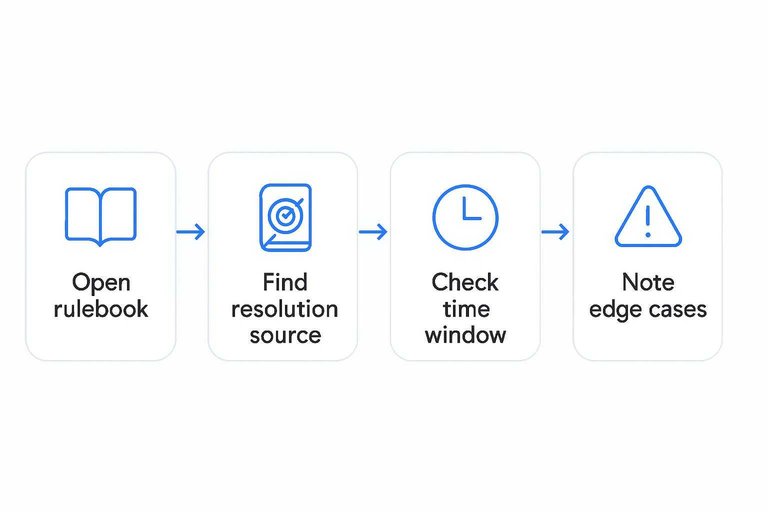
Diagnosis steps
You’re not verifying “the story.” You’re verifying the contract.
- Open the market rulebook and linked clarifications.
- Find the exact resolution source and its wording.
- Check the time window, including contest and appeal periods.
- Note edge cases: withdrawal, replacement nominees, death, disqualification.
- Screenshot key clauses and save the links.
Do this once per market, or you’ll relearn it with losses.
Fix: rule-based trading
Build a checklist that blocks trades until settlement is legible. If the resolution source, deadline, and dispute path aren’t clear, you treat the price as noise.
Use a post-news protocol too. When breaking news hits, you first re-check the rule text, then map which future documents can still change settlement.
Speed comes from rules you already wrote, not from clicking faster.
Mistake 3: Liquidity Mirage
Low-liquidity political markets can look decisive when they are just empty. Wide spreads, thin order books, and stale last-trade prints can trick you into reading “conviction” that isn’t there.
A quick way to spot the mirage is to compare the trade you see with the liquidity that could actually absorb you.
| Signal you notice | What it often is | Why it misleads | What to check |
|---|---|---|---|
| Wide bid-ask spread | Few real quotes | Price isn’t agreed | Spread % of price |
| Thin order book | Tiny displayed size | Breaks on entry | Depth at 3 levels |
| Stale last trade | Old small print | Anchors your brain | Time since trade |
| Single big jump | One aggressive order | Looks like news | Follow-on volume |
Treat the “price” as a range until the book proves it can hold size.
Mistake 4: Headlines as Catalysts
Headlines feel like catalysts because they move attention fast. Traders get trapped when they trade the clip, not the probability shift.
A viral moment, an endorsement, or “insider” chatter only matters if it changes selection mechanics. If you can’t map the pathway, you’re buying adrenaline.
Common symptom signals
You need quick tells for when you’re trading noise. They show up in the tape and the coverage pattern.
- Spike on one article, then flat
- No follow-through volume after the move
- Rapid mean reversion within sessions
- Reputable outlets contradict the narrative
- Chatter cites “sources,” not documents
Treat those as a siren, not a signal.
Catalyst validation
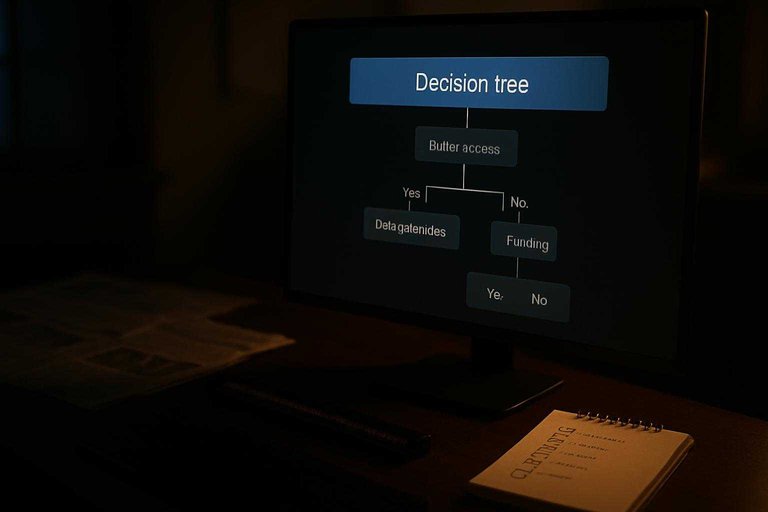
Run a simple decision tree before you size up. You’re testing whether the event touches the nomination machinery.
- Does it change ballot access or filing status?
- Does it shift delegate rules or allocation mechanics?
- Does it extend or shrink the funding runway?
- Does it alter coalition math in key contests?
- Does it affect eligibility, debates, or party processes?
If none of these move, you’re watching sentiment cosplay as probability.
Fix: evidence tiers
You need a hierarchy that stops vibes from outranking paperwork. It keeps you from overweighting the most shareable story.
Tier your inputs: rules and official filings at the top, then verifiable operational changes, then credible reporting, then punditry and social sentiment at the bottom. Reweight your position only when an item moves up the stack.
Your edge is boring: trade what can constrain outcomes, not what can trend.
Mistake 5: Base-Rate Neglect
You can trade the headlines and still lose, because the base rates do the heavy lifting. Party incentives, nomination history, and calendar math often matter more than the news cycle.
Ignore those structural hurdles and you’ll treat every bump as destiny. That’s how traders end up paying “campaign launch” prices for “long-shot” probabilities.
Build a prior
Start with a base view before you read a single breaking-news alert. A prior forces you to price structural reality, not your emotions.
- Map incumbency and mood: is the party defending, replacing, or revolting?
- Score the field: count credible rivals and their coalition overlap.
- Check party appetite: what archetype is being rewarded right now?
- Lay the calendar: debates, ballot access, filing deadlines, early states.
- Convert constraints into a starting probability range, not a point.
Once you have a prior, the news has to earn the right to move you.
Update, don’t reset
A prior isn’t a prophecy. It’s your starting price.
When new information arrives, ask one question: does it change the path, or just the vibes? A strong endorsement might widen access to donors and staff, so you nudge your probability up. A clean debate moment might lift attention, but it rarely rewires delegate math, so you move less.
Resetting to the latest headline is how you overpay for noise and underweight the grind.
Fix: pre-commit rules
Rules keep you from re-pricing your position every time your timeline panics. Tie actions to verifiable milestones you can check in public.
- Add size only after ballot access is secured in key states.
- Cut size if fundraising falls behind top-tier peers for two cycles.
- Exit if debate qualification becomes mathematically unlikely.
- Reduce exposure when delegate routes narrow after early contests.
- Re-rate only on endorsements that move infrastructure, not optics.
If you can’t write the rule down, you’re not trading a market. You’re trading a mood.
Run the 60-Second Trade Sanity Check
- Define the contract in one sentence (who/what/when counts) and confirm the exact settlement source.
- Verify you’re in the right market (nomination vs. election vs. “announces” vs. “wins”) and pass the decision gate: “What would prove me wrong?”
- Stress-test the price move: check order book depth/spread to avoid a liquidity mirage, then rank the news using evidence tiers (official filing/statement > credible reporting > chatter).
- Anchor to a base rate (your prior), update it—don’t reset it—then only trade if your rule-based plan still holds (entry, exit, invalidation).
Frequently Asked Questions
- Where can I trade “Marco Rubio for President” contracts, and how do I verify I’m looking at the right market?
- Use the platform’s market search and open the market’s rules page before trading. Confirm the exact event (e.g., nomination vs. election vs. VP) and the resolution source listed in the contract terms.
- What does the price of a “marco rubio for president” contract actually represent?
- On most prediction markets, the price usually reflects the implied probability of that specific contract resolving “Yes” under its rules. It’s not a forecast of vote share or favorability unless the market is explicitly defined that way.
- How do I track real signals for “Marco Rubio for President” without getting whipsawed by headlines?
- Follow primary-source indicators tied to the contract’s outcome—official filings, credible campaign announcements, ballot access, and delegate rules—then compare them to whether the market’s implied probability moved more than the underlying facts justify. Keeping a simple news log with timestamps helps you separate real catalysts from noise.
- Can I hedge “marco rubio for president” exposure with related markets like GOP nominee, VP pick, or “wins primary” contracts?
- Yes, you can often reduce risk by pairing positions in directly related markets, but only when the settlement conditions line up cleanly. Read both markets’ rules and resolution sources to avoid creating a hedge that breaks at settlement.
- What’s a practical way to size and manage risk when trading “Marco Rubio for President” markets?
- Use limit orders, assume you may not be able to exit quickly, and size so a total loss is acceptable if the contract resolves against you. Re-check the rules before adding to a position, especially after market renames, clarifications, or deadline updates.