
 Best Platforms
 Live Odds







7 U.S. Presidential Primary Odds Mistakes That Mislead Traders
This troubleshooter pinpoints the seven mistakes that make U.S. presidential primary/nominee “odds” look tradable when they aren’t — settlement trigger vs Expiration clock, delegates-not-linear math, party-rule cliffs, phantom displayed odds, fees/limits, resolution hygiene, and fake cross-venue arb so trades match how the contract actually settles.
You’re trying to trade the primary season like a scoreboard: a candidate wins a state, the odds move, and you size up. Then settlement day arrives and you realize you weren’t trading “who’s ahead,” you were trading a very specific condition with its own timing, sources, and edge cases.
Get this wrong and you can be politically right but contractually wrong, overpay because the shown percentage isn’t an executable price, or chase a “better” quote you can’t actually access. This troubleshooter gives you a fast audit for the seven traps that most often mislead traders in presidential primary/nominee markets.
Wrong settlement target
Name the trigger
An Event contract is a contract that pays a fixed amount (commonly $1) if a defined real‑world condition is met, otherwise $0. That condition is the Payout Criterion—the exact trigger that makes “Yes” settle.
In a united states presidential primary, headlines tempt you into trading a story (“won the primary,” “clinched delegates,” “presumptive nominee”). The contract may be paying on something narrower and later. Kalshi’s standardized presidential‑nominee terms (PRESNOM), for example, define the underlying as the identity of the person who was nominated by—and accepted the nomination of—a party for a given election year. The payout criterion is even more specific: the winner is the first person to have been nominated by the party and to have accepted the nomination.
If your “evidence” is vote share, delegate math, or cable‑news language, you may be right politically and still wrong contractually.
Check the clock
After you find the trigger, find the timestamp it’s judged at. In Kalshi PRESNOM, Expiration is 10:00 AM ET, and it’s the sooner of (a) the first 10:00 AM ET following the occurrence of an event that satisfies the payout criterion for any candidate, or (b) the day of the November popular vote.
One more line matters: revisions to the underlying made after Expiration are not accounted for in determining the Expiration Value. So a late “official” update that lands after that cutoff may not change settlement—your trade needs to be anchored to the contract’s trigger and clock, not the news cycle.
Delegates aren’t linear
In a united states presidential primary, vote share is not a smooth input into “how many delegates you got.” The rules turn it into cliffs.
Start with a delegate allocation threshold—a rule that awards zero delegates below a vote-share cutoff, creating step-changes between vote share and delegate count. The Republican National Committee’s 2024 convention call explicitly allows states to set a minimum threshold “below which a candidate may receive no delegates,” but that threshold can’t be higher than 20%. So a 19.9% headline and a 20.1% headline can describe almost the same political support while producing different delegate math.
Then there’s winner-take-all—a delegate rule where the top finisher (or someone clearing a threshold) can receive all delegates, magnifying small vote leads. Under the same RNC rules, if a state uses a threshold “above which the candidate may receive all the delegates,” that threshold can’t be lower than 50%. That creates another discontinuity: 49% and 51% are close on TV, far apart in delegates.
One more trap: don’t assume last cycle’s delegate heuristics apply. Re-check the current party rules for the specific thresholds and allocation triggers that create these step-changes before you treat vote share as delegate probability.
Missing party-rule cliffs
“Presumptive nominee” is a newsroom label for “this is basically over,” not a party event.
In a united states presidential primary, the discontinuities that move real nomination probability come from rulebooks: who gets delegates, when they’re bound (required to vote a certain way), and what happens if a candidate exits. Example: the Call of the 2024 Republican National Convention (Rule 16©(2)) requires any delegate-selection process before March 15 to allocate delegates proportionally. So an early-state “landslide” headline can be loud and still fail to create the delegate gap your chart implies, while the same margin later in the calendar can matter more.
For trading, treat rulebook cliffs like that March 15 proportional-only line as the thing that changes the delegate path. “Presumptive nominee” is commentary; the party’s rules are what convert votes into delegates.

Phantom displayed odds
That “17%” on a united states presidential primary screen may be a label, not a tradable price. Before you treat it like probability, find out whether it’s an executable level or just a display convenience.
Start with the bid-ask spread—the gap between the best available buy price (bid) and sell price (ask); when that gap is wide, the displayed “odds” can be nowhere you can actually trade. Many venues show a midpoint price—halfway between bid and ask; it reads clean, but it’s not necessarily a price you can hit. And in thin markets the last traded price—the most recent fill—can be stale and hang around long after the book has moved.
Polymarket is explicit: it displays the midpoint of the bid-ask spread, but if the spread is over $0.10 it switches the display to the last traded price. That’s the classic “phantom odds” setup: a tidy percentage backed by a book you can’t execute near.
Translate the screen into your real decision: “What can I buy at the ask, what can I sell at the bid, and what do fees do to my break-even?” Kalshi’s fee schedule, for example, shows 100 contracts at $0.50 costing $50.00 plus a $1.75 fee. If your edge can’t clear spread plus fees, it isn’t an edge.
Ignoring fees and limits
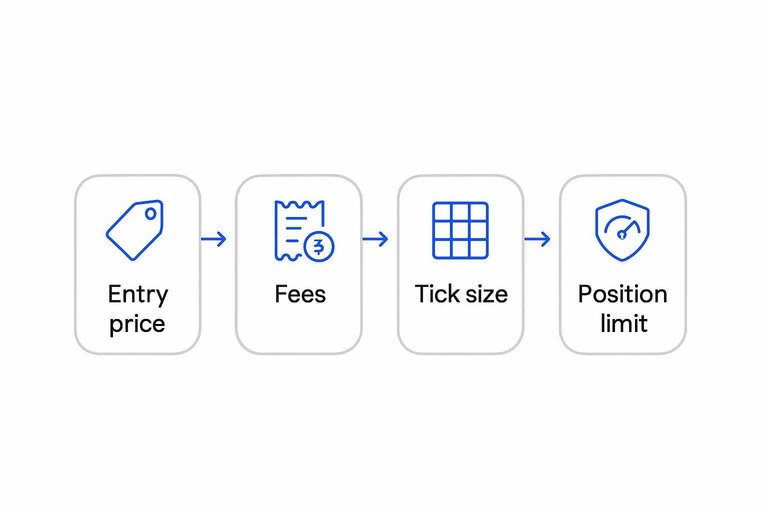
In a united states presidential primary market, “70¢” is not your payoff—it’s the price, and it may not even be the price you can hit. Your tradable number is the ask to buy (or bid to sell), then your net is: win payout ($1) − entry price − fees.
Fees are where the clean “70¢ = 70%” shortcut breaks. Kalshi’s fee schedule shows no settlement fee, but trading still costs money: the schedule’s example has 100 contracts at $0.50 costing $50.00 plus a $1.75 fee. That fee comes straight out of the “$1 minus what I paid” math, so a thin edge disappears fast.
Microstructure matters too: Kalshi’s PRESNOM terms specify a $0.001 minimum tick size (one‑tenth of a cent), so you can’t always place the exact price your model wants.
Finally, watch the position limit—the maximum exposure you’re allowed to hold in a given contract/strike—because Kalshi lists $3,000,000 per strike per Member for Individuals/Entities (and $50,000,000 for ECPs). If your strategy needs to scale or hedge past that cap, it breaks right when you need it most.
Sloppy resolution hygiene
In a united states presidential primary trade, your biggest hidden risk is settlement mechanics, not politics. Start by locating the Resolution source (or Source Agency)—the specific authority or dataset the contract treats as “official” for deciding the outcome. If you can’t point to that source, you’re trading headlines.
Next, read the revision rules like you’re reading an options expiry clause. Contracts often specify (a) what timestamp they evaluate, and (b) whether post-cutoff corrections or “updated” releases count. That’s where “the results were later corrected” turns into “the contract already locked.”
Then check dispute mechanics. Polymarket resolves markets via the UMA Optimistic Oracle and uses a challenge period—a defined window after a proposed resolution when it can be disputed. Polymarket’s help center describes a 2 hours challenge period, and a proposer risks a $750 bond if their proposal is unsuccessful. If you’re holding size, you need to know when resolution is merely “proposed” versus finalized.
Finally, scan for edge-case language around replacement/withdrawal. Don’t assume “Candidate X withdrew” maps to “No.” Map the contract to the exact entity it will recognize at resolution, or you’ll be politically right and contractually wrong.
Fake cross-venue arb
Cross-venue arbitrage is buying “Yes” on one venue and selling it elsewhere for a risk-free spread. In a united states presidential primary, most “better odds elsewhere” screenshots fail three checks.
First, verify you’re comparing identical settlement definitions: same party, same election year, and the same nomination/acceptance trigger. If the wording diverges, you’re not arbing—you’re holding two different risks.
Second, confirm you can actually trade both legs. Polymarket blocks users in the United States and explicitly prohibits using VPNs (or similar tools) to bypass geographic restrictions, so a U.S.-based trader can’t treat that price as executable hedging inventory.
Third, compare liquidity so the “better price” is usable at your size. MarketsPrediction helps by showing cross-platform odds alongside per-platform volume/liquidity and a “Last updated” freshness timestamp before you chase a gap. You can also review Polymarket’s own geographic restrictions before treating cross-venue screenshots as tradable arb.
Trade the contract, not headlines
Primary markets don’t pay out for being “ahead” on TV—they pay out for a specific payout criterion, judged on a specific clock, using a specific resolution source. If you don’t anchor your trade to those mechanics, you can be politically right but contractually wrong, or buy “odds” that are really just a midpoint/last print you can’t execute after spread and fees. Before your next entry, do one quick audit: read the trigger and expiration language, confirm what counts at resolution (including revisions and disputes), then price the trade at the bid/ask net of fees and limits. If any of those checks fail, you’re not trading an edge—you’re trading a story.
Frequently Asked Questions
- In a united states presidential primary market, is “presumptive nominee” the same thing as winning a nominee contract?
- Not necessarily—“presumptive nominee” is a media label, while many nominee contracts settle only when the party formally nominates a person and that person accepts the nomination. Always trade the contract’s payout criterion and expiration rules, not delegate chatter or TV language.
- Do united states presidential primary odds in cents equal the true probability once fees are included?
- No—once trading fees exist, “70¢ = 70%” stops being a literal mapping for decision-making because fees change your break-even and expected value. Convert the quote into net payout math (win payout minus entry price minus fees) before treating it like probability.
- When do most united states presidential primary elections happen, and why does that timing matter for trading?
- Most states hold primaries 6–9 months before a presidential election, so liquidity and headline flow can cluster in that window. For trading, that calendar matters because market activity can spike while contract settlement may still be tied to later party actions.
- How can I tell if the united states presidential primary odds I’m seeing are fresh or stale across platforms?
- Check for a visible “last updated” timestamp and avoid comparing screenshots without knowing when the quotes were pulled. MarketsPrediction shows live-data freshness with a “Last updated” time so you can sanity-check whether cross-platform odds are being compared from the same moment.
- Can I compare united states presidential primary markets across venues if the contract wording is slightly different?
- No—if the settlement definition differs (trigger, source, timestamp, or nominee/acceptance wording), you’re not comparing the same risk. Only treat it as a real comparison when the payout criterion matches line-by-line across venues.