
 Best Platforms
 Live Odds








11 Prediction Market Examples Worth Knowing in 2026
A curated collection of prediction market examples you should know in 2026 — what changed, where markets beat forecasts, where they fail, and how to choose platforms using tool comparisons and a viability checklist.
Prediction markets aren’t new—but by 2026 they’re no longer a niche curiosity reserved for elections night. You’re just as likely to see them used for macro questions, product decisions, or research timelines, often alongside traditional forecasting and expert judgment.
This collection helps you make sense of the landscape fast. You’ll see where platforms like Polymarket, Kalshi, Manifold, Metaculus, and GJ Open fit best, what each does well, and the common failure modes that make some markets more noise than signal.
Why prediction markets
In 2026, the world runs on smaller headlines, faster. Polls and pundits still exist, but they often lag the moment when decisions get made.
Prediction markets matter because they turn beliefs into prices. That gives you a live, incentive-weighted probability when timing matters—and a feedback loop that punishes confident wrongness more than loudness.
What changed by 2026
Over the past few years, the plumbing got real. Better rails, clearer rules in some jurisdictions, and fewer sharp edges made more markets feel usable outside of niche circles.
Onchain settlement became more routine for teams who can use it and can operate within their constraints. At the same time, compliance-first platforms gained share—especially in environments where regulators scrutinize retail speculation and market integrity.
UX improved enough for non-crypto users to participate without feeling like beta testers. Enterprises also moved beyond curiosity into pilots for internal forecasting, not just public betting.
The practical shift is trust: fewer people argue about whether the mechanism can work, and more argue about whether the question is well-posed.
Where they outperform
Prediction markets shine when you need fast, incentive-aligned aggregation. They do best where information is scattered, time-sensitive, and costly to communicate through normal channels.
- Aggregating dispersed, local knowledge
- Updating quickly on breaking news
- Surfacing contrarian, early signals
- Aligning incentives to be correct
- Reducing social desirability bias
Use them when “who knows” matters more than “who answers.”
Where they break down
Markets fail when the price is fragile. Thin liquidity, small crowds, and unclear settlement can make probabilities look precise while staying brittle.
Manipulation often becomes a narrative problem, not a math problem. Even when manipulation is costly or short-lived, the accusation can poison decision-making—especially for organizations that need defensible processes.
Ambiguous events are the silent killer. If traders can’t agree on what “counts,” the price becomes a fight about definitions.
The pattern of what doesn’t work is consistent: vague questions, weak settlement rules, and legal gray zones. That’s the line that gets crossed.
How to judge viability
Before you trust a probability, sanity-check the market like a product. Treat it like a system with failure modes.
- Read the question and resolve criteria like a lawyer.
- Check liquidity and spread; avoid ghost-town markets.
- Inspect the oracle and dispute process for edge cases.
- Look for participant diversity, not one dominant clique.
- Verify settlement credibility, including legal and operational risk.
If you can’t explain how it resolves, you’re not forecasting. You’re vibing.
Politics and elections
Prediction markets shine in politics because outcomes are clear, timelines are fixed, and new information lands suddenly. They also attract the most noise, because incentives and narratives get tangled fast.
Polymarket politics
Polymarket is the fast-twitch layer for political news, where prices react before pundits finish a segment. You use it to track race probabilities, coalition scenarios, and policy headlines in near real time.
Its strengths are speed and breadth: global participation, constant pricing, and lots of adjacent contracts that triangulate sentiment. The limits are real too: access depends on jurisdiction, and ambiguous wording can turn “forecasting” into “arguing about the rules.”
Treat it as an early signal, then verify the contract framing before you trust the number.
Kalshi elections
Kalshi’s election contracts sit inside a regulated U.S. framework, so the product feels closer to mainstream finance than crypto. You use it when compliance, rails, and predictable market rules matter more than maximal variety.
The typical users are U.S.-based traders, politically attentive hedgers, and teams that want a cleaner audit trail. The tradeoff versus crypto venues is straightforward: availability and legitimacy are stronger, while product scope and experimental markets can be narrower.
If you need “boring but defensible,” regulated contracts usually beat edgy breadth.
Manifold election markets
Manifold works when you want weird, specific political questions that no major venue lists. It’s also useful when you want a community to iterate on a forecast in public.
- Create niche questions in minutes
- Capture long-tail local races
- Aggregate knowledgeable hobbyists
- Iterate quickly on wording
- Surface contrarian takes early
Social dynamics can move prices as much as evidence, so sanity-check with outside sources.
GJ Open politics
GJ Open uses play-money forecasting to turn civic questions into repeatable practice. You use it for engagement, calibration training, and directional signals when real-money markets are unavailable.
It’s good for participation and learning because barriers are low and questions can cover policy, institutions, and public outcomes. It’s not good for pure price-as-truth, because incentives are softer and “winning” can drift toward performative consensus.
Use it to sharpen judgment, not to set a trading-grade probability.
Finance and macro
Rates, recessions, and crypto milestones attract traders who love both spreadsheets and stories. The edge often comes from combining scheduled data releases with narrative shifts that move faster than models.
Kalshi macro contracts
Kalshi’s macro-style contracts work best when the settlement rule is boring and mechanical. You want “what prints” to matter, not “what people meant.”
The strongest setups look like CPI, jobs, or Fed-meeting outcomes where the source and timestamp are locked. Trouble starts when headlines compress nuance, or when the market fights over which release counts.
Clear settlement is alpha, because it turns macro chaos into a clean yes-or-no trade. (See Kalshi’s Market FAQs on settlement for how official sources and timing are handled.)
Polymarket macro bets
These markets are popular because the story is simple, even when the macro isn’t. Price moves can be real information, or just crowded positioning.
- BTC price levels by date
- Spot ETF approvals and timing
- Recession odds within a window
- Fed cuts by meeting
- Inflation prints above thresholds
When liquidity clusters on one framing, the “wrong” wording can dominate the right idea. Treat the question text like contract law, not vibes.
Metaculus finance questions
Metaculus finance prompts act more like forecasting tournaments than tradable markets. The goal is calibrated probabilities, not P&L.
It often outperforms thin markets when topics are niche, long-dated, or require domain context. Incentives differ too, because reputation scoring rewards accuracy over drama.
Use it when you want signal from careful forecasters, not signal from leverage.

Manifold macro threads
Manifold macro markets can be great, but only if you treat them like a research feed. The value is in the comments and counterarguments.
- Find markets with frequent trades and active discussion.
- Read the top rationales, then the best dissent.
- Compare claims to base rates and historical analogs.
- Sanity-check key numbers against primary data.
- Re-evaluate after each major release or policy signal.
If you can’t trace a bet back to data and a timeline, you’re just buying a narrative.
Business and product
Internal prediction markets
Some companies run internal markets to forecast delivery dates and sales milestones because status reports get polished. Prices force people to put a number on what they really believe.
In a typical pilot, teams write resolvable questions like “Release v2 to 10% by Q3?” and trade with play money or small stakes. What often works is truth-telling, because the market rewards the unpopular but correct view. What often fails is HR fear, because employees worry their trades will be used against them.
Make anonymity real, or the signal turns into theater.
Manifold product bets
You can use public-style markets for product questions when you want fast aggregation and visible dissent. They work best when you treat them like a decision aid, not a vote.
- Roadmap bets on ship dates
- Feature bets on adoption
- Retention bets on churn risk
- Competitor bets on launches
- Pricing bets on conversion
Moderation and incentives are the whole game, because bad questions create confident nonsense.
Hypermind platform
Some organizations prefer structured forecasting programs with expert panels over open markets. The appeal is governance, clearer accountability, and fewer concerns about gambling optics.
A common setup uses forecasters who submit probabilities, then update them as new evidence lands. You get an audit trail, stable participation, and a cleaner path through compliance reviews. You lose some of the market’s playful energy and crowd-driven discovery.
If your risk team needs names and rationale, forecasts beat markets.
Calibration over hype
A lightweight pilot works when you optimize for resolvable questions and measurement, not excitement.
- Write questions with unambiguous resolution criteria.
- Assign an owner who publishes the resolution source.
- Set a review cadence for updates and decision check-ins.
- Track forecast error with a simple scoring rule.
If you can’t score it, you can’t improve it.
Science and health
Prediction markets get tricky in science and health because the “truth” often arrives late and messy. The best examples bake in verification, timelines, and ethics from day one.
Metaculus science tracks
Some science questions take years, and the signal arrives in fragments. Metaculus handles this by running long-horizon questions and aggregating forecasts into a single evolving estimate.
The method works best when you can anchor to base rates and comparable past outcomes, like typical approval rates or replication rates. It fails when the endpoint is fuzzy, like “a breakthrough” with no crisp resolution criteria.
If you can’t write the resolution rule in one sentence, don’t market-make it.
Manifold bio markets
Bio-flavored markets attract curiosity fast, and confusion even faster. Use them as hypothesis pressure-tests, not medical guidance.
- Clinical trial readouts and approval calls
- AI-for-biology capability milestones
- Longevity interventions and biomarkers
- Public health policy impacts
- Replication and retraction predictions
Treat price as sentiment, then go hunt for actual evidence.
Resolution and ethics
Science markets live or die on resolution sources, so you need authoritative endpoints like a registry entry, regulator decision, or journal record. Avoid questions that could incentivize harm, privacy violations, or selective disclosure.
Contested science needs guardrails: define what counts as evidence, name the adjudicator, and ban “vibes-based” resolutions. If you can’t prevent a market from laundering misinformation into a tidy number, don’t run it.
The ethical move is boring and strict: fewer markets, cleaner endpoints.
The 11 examples
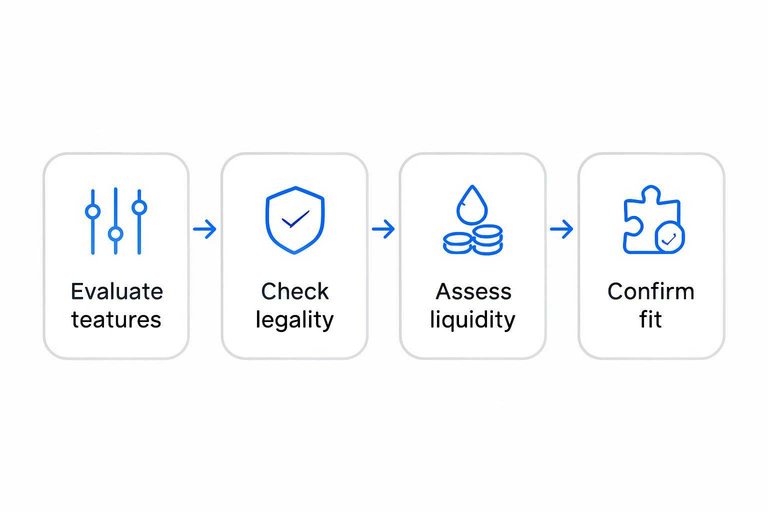
Use this as a quick scan before you evaluate features, legality, liquidity, and fit.
| Example | Best-fit use case | Key limitation (2026) | What to check first |
|---|---|---|---|
| Polymarket | Fast, public forecasting | Access varies by jurisdiction | Eligibility, market depth |
| Kalshi | Regulated event contracts | Narrower market scope | Product coverage, fees |
| Metaculus | Team + community forecasts | Not always tradable | Track record, scoring |
| Manifold Markets | Play-money experimentation | Prices aren’t capital-backed | Incentives, manipulation risk |
| PredictIt | Academic-style political markets | Tight caps and limits | Rules, liquidity |
| Smarkets | Sports and events betting | Not a pure prediction focus | Licensing, market rules |
| Betfair Exchange | High-liquidity event exchange | Betting constraints and geofencing | Availability, commission |
| Hypermind | Enterprise forecasting projects | Less open participation | Vendor fit, integrations |
| Augur (legacy) | On-chain, censorship-resistant markets | UX and oracle complexity | Resolution process, fees |
| Omen (Gnosis) | On-chain conditional markets | Thin liquidity at times | Collateral, oracle choice |
| Internal company market | Private operational forecasts | Small crowds can bias | Participation design, governance |
If one row fails your constraints, drop it early and keep scanning. For background on why Polymarket’s access can vary, see the CFTC’s Polymarket enforcement action.
Choosing the right tool
Pick the wrong market format and you get noise, not signal. Match your scenario to constraints first, then optimize for liquidity and incentives. In practice, it helps to sanity-check liquidity and price differences across venues before you commit to a format—using an aggregator like inabit (MarketsPrediction) can make that scan faster by showing live odds and activity across multiple platforms in one view.
| Your scenario | Best category | Why it fits | Watch out for |
|---|---|---|---|
| Public election forecasting | Regulated + public | Clear rules, compliance | Jurisdiction limits |
| Crypto protocol launch odds | Onchain + public | Fast settlement, composable | Oracle disputes |
| Company roadmap confidence | Internal + tournament | Low legal risk | Participation bias |
| Trading a macro view | Regulated + tradable | Depth, hedging | Access requirements |
| Community decision inputs | Onchain + tournament | Cheap, inclusive | Sybil attacks |
If your “best category” changes mid-project, your requirements were never stable. And if the “best” platform changes because liquidity migrates, it’s another reminder to keep an eye on cross-platform volume and pricing—not just the market type.
Viability checklist
Decide fast whether a market price is decision-grade for your use. When it fails, you need a clean fallback.
- Define the decision and threshold you need, not just the question wording.
- Check resolution rules for clarity, timing, and ungameable sources.
- Inspect liquidity and depth so one trade can’t move the price.
- Compare against a baseline forecast you already trust, then explain gaps.
- Pick your default alternative, then pre-commit to the switch trigger.
Treat market probabilities like sensors: calibrate them, or ignore them.
Use the examples to place smarter bets—and better decisions
Treat these 11 examples as patterns, not predictions: match the platform to your question’s incentives, liquidity (or participation), and resolution rules before you trust the price. When the market is thin, the wording is fuzzy, or the outcome can’t be cleanly resolved, use it as a discussion tool—not a forecast. Pick one tool from the comparison table, run the viability checklist on a single real question you care about, and iterate on market design until the signal is repeatable.